

It’s day four with your new puppy, and your hands look like you lost a fight with a rosebush.
Every time you reach down to pet them, play with them, or pick them up — teeth. Sharp, tiny, relentless teeth. You’ve tried saying “no.” You’ve tried pulling your hand away. You’ve tried yelping dramatically like every forum post told you to. And yet, here you are, bleeding slightly, wondering if you made a terrible mistake.
You didn’t make a mistake. Your puppy is completely normal.
But “normal” doesn’t mean you have to just endure it, and it definitely doesn’t mean it’ll fix itself without your help. Puppy biting is one of the most universal frustrations of new dog ownership — and it’s also one of the most fixable, once you understand what’s actually driving the behavior and what consistently works to change it.
This guide covers all of it: why puppies bite, what to do at each stage of development, how to use positive reinforcement the right way, and how to get everyone in your household on the same page so your puppy isn’t getting mixed signals from five different people.
Key Takeaways
- Puppy biting is completely normal developmental behavior — puppies use their mouths to explore, play, and relieve teething discomfort. It is not aggression and it is not a sign of a “bad” puppy.
- The goal of training is not to eliminate all mouth contact but to teach bite inhibition — the ability to control the force and frequency of biting — and then gradually reduce mouthing altogether.
- Positive reinforcement (rewarding the behavior you want) is significantly more effective than punishment for stopping puppy biting. Punishment increases fear and anxiety, which often makes biting worse.
- Most puppies show meaningful improvement within 2 to 4 weeks of consistent training. Full resolution typically comes between 4 and 7 months of age.
- Consistency across every person in your household is the single biggest factor in how fast your puppy learns. One person letting the biting slide undoes everyone else’s work.
Why Puppies Bite: The Actual Reasons
Before you can fix the biting, it helps to know why it’s happening. The answer is almost never “my puppy is aggressive” or “my puppy doesn’t respect me.” The real reasons are far more mundane — and far more manageable.
They’re exploring the world with their mouths
Puppies don’t have hands. Their mouths are their primary tool for investigating textures, testing objects, and interacting with their environment. When your puppy bites your hand, they’re often doing the same thing a human baby does when they put everything in their mouth — gathering information.
They’re playing
In the litter, puppies played almost entirely through mouthing and wrestling. Biting was how they interacted with their siblings, how they signaled excitement, and how they initiated play. When your puppy comes home, they try to play the same way with you — because that’s the only way they know.
They’re teething
Between roughly 12 and 20 weeks, your puppy loses their 28 baby teeth and grows 42 adult teeth. This process causes genuine discomfort — swollen, itchy gums that chewing helps relieve. A teething puppy bites more frequently and more intensely than a non-teething one, and for good reason: it hurts, and pressure helps.
They’re overtired or overstimulated
Every experienced dog owner knows the “witching hour” — usually late afternoon or early evening — when a puppy suddenly transforms from a manageable little creature into a tiny land shark. Overtired and overstimulated puppies lose impulse control rapidly. More biting during these windows is almost always a signal that your puppy needs to wind down, not ramp up.
They’ve accidentally learned it works
If biting got them attention — even negative attention like yelling — it got reinforced. If biting made playtime more exciting, it got reinforced. If biting happened and nothing consistently happened in response, the puppy learned there were no consequences. Puppies are fast learners. They notice patterns quickly.
Understanding Bite Inhibition: The Real Goal
Most guides talk about “stopping puppy biting” as if the goal is zero mouth contact by next Tuesday. That’s not realistic — and it’s not actually what you want either.
The real goal is bite inhibition: teaching your puppy to control the pressure and frequency of their biting. A dog with good bite inhibition understands that human skin is sensitive, adjusts accordingly, and eventually stops mouthing people altogether as they mature.
Why does this matter? Because a dog that has never learned bite inhibition — who has only been punished into not biting — has skipped a critical developmental step. If that dog is ever frightened, in pain, or stressed as an adult, they may bite reflexively and with full force because they never learned to moderate pressure. A dog with good bite inhibition, in the same situation, is far more likely to give a warning nip rather than a serious bite.
You’re not just stopping the immediate behavior. You’re building a lifelong skill.
The Core Method: Positive Reinforcement
Positive reinforcement training works on a simple principle: behaviors that are rewarded increase, and behaviors that receive no reward decrease. For puppy biting, this translates into two parallel tracks running simultaneously.
Track 1: Remove reward when biting happens. Every time your puppy bites you, the fun stops. Immediately and consistently. No exceptions.
Track 2: Reward the behavior you want. Every time your puppy makes a good choice — choosing a toy over your hand, mouthing gently, stopping when asked — that gets rewarded. Consistently.
The combination teaches your puppy a clear equation: biting = everything stops, good choices = good things happen.
Why punishment doesn’t work here
Physical punishment, scruff-shaking, alpha rolls, spray bottles, or any aversive correction for puppy biting tends to backfire for specific reasons.
Pain or startle responses can increase arousal in puppies, making biting more frantic rather than less. Fear-based responses suppress behavior in the moment but don’t teach the puppy what to do instead. And for some puppies — particularly those with bold temperaments — an exciting response from you (even a negative one) reads as engagement, which reinforces the biting.
The ASPCA, the American Veterinary Society of Animal Behavior, and most certified professional dog trainers consistently recommend positive reinforcement and redirection over punishment for puppy biting. This isn’t sentimentality. It’s what the evidence consistently shows works faster and more durably.
Step-by-Step: How to Stop Puppy Biting
Step 1: Have the right tools ready before you need them
Before any training session — or any interaction with your puppy — have a chew toy within arm’s reach. The redirection has to happen within one to two seconds of the bite to be meaningful. If you’re scrambling to find a toy after the fact, the moment has passed.
Rotate toys every few days so they maintain novelty. A toy that’s been sitting in the same spot for a week is less interesting than one that just appeared.
Step 2: When biting happens — stop everything
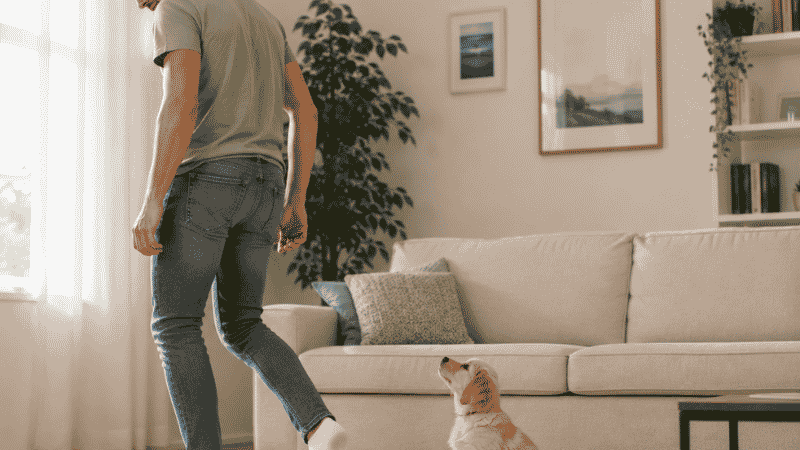
The instant your puppy’s teeth make contact with your skin, stop all movement and interaction. No eye contact. No talking. No reaction. Stand still or turn your back. If you’re sitting, stand up calmly and cross your arms.
The message is non-negotiable: biting ends the interaction. Every single time.
Wait for 3 to 5 seconds of calm — for your puppy to pause and look at you, or simply stop biting — before resuming any interaction. If they immediately bite again when you re-engage, repeat the sequence.
Step 3: Redirect to the toy
Once there’s a momentary pause in the biting, offer the chew toy calmly and directly. Not as a distraction trick — as a clear invitation: “this is what you can bite.” When they take the toy, immediately resume positive interaction. Play with them, talk to them, make it clear that choosing the toy is the version of this moment that goes well.
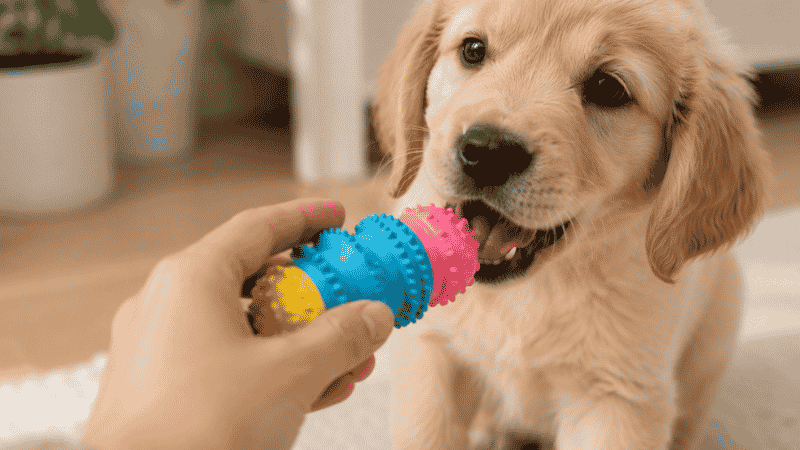
This redirection is the most important piece of the puzzle. You’re not just stopping the biting — you’re actively teaching them what to do with the urge to chew.
Step 4: Use the time-out for persistent biting
If your puppy bites, you stop the interaction, you offer the toy — and they bite again anyway, escalating rather than redirecting — that’s the signal for a brief time-out.
Calmly and without drama, put your puppy behind a gate, in their kennel, or in a puppy-safe room for 60 to 90 seconds. No scolding, no lecture, no drawn-out production. The time-out ends the moment calmly — you bring them back out, offer the toy, and start again.
The time-out communicates: this level of biting ends the whole social situation, not just the hand. Used consistently, it’s highly effective for puppies who aren’t responding to the basic stop-and-redirect alone.
Step 5: Reward the good stuff
This step gets skipped constantly — and it’s arguably the most important for long-term success.
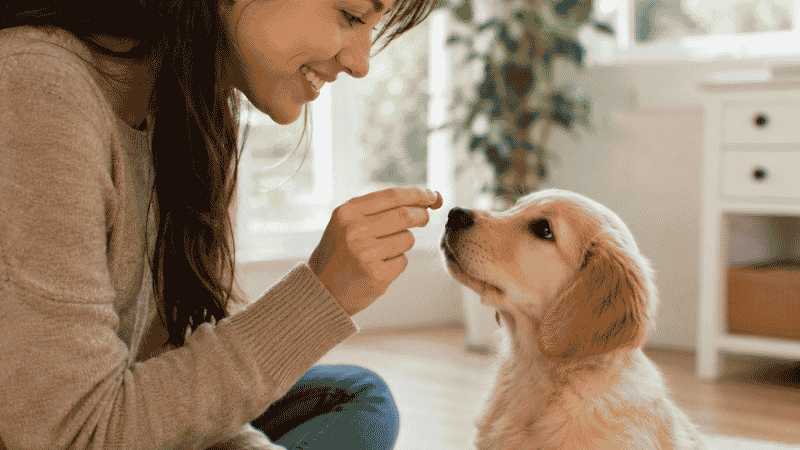
When your puppy is playing calmly without biting, tell them they’re wonderful. When they choose the toy without being redirected, give them a small, high-value treat and genuine enthusiasm. When they mouth your hand gently and then stop on their own, that moment deserves acknowledgment.
Positive reinforcement dog training works in both directions: you’re removing reward for biting, but you’re also actively building a reward history for not biting. Puppies repeat what works. Make not biting work.
By Age: What to Expect and What to Focus On
8 to 12 weeks — The new arrival phase
Biting at this age is almost entirely exploratory and play-driven. Your puppy is adjusting to a new environment, learning that you’re their primary social partner, and playing the only way they know how.
Focus: Introduction of the stop-and-redirect method. Start building the association: biting = fun stops, toy = fun continues. Keep interactions short — puppies this age tire quickly, and a tired puppy bites more. Aim for play sessions of 5 to 10 minutes with rest breaks built in.
What’s normal: Frequent mouthing, little pressure control, biting that seems constant during play. This is expected and improves with consistent response.
12 to 20 weeks — The teething phase
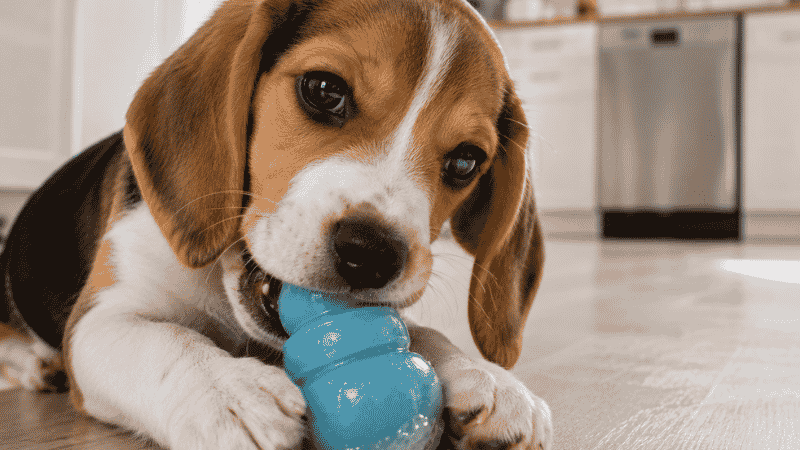
This is peak biting intensity for most puppies. The teething discomfort is real, and your puppy needs to chew. This period is often the hardest for new owners because it can feel like the training isn’t working — when in reality, the biological drive to chew is at its highest and has to be redirected rather than simply stopped.
Focus: Teething-specific toys become critical here. Frozen rubber toys, chilled wet washcloths, and puppy-appropriate frozen treats provide both the chewing outlet and relief for sore gums. Keep these stocked and accessible. Continue the stop-and-redirect consistently — consistency during this phase determines how quickly things improve after teething ends.
What’s normal: More intense biting than at 8 weeks, particularly in the evenings. More frequent redirections needed. Progress may feel slower — this is temporary.
4 to 6 months — The impulse control phase
Teething is winding down or complete. The biting that persists at this stage is habit and impulse control, not teething discomfort. Puppies who received consistent training during the earlier phases typically show significant improvement here. Those who didn’t are now working against an established pattern.
Focus: Raise your expectations gradually. Begin asking for a brief “sit” or “look at me” before resuming play after any biting incident. Introduce the concept of calm as the prerequisite for good things. The time-out method is particularly effective at this stage.
What’s normal: Meaningful reduction in biting frequency. Some puppies are essentially done at this point; others still need another month or two of consistency.
6 to 7 months — Adult teeth in, habit resolution
All adult teeth are present by around 7 months. Any biting that continues past this point is behavioral, not teething-driven. Most puppies who have received consistent training have resolved the biting issue or reduced it to occasional, gentle mouthing by now.
What’s normal: Occasional mouthing during excited play. This should be easily redirectable and should cause no pain.
The Family Consistency Plan
Here’s the uncomfortable truth about puppy biting: if one person in your household is inconsistent — allows the biting, laughs at it, or responds differently — your training timeline just doubled. Maybe tripled.
Puppies are extraordinarily good at reading situations. They will quickly learn that biting is okay with Grandma, okay when Dad is distracted, okay with the kids — and they’ll act accordingly. The training only works as a system if everyone participates.
Print this and put it on your fridge:
PUPPY BITING — HOUSE RULES (everyone, every time)

When the puppy bites:
1. Stop moving immediately. No yelling, no reaction.
2. Wait 3-5 seconds of calm.
3. Offer the chew toy.
4. If biting continues → calm time-out (60-90 seconds).

When the puppy is gentle:
→ Praise them. Always. Every time.

What NEVER to do:
✗ Rough play with hands (no wrestling, no teasing)
✗ Letting small bites slide "just this once"
✗ Yelling, hitting, scruffing, or spraying
✗ Continuing to play after biting happens
Walk every person in your household — including children — through these steps before they interact with the puppy. Children especially need coaching, because their instinct when bitten is often to squeal and run, which puppies read as exciting prey behavior and immediately escalates.
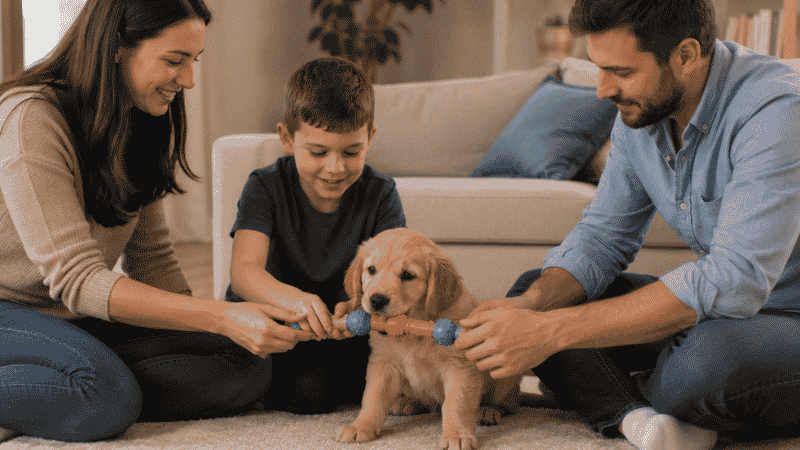
Tools That Help
The right tools make a significant difference during the training process. These are the categories worth investing in, with what to look for in each.
Chew toys for redirection: You want variety in texture — rubber, rope, and nylon options — because different puppies respond to different textures. Look for puppy-specific sizing. A toy designed for a large adult dog doesn’t give a small puppy the satisfying resistance they need.
Teething toys: Rubber toys designed to be frozen are particularly effective during the 12 to 20 week phase. The cold provides gum relief; the texture satisfies the chewing urge. Keep 2 to 3 in the freezer at all times so you always have one ready.
High-value training treats: For rewarding the good choices. Small size is essential — the treat should take less than 2 seconds to eat so it doesn’t interrupt the training rhythm. Soft texture is better than hard biscuits because it’s faster. The treat should be something your puppy finds genuinely exciting, not just adequate.
A puppy gate or exercise pen: For implementing time-outs without using the kennel (you don’t want the kennel associated with punishment). A simple gate that lets your puppy see and hear you while being briefly separated is all you need.
Common Mistakes That Make Biting Worse
Rough play with hands. Letting your puppy wrestle with your hands, chasing them with wiggling fingers, or allowing play-biting “just because they’re small” actively teaches them that hands are toys. Stop this immediately, even if it seems harmless. It won’t be harmless at 6 months.
Inconsistent responses. Sometimes stopping the play, sometimes not. Sometimes offering the toy, sometimes just pulling away. Inconsistency teaches your puppy that the outcome of biting is unpredictable — which means the behavior continues as they keep testing.
Flooding with stimulation before bed. Intense play sessions right before the time when your puppy should be winding down for the night create overtired, overstimulated puppies who bite harder and respond to redirection less reliably. Build a wind-down routine: calm chewing, quiet time, then sleep.
Expecting too much too soon. If your puppy is 9 weeks old and you’ve been training for 4 days, you have not failed. Puppy training operates on a timeline of weeks and months, not days. Consistency now pays off later.
Stopping reinforcement too early. Once biting reduces significantly, many owners stop praising the good behavior — the gentle moments, the toy choices, the calm play. This is when the good behavior becomes fragile. Keep reinforcing until it’s completely solid.
When to Get Professional Help
Most puppy biting resolves with consistent home training. Some situations, however, warrant professional support — and recognizing them early matters.
Seek professional help if you see:
- Biting that breaks skin on a regular basis in a puppy older than 4 months, despite 4 or more weeks of consistent training
- Growling, snapping, or snarling that accompanies the biting — particularly when the puppy is guarding food, toys, or resting spaces
- Biting directed at strangers, children, or visitors in a way that feels escalatory rather than playful
- Any biting accompanied by a stiff body, raised hackles, or a fixed stare — these are signals of something beyond normal play behavior
A certified professional dog trainer (CPDT-KA) or a veterinary behaviorist (DACVB) can assess whether what you’re seeing is normal developmental behavior or something that needs a tailored intervention. Getting an early professional opinion is almost always worth it — behavior issues are significantly easier to address at 4 months than at 14 months.
FAQ: What New Puppy Owners Actually Search For
Why does my puppy bite me so much? Puppies bite as a primary way of exploring, playing, and relieving teething discomfort. It’s the same way they interacted with their littermates. It isn’t aggression — it’s communication and play that hasn’t yet been redirected toward appropriate outlets.
When do puppies stop biting on their own? Most puppies naturally reduce biting between 4 and 7 months of age as teething ends and impulse control develops. However, “on their own” significantly overstates it — consistent training dramatically speeds up this timeline. Puppies who receive no guidance can continue biting well past 7 months.
Does yelping actually work to stop puppy biting? For some puppies, yes — a high-pitched yelp mimics the sound a littermate would make when bitten too hard, and can momentarily interrupt the behavior. For others, particularly excitable puppies, the yelp increases arousal and makes biting worse. Try it a few times; if it’s not producing a pause and calm response within a few repetitions, switch to the silent stop-and-redirect method instead.
Is it okay to use a spray bottle to stop puppy biting? Spray bottles are a form of aversive correction that suppresses behavior through discomfort but doesn’t teach the puppy what to do instead. Most certified trainers and veterinary behaviorists advise against them — they create negative associations with you and can increase anxiety without reliably stopping the biting. Positive redirection is more effective and doesn’t damage your relationship.
How do I stop my puppy from biting my ankles? Ankle biting typically happens when you’re moving — which triggers prey-chasing instincts in puppies. Stop moving immediately the moment biting happens (moving away encourages chasing). Keep a toy in your pocket to redirect on walks around the house. If your puppy reliably targets ankles during walks from room to room, practice with a toy held at ankle height to redirect before the biting starts.
My puppy bites harder when I try to stop them — is that normal? Yes. This is called an extinction burst — when a previously rewarded behavior stops working, many animals temporarily increase the intensity of that behavior before giving up. If your puppy bites harder when you stop the play, the correct response is to stay the course: keep stopping the interaction, keep the response calm and consistent. The intensity will decrease as the puppy learns that escalating doesn’t change the outcome.
How do I stop my kids’ puppy from biting the children? Children are high-stimulation targets for puppies — they move fast, make exciting sounds, and often react in ways that escalate biting. Supervise all interactions between young children and the puppy directly. Teach children the same response you use: stop moving, no reaction, offer the toy. Never leave young children alone with a puppy who is actively biting. Structured, calm play sessions — rather than chaotic free-for-alls — dramatically reduce biting incidents.
The Bottom Line
Your puppy isn’t trying to hurt you. They’re doing exactly what a normal puppy does — exploring with their mouth, playing the only way they know, and waiting for someone to teach them a better way.
That someone is you. And the method that works is simpler than it feels in the moment: stop the interaction when biting happens, offer the toy, reward the good choices, and do it the same way every single time — everyone in the house, no exceptions.
Two to four weeks of consistent practice. That’s genuinely what it takes for most puppies to show meaningful improvement. Not months. Not a professional trainer. Just consistency, the right redirection, and the patience to see it through the hard evenings when your puppy is overtired and your hands are sore.
It gets better. It gets better faster when you’re consistent. And on the other side of this phase is a dog who knows how to play gently — and a relationship built on trust rather than fear.

References
- American Society for the Prevention of Cruelty to Animals. (2024). Mouthing, Nipping and Biting in Puppies. aspca.org
- American Veterinary Society of Animal Behavior. (2021). AVSAB Position Statement on the Use of Dominance Theory in Behavior Modification of Animals. avsab.org
- Sung, W. (2026). How To Stop a Puppy From Biting. PetMD. petmd.com
- Overall, K.L. (2013). Manual of Clinical Behavioral Medicine for Dogs and Cats. Elsevier Mosby.
- Certification Council for Professional Dog Trainers. (2024). Standards for Professional Dog Training. ccpdt.org