
If you’ve ever watched your dog sleep, you know it’s one of the most peaceful sights on earth. From the soft “woofs” in their dreams to the way they twitch their paws while chasing imaginary squirrels, sleep is where our furry friends recover. But as a pet health advocate, I’ve realized one stark truth: Most pet parents spend more time picking out a collar than they do a Dog Bed, yet the latter defines their dog’s long-term mobility.
Dogs spend 12 to 14 hours a day sleeping. For senior pups, that number climbs to 18 hours. If that time is spent on a flat, lumpy, or unsupportive cushion, their joints pay a silent price. In this 2026 guide, we’re moving past the aesthetics. We are looking at the Dog Bed as a medical tool—exploring why an orthopedic dog bed is a must for spinal alignment and when an elevated dog bed becomes a life-saver for temperature regulation.
The Science of Support: Why Your Dog’s Spine Can’t Wait
In the veterinary world, aging happens rapidly. For a 10-year-old Golden Retriever, getting up from a flat floor is equivalent to an 80-year-old human getting out of a low beanbag chair. This is where the orthopedic dog bed transitions from a luxury to a necessity.
Not All Foam is Created Equal
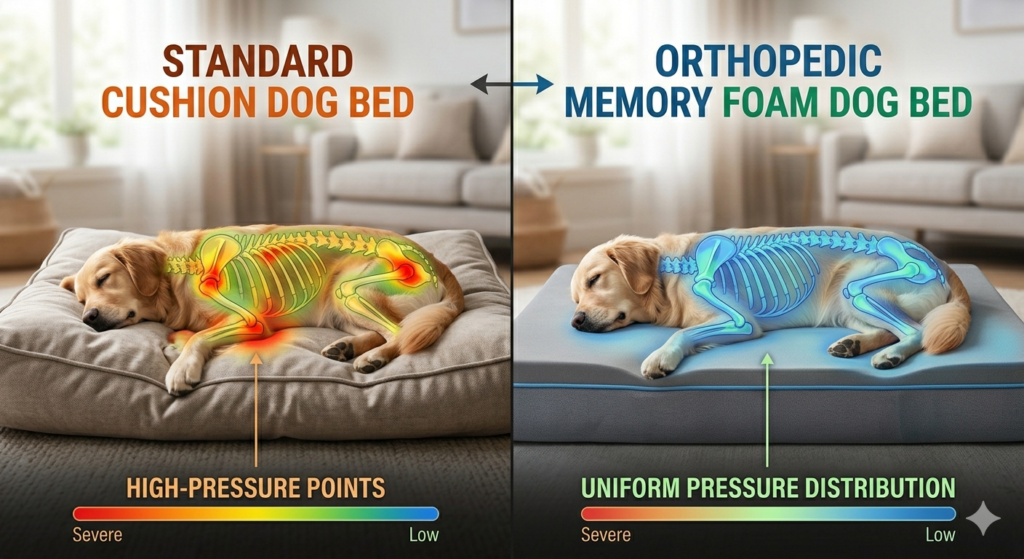
Many “budget” beds use egg-crate foam or shredded scraps. These collapse under weight, creating “bottoming out” points where the dog’s elbows and hips hit the hard floor. A true orthopedic dog bed must feature at least 3 to 4 inches of medical-grade memory foam with a density of at least 1.8 lbs/cu. ft.
The Data: Research from the University of Pennsylvania School of Veterinary Medicine indicates that high-density memory foam can reduce pressure on sensitive joints by up to 80%. By distributing weight evenly, it prevents the synovial fluid in the joints from pooling, which reduces morning stiffness and long-term inflammation.
Beating the Heat: The Case for an Elevated Dog Bed
While memory foam is the gold standard for support, it has one weakness: heat retention. If you have a “hot-natured” breed like a Bernese Mountain Dog or a thick-coated Husky, they might abandon a plush bed for the cold kitchen tiles. This is where an elevated dog bed (or “cot”) shines.
The 360-Degree Airflow Advantage
By lifting your dog 5 to 7 inches off the ground, an elevated dog bed allows air to circulate underneath their belly—the area where dogs regulate most of their body heat.
Case Study: One of our readers, Mark, struggled with his English Bulldog’s heavy panting during humid July nights in Florida. After switching to an elevated dog bed, he noted a visible decrease in the dog’s respiratory rate. The Science: Studies show that surface-to-air cooling can lower a dog’s resting body temperature by 3°F to 5°F compared to traditional floor beds, significantly reducing the risk of heat stress.
Decoding the “Bedtime Ritual”: Why Do Dogs Scratch Their Beds?
It’s the same routine every night: three circles, a heavy sigh, and a frantic digging session. It leaves every owner wondering: why do dogs scratch their beds?
Ancestral Instincts Meet Modern Comfort
- The “Nest” Factor: In the wild, wolves scratch away sticks, stones, and cold topsoil to reach the warmer earth below. Even on a $200 mattress, that “nesting” software is still running in your dog’s brain.
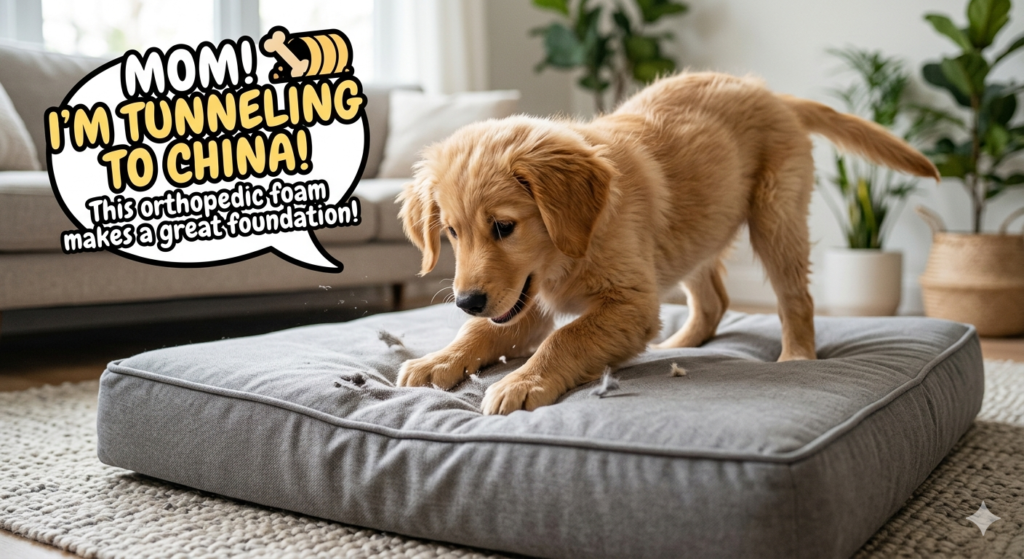
- Scent Marking: Dogs have pheromone glands in their paws. By scratching, they are literally “signing” the bed, claiming it as a safe territory.
- Temperature Tuning: Digging can be a sign that they are trying to flip to a “cooler” side of the fabric.
Pro Tip: If your dog is a heavy scratcher, look for a Dog Bed with a cover made of 1680D Ballistic Nylon. It’s the same material used in bulletproof vests and can withstand thousands of “digging” cycles without fraying.
The Ultimate Buyer’s Comparison Table
| Feature | Orthopedic Dog Bed | Elevated Dog Bed |
| Primary Goal | Joint support & pain relief | Cooling & airflow |
| Best For | Seniors, IVDD-prone, thin dogs | Thick coats, outdoor use, allergies |
| Cleaning | Machine-washable covers | Hose-down mesh |
| Durability | High (if memory foam is solid) | Extreme (chew-resistant frames) |
Maintenance Lab: How to Make Your Investment Last
- The Hand-Press Test: Every 6 months, press your palm firmly into the center of the bed. If you can feel the floor, the foam has lost its structural integrity and needs replacing.
- Waterproof Liners are Non-Negotiable: Drool, “accidents,” and damp paws will eventually ruin memory foam. Always buy a bed with a zippered waterproof inner liner.
- Rotating the Core: Just like your own mattress, flip or rotate the foam insert every 3 months to prevent permanent “dips.”
Frequently Asked Questions (FAQ)
Q: Can a puppy use an orthopedic dog bed? A: Absolutely. While they don’t have joint pain yet, providing high-quality support during their growth phase can help prevent developmental issues. Just ensure the cover is “puppy-proof” against chewing!
Q: My dog ignores the new bed. What should I do? A: It likely smells “too new” and clinical. Place one of your unwashed T-shirts on the bed for 48 hours. Your scent will transfer to the bed, making it feel like a safe part of the pack’s territory.
Q: Is an elevated dog bed okay for a dog with arthritis? A: Yes, surprisingly so. The firm, non-sagging mesh of an elevated dog bed is often easier for a stiff dog to stand up from than a deep, sinking plush cushion.
Conclusion: A Small Change for a Big Impact
At the end of the day, a Dog Bed is the most utilized piece of “gear” your pet will ever own. Whether you choose the therapeutic support of an orthopedic dog bed to soothe aching bones or the breezy comfort of an elevated dog bed for those hot summer days, you are making a conscious decision to extend your dog’s “golden years.”
My Warm Advice: Watch your dog tonight. If they are constantly shifting positions or seeking out the cold bathroom tile, their current bed is failing them. Invest in their rest—because a well-rested dog is a healthier, happier companion for years to come.