
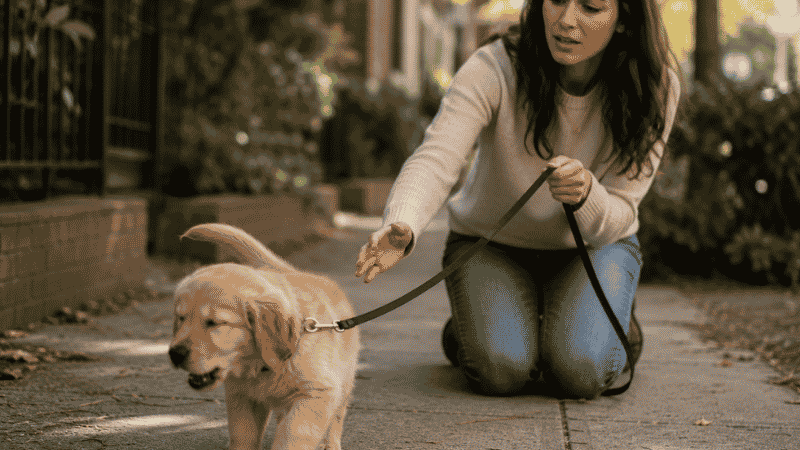
You’ve just clipped a leash onto your puppy’s collar for their very first walk. They lunge forward at a leaf, the leash goes taut — and you hear it. That little cough. That strangled, gagging sound.
You immediately feel terrible. You loosen the collar. You wonder if you’ve hurt them. And then you spiral: Should I be using a harness instead? Are collars even safe? Why didn’t anyone tell me this before I left the house?
This is one of the most common first-walk moments for new puppy owners, and it’s almost always followed by a frantic Google search about puppy collars versus harnesses. The answers online are all over the place — some say collar, some say harness, some say both, and almost nobody explains when to use each one or why it actually matters.
Here’s the honest answer: your puppy needs both a collar and a harness — but for completely different purposes. Once you understand what each one is actually for, the whole debate becomes much simpler.
Key Takeaways
- Collars are for identification, not for walking. Your puppy should wear a flat collar with ID tags at all times — but the leash for walks should almost always attach to a harness, not the collar.
- Harnesses are safer for puppy walks because they distribute pressure across the chest and shoulders rather than concentrating it on the delicate neck and trachea.
- According to veterinary behaviorist Dr. Christopher Pachel, harnesses are especially important for young puppies “still learning to walk on a leash who might pull or lunge.”
- Flat-faced breeds (Pugs, French Bulldogs, Bulldogs) and narrow-necked breeds (Greyhounds, Whippets) should never walk on a collar — a harness is non-negotiable.
- The two-clip rule is the simplest approach: collar on for ID, harness on for any leash activity.
Why Almost Every New Owner Gets This Backwards
The instinct for most new owners is to put a collar on the puppy — it’s familiar, it’s simple, it’s what you see in movies. Then they clip the leash to the collar and head out.
The problem isn’t the collar. It’s using the collar as a walking tool for a puppy that doesn’t yet know how to walk on a leash.
A puppy learning to walk on a leash will pull. They’ll lunge at pigeons. They’ll stop dead and then bolt sideways. Every one of those sudden movements translates to a sharp jerk of pressure directly onto the neck — onto the trachea, the thyroid gland, the cervical spine, and the major blood vessels of the throat.
For an adult dog who walks calmly on a loose leash, a collar is generally fine. For a puppy still learning — which is every puppy for the first several months — that repeated neck pressure is a real concern that most new owners don’t realize until they hear that first gagging sound.
The Purpose of a Puppy Collar
Let’s be clear: collars are not the enemy. They serve a specific and genuinely important purpose — they’re just not a walking tool for young puppies.
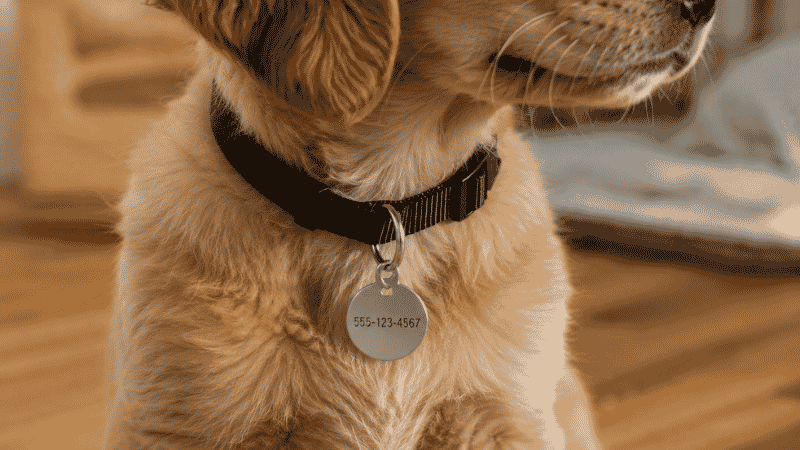
What a collar is for
Identification. Your puppy should wear a flat collar with an ID tag from the moment they arrive home. The tag should have your phone number (not your puppy’s name — that doesn’t help anyone who finds them). This collar stays on during the day when you can supervise your puppy, and comes off when they’re in their kennel or sleeping unsupervised.
Microchip backup. A collar is the first thing someone checks when they find a lost dog. A microchip is the backup if the collar comes off. Both matter — neither replaces the other.
Getting used to wearing something. Introducing a lightweight collar early helps your puppy become comfortable with the sensation of something around their neck. This makes future vet visits, grooming sessions, and gear introductions easier.
What a collar is not for
Walking a puppy on a leash. Specifically, any puppy who hasn’t yet learned to walk calmly on a loose leash — which is most puppies for the first six months to a year — should not be walked with a leash attached to a collar.
How to fit a puppy collar correctly
The fit rule is simple: you should be able to slip two fingers comfortably underneath the collar when your puppy is relaxed. Any tighter causes discomfort; any looser and a small puppy can back out of it.
Check the fit weekly in the first few months. Puppies grow fast, and a collar that fits at 10 weeks can become dangerously tight by 14 weeks without you noticing.
The Purpose of a Puppy Harness
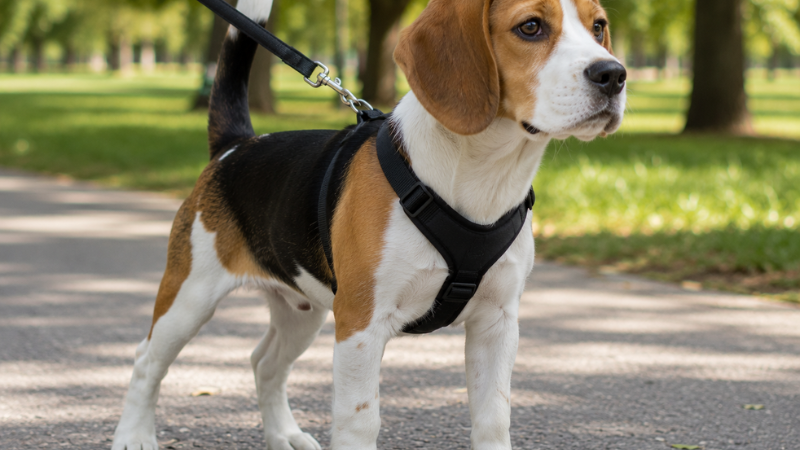
A harness does what a collar can’t: it distributes the force of pulling across the chest and shoulders — the strongest, most structurally capable parts of your puppy’s body — rather than concentrating it on the neck.
For a puppy still learning to walk on a leash, a harness is simply the safer tool for the job.
Why harnesses are better for puppy walks
The anatomy matters here. Dogs carry their heads horizontally, with the throat and neck exposed at the front of the leash attachment. The trachea (windpipe), thyroid gland, lymph nodes, and major blood vessels all run through this area. When a puppy pulls and the leash jerks the neck, those structures absorb the impact.
A harness moves that impact to the chest and upper back — areas with muscle, bone, and structural strength designed to handle it. For a puppy whose trachea is still developing and whose neck muscles are not yet conditioned, this difference is genuinely meaningful.
A 2019 study published in the Veterinary Record found that collar use was associated with increased intraocular (eye) pressure in dogs — a particular concern for flat-faced breeds whose eyes are already more vulnerable to pressure changes.
The two main harness types
Back-clip harness (leash attaches at the back): The most common type. Comfortable, easy to put on, and appropriate for most puppies. The main limitation is that it doesn’t actively discourage pulling — if your puppy lunges forward, the back attachment gives them their full pulling power. For puppies who are still in early leash training, this is fine — the goal at this stage isn’t stopping pulling, it’s protecting their neck while they learn.
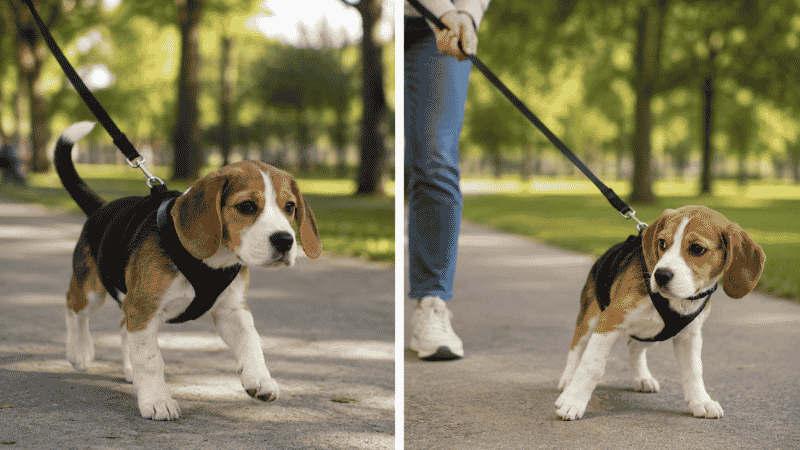
Front-clip (no-pull) harness (leash attaches at the chest): When a front-clip harness is pulled, the dog’s body is redirected sideways toward the owner rather than forward. This naturally interrupts pulling momentum without any pain or correction. Most trainers recommend transitioning to a front-clip harness once your puppy has the basics of leash walking and you want to actively reduce pulling.
For most new puppy owners, starting with a back-clip harness and transitioning to a front-clip harness around 4–6 months (once leash training is underway) is the practical approach.
Which Harness Does Your Puppy Actually Need?
The right harness depends on your puppy’s size, breed, and what you need it to do. Here’s a straightforward breakdown.
For small breeds (under 20 lbs adult weight)
Small breeds are fragile, and their tracheas are especially vulnerable to collar pressure. For Chihuahuas, Yorkshire Terriers, Shih Tzus, Maltese, and similar breeds, a harness is non-negotiable from day one — these breeds are the most frequently seen in veterinary offices with tracheal damage from collar use.
Look for a Y-shaped or H-shaped harness that sits low on the breastbone without crossing the shoulder joint. A harness that restricts shoulder movement will affect your puppy’s gait and can cause long-term joint problems.
What to avoid: Vest-style harnesses with a horizontal strap across the chest that restricts the shoulder. These are common because they look secure, but they interfere with natural movement.
For medium breeds (20–50 lbs adult weight)
Medium breeds have more structural resilience, but a harness is still the better walking tool during the puppy phase. A standard back-clip harness works well to start, with a transition to a front-clip option if pulling becomes an issue.
Look for four adjustment points (neck circumference, chest girth, and two body straps) for the best fit as your puppy grows.
For large and giant breeds (50+ lbs adult weight)
Large breed puppies seem sturdy, but their joints and skeletal structure are actually more vulnerable during growth — not less. A harness that fits well and doesn’t restrict shoulder movement is especially important.
The key fitting issue for large breeds: ensure the front chest strap sits on the breastbone, not across the shoulder blades. Many harnesses marketed for large breeds sit too high and restrict the natural forward reach of the front legs.
For flat-faced breeds (Pugs, French Bulldogs, Bulldogs, Boston Terriers)
This is the category where the collar-for-walking choice has the most serious consequences. Brachycephalic breeds already have compromised airways — a collar adds direct pressure to an area that’s already struggling. A harness is not a preference for these breeds; it’s a medical recommendation.
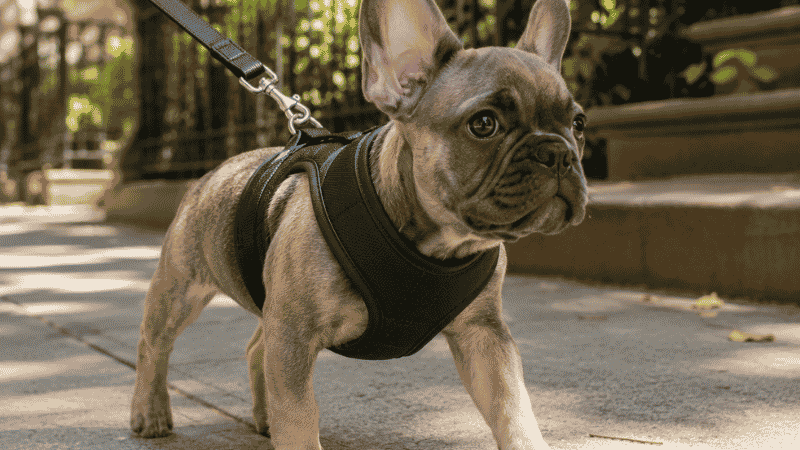
Use a Y-shaped or vest-style harness with excellent chest coverage. Avoid anything that puts pressure on the neck area. And for these breeds specifically, keep walks shorter in warm weather regardless of what gear you use.
For sight hounds (Greyhounds, Whippets, Italian Greyhounds)
Sight hounds have narrow heads and wide necks — which means standard collars slip off easily, and these breeds are notorious escape artists. A martingale collar is the right choice for identification and for situations where you need collar control. A properly fitted harness is still the better walking tool.
The Practical Two-Piece System
The answer to “collar or harness” is not actually either/or. The practical approach that most trainers and vets recommend is:
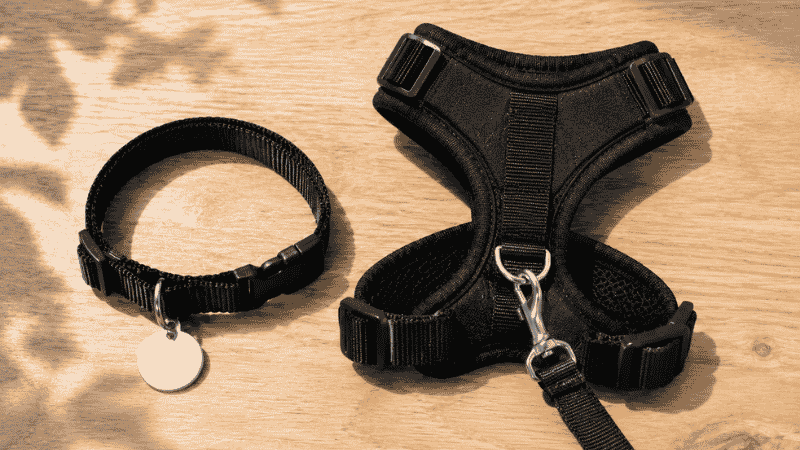
Collar: Flat collar with ID tags, worn during supervised time at home. Comes off in the kennel.
Harness: Goes on before any leash activity — walks, potty trips, car rides, anywhere the leash is attached.
This is the “two-clip rule” in practice. The collar is always there for identification. The harness is the walking tool. They serve different purposes and you need both.
How to Fit a Harness Correctly
A harness that doesn’t fit correctly is worse than no harness — it can cause chafing, restrict movement, allow escape, or put pressure in the wrong places.
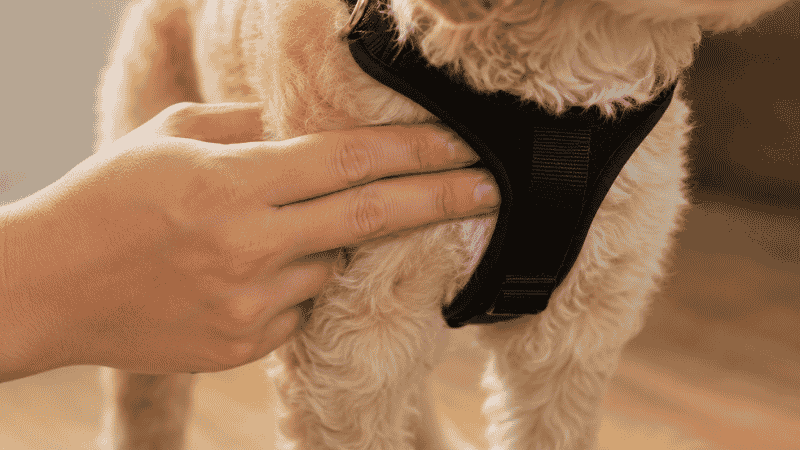
The two-finger rule (same as collars): You should be able to slip two fingers under every strap when your puppy is standing naturally. If you can fit your whole hand, it’s too loose. If you have to pull to fit two fingers, it’s too tight.
Check for shoulder restriction: Have your puppy walk toward you and watch their front legs. The stride should look natural and even. If the front paws don’t extend fully forward, the harness is sitting too high on the shoulders and restricting the gait. Adjust or try a different style.
The armpit check: After a walk of 20–30 minutes, check the area behind your puppy’s front legs (the “armpits”). Any redness, hair loss, or irritation means the straps are rubbing — loosen slightly or add padding.
Check fit weekly. Puppies grow rapidly, especially in the first six months. A harness that fits perfectly at 10 weeks will be too small at 14 weeks. Build a weekly fit check into your routine.
Introducing the Harness: Making It a Positive Experience
Some puppies accept a harness immediately. Others act as though you’ve placed a monster on their back. Both reactions are normal.
The gradual introduction approach:
Day 1: Place the harness on the floor near your puppy’s food bowl or favorite toy. Let them sniff it, step on it, interact with it without pressure.
Day 2: Hold the harness near your puppy and treat every time they sniff or investigate it. Then gently touch them with it while they eat.
Day 3: Try slipping the harness on briefly while offering high-value treats — tiny pieces of boiled chicken work well. Remove it after 30 seconds. Keep it positive and short.
Day 4–5: Leave the harness on for increasing durations during positive experiences (meals, play sessions). Clip the leash and do a short indoor practice walk before going outside.
The goal is for your puppy to associate the appearance of the harness with something good happening. Within a week, most puppies learn that harness = walk, and they’ll start getting excited when they see you pick it up.
Common Mistakes New Owners Make
Using a collar for walks from day one. The most common error, covered above. Collar for ID, harness for walking — always.
Buying a harness that’s too big “to grow into.” Unlike kennels, harnesses don’t have dividers. A harness that’s too large will move around, cause chafing, and allow your puppy to back out of it. Buy for now and replace when they grow.
Choosing style over fit. Some harnesses look great on Instagram and fit terribly in real life. A harness with multiple adjustment points will always fit better than a one-size harness, regardless of how cute the pattern is.
Leaving the harness on at home unsupervised. Harnesses can get caught on furniture, kennel bars, and other objects. Your puppy should wear their flat collar at home — the harness goes on for walks and comes off when you return.
Not adjusting as the puppy grows. Check the fit weekly. This is non-negotiable in the first year.
A Note on Special Situations
Car travel: A harness that attaches to a seatbelt clip is significantly safer than a collar during car travel. In an accident, a dog attached by the collar is at serious risk of neck injury. A crash-tested harness keeps them in place without the neck risk.
Puppies who hate the harness: Some puppies resist strongly. Don’t force it — force creates lasting negative associations. Slow the introduction process down and increase the reward value. If you’re genuinely stuck after two weeks, a session with a certified trainer is worth it.
Off-leash time: Neither collar nor harness is needed for safe, enclosed off-leash play. The collar (with ID) stays on; the harness comes off.
FAQ: What New Puppy Owners Actually Search For
Should a puppy wear a collar or harness? Both, for different purposes. The collar holds ID tags and stays on during supervised time at home. The harness is the walking tool — clip the leash to the harness, not the collar, for any walk or outdoor activity.
At what age can a puppy wear a harness? Puppies can wear a harness from 8 weeks of age. Starting early helps them get used to the sensation of wearing gear before walks begin.
Is a harness better than a collar for puppies? For walking, yes — harnesses distribute leash pressure across the chest and shoulders rather than the neck, reducing the risk of tracheal injury. Most veterinarians recommend harnesses for puppies who are still learning to walk on a leash.
What type of harness is best for a puppy? For most puppies, a back-clip harness is the best starting point. Transition to a front-clip (no-pull) harness at 4–6 months if pulling becomes an issue. Y-shaped or H-shaped designs are generally better than vest styles with chest-crossing straps.
Can I leave a harness on my puppy all day? No. Harnesses can get caught on objects and shouldn’t be worn unsupervised. Use a flat collar for everyday wear at home and put the harness on specifically for walks.
How tight should a puppy harness be? The two-finger rule: you should be able to slip two fingers under every strap when your puppy is standing naturally. Check all adjustment points, including behind the front legs where chafing is most common.
My puppy hates wearing a harness — what do I do? Slow down the introduction. Associate the harness with high-value food — place treats on or near it, then feed meals while the harness is in contact with them, then with it on briefly. Never force it. Gradual positive association works; force does not.
The Bottom Line
The puppy collar versus harness question has a genuinely simple answer once you separate the two purposes:
Collar = identification. Wear it at home during supervised time. Never clip the leash here for walks.
Harness = walking tool. Clip the leash here for every outdoor activity.
Your puppy needs both from day one. The collar is always on (except in the kennel). The harness goes on for walks and comes off when you return home.
Get a flat collar with an ID tag engraved before your puppy even arrives. Get a properly-fitted Y-shaped or H-shaped back-clip harness for walks. Check both fits weekly as your puppy grows. Graduate to a front-clip harness when you want to reduce pulling.
That’s the whole system. Simple, safe, and exactly what your puppy’s neck will thank you for.
References
- Pauli, A.M., Bentley, E., Diehl, K.A., et al. (2006). Effects of the application of neck pressure by a collar or a harness on intraocular pressure in dogs. Journal of the American Animal Hospital Association, 42(3), 207–211.
- Pachel, C. (2024). Clinical Behavioral Medicine for Dogs: Walking Safety and Equipment. American College of Veterinary Behaviorists.
- American Kennel Club. (2026). Dog Harnesses and Dog Collars: Which Is Right For Your Dog? akc.org
- American Veterinary Medical Association. (2023). Dog Safety and Equipment Guidelines. avma.org