
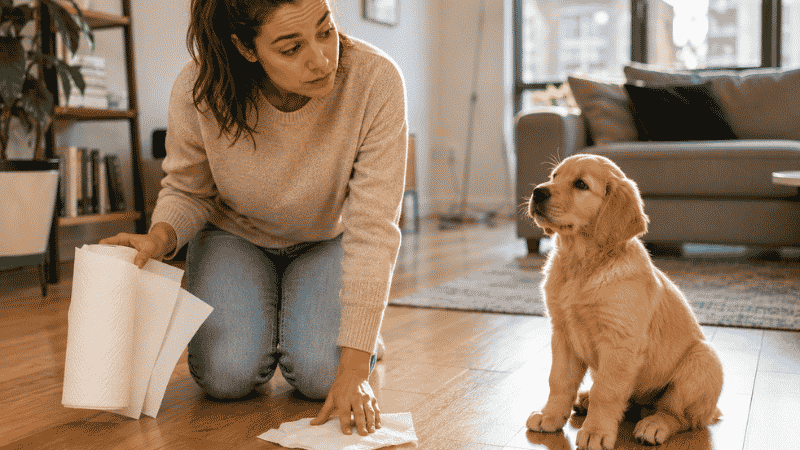
Day three with your new puppy. You’ve taken them outside six times today. They sniffed around, got distracted by a leaf, came back inside — and immediately squatted in the corner of the living room.
You cleaned it up. You took them out again. You waited. Nothing. You came back inside. Fifteen minutes later, another puddle — right next to the first one.
If this sounds familiar, you’re not doing it wrong. You’re just at the beginning of a process that requires more patience, more consistency, and more enzymatic cleaner than anyone tells you before you bring a puppy home.
Potty training is one of the most universal challenges of new puppy ownership — and one of the most fixable. Most puppies can be reliably house-trained within four to six months. Some do it faster. A few take longer. What almost always determines the timeline is not the puppy’s intelligence — it’s the owner’s consistency.
This guide covers everything you actually need: the science behind why puppies have accidents, a realistic daily schedule by age, the right way to handle accidents when they happen, and a specific plan for apartment dwellers and 9-to-5 owners who can’t be home all day.
Key Takeaways
- Potty training success is 90% about your consistency and 10% about your puppy’s cooperation. The schedule, the supervision, and the response to accidents all come from you.
- Puppies can control their bladder for roughly one hour per month of age — a 2-month-old puppy needs a bathroom break every 2 hours, including overnight.
- Never punish accidents. Puppies cannot connect punishment to something that happened even 30 seconds ago. Punishment increases anxiety and slows training progress.
- Enzymatic cleaner is non-negotiable. Standard cleaners leave scent residue that draws puppies back to the same spot. Enzymatic formulas break down the compounds completely.
- Most puppies are reliably house-trained between 4 and 6 months of age. Small breeds often take longer due to smaller bladders.
Why Puppies Have Accidents — The Biology First
Before the schedule and the steps, it helps to understand what’s actually happening when your puppy has an accident indoors.
Puppies are not being defiant. They are not “getting back at you.” They do not have the neurological capacity to feel spite or plan revenge. What they have is an immature bladder and bowel system with limited voluntary control — and a brain that hasn’t yet learned where the approved elimination area is.
Bladder control develops gradually. A puppy under 12 weeks has almost no voluntary control over their bladder muscles. When they feel pressure, they go — the signal from brain to sphincter is essentially bypassed. This is why very young puppies seem to eliminate with zero warning. By 4 to 5 months, most puppies have developed enough muscle control to hold it briefly. By 6 months, most can manage 4 to 6 hours during the day with a consistent schedule.
The scent factor. Dogs naturally return to places where they’ve eliminated before, because the scent signals “this is a bathroom.” This is actually useful — it’s why having a designated outdoor spot accelerates training — but it also means that accidents cleaned with the wrong products leave invisible scent markers that keep attracting your puppy back. Standard household cleaners don’t break down urine’s organic compounds. Enzymatic cleaners do.
The distraction factor. Puppies taken outside often spend the first several minutes absorbed by smells, sights, and stimulation. By the time the novelty wears off, they’ve either forgotten the urge or it’s passed — and then the moment they step inside, the urge returns. This is not manipulation. It’s exactly what immature bladder control looks like.
The Potty Training Formula: Four Elements
Every successful potty training approach has four things in common. Get all four right and training moves quickly. Miss any one of them and progress stalls.
Element 1: Schedule
The schedule is the backbone of potty training. Puppies learn patterns — and a consistent schedule teaches them when and where elimination happens. A predictable schedule also lets you anticipate accidents before they occur, which is far more effective than reacting to them after.
When to take your puppy outside:
- Immediately upon waking (morning and after every nap)
- Within 15 to 20 minutes after every meal
- After every play session
- After any period of excitement (visitor arrives, new toy, burst of energy)
- Every 1 to 2 hours during the day for young puppies
- Last thing before bed
- Once or twice overnight for puppies under 16 weeks
The frequency decreases as your puppy’s bladder control develops. A 3-month-old needs trips every 2 hours. A 5-month-old can stretch to 3 to 4 hours during the day. By 6 months, most puppies are managing 4 to 6 hours comfortably.
Element 2: Supervision
When your puppy is not outside and not in their kennel, your eyes are on them. Not in the same room while you’re watching TV. On them. Watching for the pre-elimination signals — circling, sniffing the ground intently, squatting — that give you the 10 to 15 seconds you need to scoop them up and get outside.
This level of supervision is intensive and it doesn’t last forever. But during the first 4 to 8 weeks of training, it is the single most effective accident-prevention tool you have. Every accident that doesn’t happen indoors is one less scent marker being laid down.
Useful tools for maintaining supervision: keeping your puppy tethered to you on a 6-foot leash inside the house (so they’re always in your field of vision), using baby gates to restrict access to carpeted rooms, and keeping your puppy in the same room as you rather than giving them free range of the house.
Element 3: Confinement
When you cannot supervise — during work calls, while cooking, when you’re asleep — your puppy goes into their kennel or a small, puppy-safe confinement area. This uses the dog’s natural instinct to avoid eliminating where they sleep. A correctly sized kennel (just large enough to stand, turn, and lie down) leverages this instinct effectively.
The kennel is not punishment. It is a management tool that prevents accidents from happening when you’re not available to intercept them. A puppy who has never had an unsupervised accident in the house learns much faster than one who has established the habit of indoor elimination.
Important: the kennel only works if your puppy isn’t left in it longer than they can physically hold their bladder. Leaving an 8-week-old puppy in a kennel for 6 hours will result in accidents — not because the training isn’t working, but because you’ve exceeded their physiological capacity.
Element 4: Reward
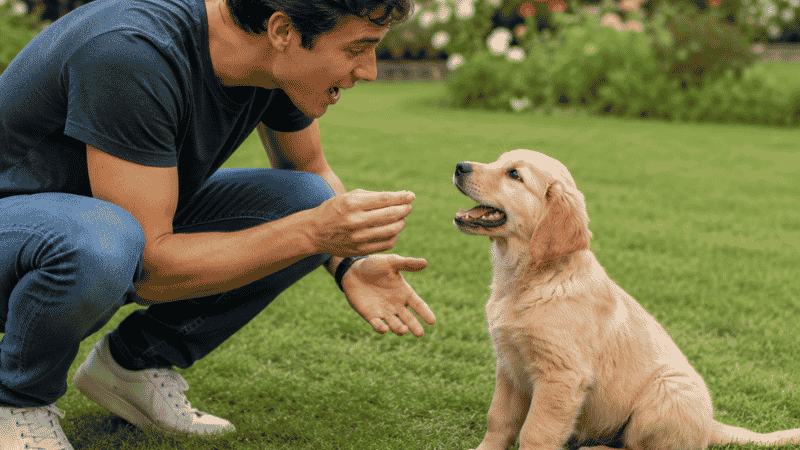
The moment your puppy eliminates outdoors, they get enthusiastic praise and a high-value treat — immediately, while they’re still in the act of finishing, not after you’ve walked back inside. The reward has to happen within 2 to 3 seconds of the behavior to create a clear association.
“Good girl” in a quiet voice while you’re already heading toward the door doesn’t register. Big, genuine, over-the-top enthusiasm the instant they finish — “YES, good puppy, GOOD GIRL!” — followed immediately by a treat, registers.
Over time, the treat reward can be phased out and replaced by verbal praise and affection. But early in training, food rewards are your most powerful tool. Use them.
The Realistic Potty Training Schedule by Age
8 to 10 Weeks
Bladder capacity: 1 to 2 hours maximum. Overnight: Expect 1 to 2 trips outside between midnight and 6am. Daily trips outside: 10 to 14 times.
This stage is intensive. You are essentially watching your puppy constantly when they’re awake, and getting up once or twice overnight. It’s exhausting and it doesn’t last long — most puppies move through this phase within 4 to 6 weeks with consistent management.
Sample schedule:
- 6:00am — Wake up, outside immediately
- 6:15am — Breakfast, outside 15 minutes after eating
- 8:00am — Outside (2 hours after last trip)
- 10:00am — Outside
- 12:00pm — Lunch, outside 15 minutes after eating
- (Continue every 2 hours through the afternoon)
- 6:00pm — Dinner, outside 15 minutes after eating
- 8:00pm — Outside
- 10:00pm — Last trip before bed
- 1:00am — Overnight trip (set an alarm)
- 4:00am — Second overnight trip if needed
12 to 16 Weeks
Bladder capacity: 2 to 3 hours during the day. Overnight: Most puppies can manage 4 to 5 hours by 14 to 16 weeks, meaning one overnight trip or none. Daily trips outside: 8 to 10 times.
This is where you start seeing real progress if training has been consistent. Accidents become less frequent. Your puppy may start moving toward the door or giving clearer signals before they need to go. Overnight sleep is improving.
4 to 6 Months
Bladder capacity: 3 to 5 hours during the day. Overnight: Most puppies are sleeping through the night by 4 months with a late last trip and early morning first trip. Daily trips outside: 5 to 6 times.
By this stage, most puppies are essentially house-trained with occasional accidents. The schedule is now morning, midday, afternoon, after dinner, and before bed. The kennel is still useful but your puppy can handle more supervised freedom during the day.
6 Months and Beyond
Bladder capacity: 4 to 6 hours during the day (varies by size). Reliable house-training: Most puppies at this stage have infrequent to zero accidents with a maintained schedule.
Small breeds often reach this stage later than medium and large breeds. A Chihuahua or Yorkshire Terrier may not achieve reliable house-training until 7 to 9 months due to smaller bladder capacity. Expect this and plan accordingly.
Handling Accidents the Right Way
Accidents will happen. How you respond to them has a significant impact on how quickly training progresses.
What to do in the moment
If you catch your puppy mid-accident indoors: interrupt calmly — a quiet “oops” or clap your hands once — and immediately take them outside to finish. If they do finish outside, reward enthusiastically. You’ve just turned an accident into a partial success.
If you find an accident after the fact: say nothing. Your puppy cannot connect your reaction to something that happened minutes or hours ago. Scolding, rubbing their nose in it, or expressing frustration achieves nothing training-wise and actively damages your relationship. Clean it up and use the information — an accident means you missed a cue or waited too long. Adjust the schedule.
The right way to clean up
This matters more than most owners realize.
Standard household cleaners (including many products labeled “pet cleaners”) do not break down urine’s uric acid crystals — the compound responsible for attracting dogs back to the same spot. They may mask the smell to human noses while leaving enough residue for your puppy’s far more sensitive nose to detect.
Enzymatic cleaners contain live enzymes that break down and digest the organic compounds in urine and feces completely, eliminating the scent marker rather than covering it. Apply generously, let it soak for the recommended time on the label, and blot dry rather than wiping (wiping spreads the residue).
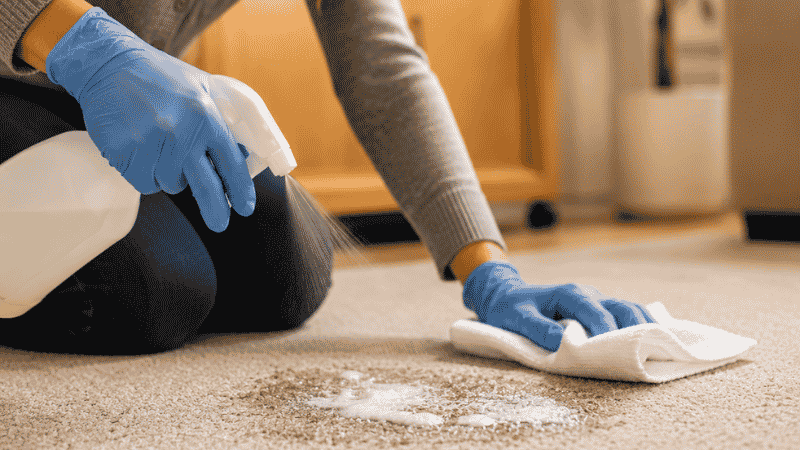
Common enzymatic cleaner options include products like Nature’s Miracle, Rocco & Roxie, and Angry Orange. Any enzymatic formula specifically designed for pet waste will work. Keep a bottle within reach during the training period.
For carpet accidents: apply the enzymatic cleaner, cover with a clean cloth, and weight it down overnight to allow full penetration. A single thorough clean with enzymatic cleaner is worth more than three inadequate cleanups with standard products.
Apartment and City Living: Potty Training Without a Yard
Most potty training guides assume you have a backyard. If you live in an apartment — particularly in a high-rise building — the logistics are genuinely more complicated, and you need a slightly different approach.

The elevator problem
Getting a young puppy from your apartment to the street takes time — time during which a puppy with a full bladder is straining to hold it. The solution is training your puppy to eliminate on a designated pad on your balcony or in your bathroom during the early weeks, then gradually transitioning to outdoor elimination as bladder control develops.
The tradeoff: puppies trained on indoor pads can develop a surface preference for soft absorbent surfaces, which can make the transition to outdoor elimination slower. If you want outdoor elimination as your end goal, minimize indoor pad use as much as possible and transition away from pads as early as bladder control allows — typically around 12 to 14 weeks.
The designated outdoor spot
If you can get outside regularly, choose one specific spot within easy walking distance and use it every time. The familiar scent of previous eliminations in that spot makes it significantly easier for your puppy to “go” — they recognize it as a bathroom location. Using six different spots around the block is less effective than returning to one consistent location.
Managing the elevator and lobby
Carry your puppy through the lobby and in the elevator until reliable house-training is established — not to protect against disease (your puppy should be interacting with the world), but because a puppy in a new environment may squat mid-lobby or mid-elevator with zero warning. Being carried gives you control until their bladder signals are more reliable and their control is stronger.
The 9-to-5 reality
The honest answer: very young puppies (under 12 weeks) cannot be left home alone for a full workday. An 8-week-old puppy needs a bathroom break every 2 hours. A 10-hour workday with no midday break is beyond their physiological capacity and will result in accidents, anxiety, and slower training progress.
Practical solutions:
- A midday dog walker or neighbor who can come in for a bathroom break
- Puppy daycare for part or all of the day during the earliest weeks
- A puppy camera and flexible work schedule to allow breaks during the critical first months
- An exercise pen with a pad in one corner during extended absences — not as a substitute for regular outdoor training, but as a management tool for times when you genuinely cannot be home
The puppy phase is short. The investment of a dog walker for 2 to 3 months during the critical training period pays off in years of a reliably house-trained dog.
Pre-Elimination Signals — What to Watch For
Learning to read your puppy’s pre-elimination signals gives you the 10 to 30 seconds you need to get outside before an accident happens. These signals vary by puppy but common ones include:
- Sudden sniffing of the floor with focused intensity, often in circles
- Circling in one spot or moving from room to room restlessly
- Squatting — by this point you have about 3 seconds
- Heading toward a previously soiled area — the scent is pulling them back
- Stopping play suddenly and standing still
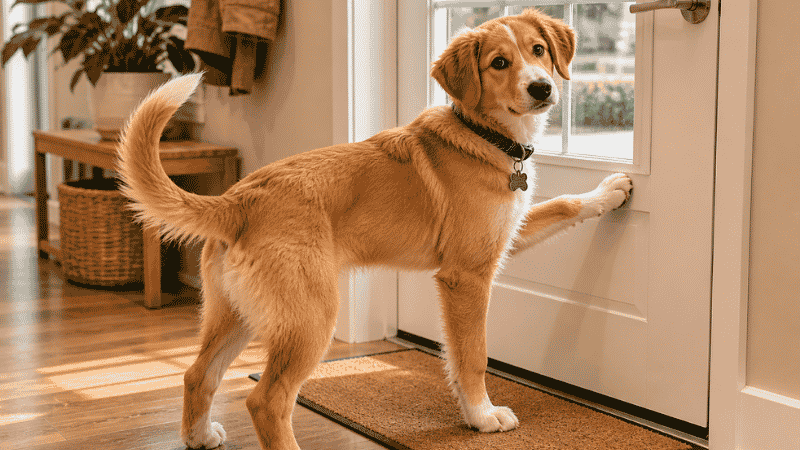
- Moving toward the door (this is the trained signal you’re building toward — celebrate it enthusiastically when it appears)
Every puppy has their own pre-elimination pattern. Pay attention in the first two weeks and you’ll start to recognize your specific puppy’s signals. Once you can predict the accident 20 seconds before it happens, you’ve dramatically accelerated the training timeline.
Training Regressions — Why They Happen and What to Do
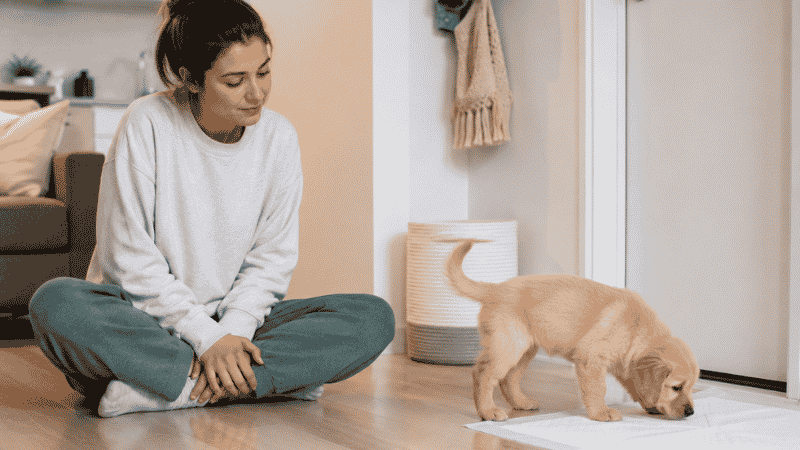
Many owners experience a period of good progress followed by what seems like complete reversal — a puppy that was having no indoor accidents suddenly has several in a row. This is called a regression, and it’s normal.
Common causes of regression:
Schedule disruption. Travel, visitors, a change in your work schedule, or any disruption to the established routine can trigger temporary regression. The puppy’s routine has been their guide — without it, accidents return.
Adolescence. Between 4 and 8 months, many puppies go through a developmental phase that includes some behavioral regression across multiple areas. A puppy that was reliably house-trained at 4 months may have accidents again at 6 months. This is temporary and responds to returning to the basics — more frequent trips, more supervision, more reward.
Medical issues. If a previously house-trained puppy suddenly starts having frequent accidents without any schedule disruption, a veterinary visit is appropriate. Urinary tract infections, bladder stones, parasites, and other medical issues can cause loss of bladder control. Never assume regression is behavioral without ruling out medical causes first.
Incomplete training. Sometimes what looks like regression is actually a puppy who was managed well enough that accidents didn’t happen — but whose training wasn’t fully internalized. When supervision relaxes, accidents return. The solution is returning to the earlier schedule and supervision level and maintaining it longer.
Response to regression: Go back to basics. Increase supervision and schedule frequency as if you’re starting over. Don’t reduce the schedule again until you’ve had two full weeks of accident-free progress.
Puppy Pads: Useful Tool or Confusion Creator?
Puppy pads have a role in potty training — particularly for apartment dwellers and for managing overnight and extended absences. But they come with a real tradeoff that’s worth understanding before you rely on them.
The case for puppy pads:
- Provides an approved indoor elimination surface for periods when you can’t get outside
- Reduces mess during the early weeks when bladder control is minimal
- Useful for overnight management and extended absences
The tradeoff:
- Teaches your puppy that eliminating indoors is sometimes acceptable — which is the opposite message of what outdoor training is trying to establish
- Can create a surface preference for soft absorbent materials that makes transitioning to outdoor elimination harder
- Requires a second training phase to eliminate indoor pad use
The best approach: If you use puppy pads, use them strategically — overnight management and genuine emergency situations only — rather than as a primary training method. Place them near the door where your puppy will eventually go to signal they need to go out, so the location association transfers. Eliminate pads as early as bladder control allows, typically around 12 to 14 weeks.
FAQ: What New Puppy Owners Actually Search For
How long does it take to potty train a puppy? Most puppies are reliably house-trained between 4 and 6 months of age with consistent training. Small breeds often take longer — up to 9 months — due to smaller bladder capacity. The timeline is primarily determined by the owner’s consistency, not the puppy’s intelligence.
What do I do when my puppy has an accident inside? If you catch them in the act: calmly interrupt and take them outside immediately to finish, then reward. If you find it after the fact: say nothing, clean thoroughly with enzymatic cleaner, and adjust your schedule to prevent it next time. Never scold, yell, or physically correct your puppy for accidents.
How often should I take my puppy outside? Every 1 to 2 hours for puppies under 12 weeks. Every 2 to 3 hours for puppies 12 to 16 weeks. Every 3 to 4 hours for puppies 4 to 5 months. Always take them out immediately after waking up, within 15 to 20 minutes after eating, and after play sessions.
Should I use puppy pads? Puppy pads are a useful management tool for extended absences and overnight, but using them as a primary training method creates a second training phase to eliminate indoor elimination. Use them strategically and transition away from them as early as bladder control allows.
My puppy goes outside but then has an accident right when we come in — why? Very common. Puppies go outside, get overwhelmed by stimulation, don’t eliminate, and then have an accident immediately upon returning inside where they feel calmer. Solution: stay outside longer (10 to 15 minutes minimum), stay still rather than walking around (less stimulation makes elimination more likely), and go back to the same spot repeatedly. If they don’t go within 15 minutes, return inside to their kennel and try again in 20 minutes.
When can I give my puppy more freedom in the house? Gradually increase freedom as accident-free weeks accumulate — not as a single transition. Start with supervised access to one additional room, confirm accident-free behavior, then expand. Most puppies can have significant unsupervised house access by 6 to 7 months, but this varies by individual.
Is it normal for potty training to go backwards? Yes. Regressions happen due to schedule disruption, adolescence, or medical issues. Always rule out medical causes for sudden regression in a previously trained puppy. For behavioral regression, return to the basics — more frequent trips, more supervision — and maintain them for at least two accident-free weeks before relaxing again.
The Bottom Line
Potty training is not complicated. But it is intensive, and the intensity is front-loaded — the first 4 to 8 weeks require a level of supervision and schedule consistency that most new owners underestimate.
The good news: if you do those first weeks right — consistent schedule, constant supervision when your puppy is loose, appropriate kennel use during confinement, immediate enthusiastic reward for outdoor elimination, and enzymatic cleaner for every indoor accident — most puppies house-train faster than you expect.
The accidents stop. The overnight trips stop. The constant vigilance stops. And what remains is a dog that walks to the door when they need to go outside, every time, reliably — for the next decade of your life together.
That’s worth a few weeks of intensive effort now.
References
- American Kennel Club. (2026). How to Potty Train a Puppy: A Comprehensive Guide. akc.org
- Humane World for Animals. (2024). How to Potty Train Your Dog or Puppy. humaneworld.org
- Bloom, I., CPDT-KSA. (2025). How to Potty Train a Puppy. Chewy. chewy.com
- McGowan, R.T.S., PhD. (2026). Puppy Potty Training Guide. Purina. purina.com
- Overall, K.L. (2013). Manual of Clinical Behavioral Medicine for Dogs and Cats. Elsevier Mosby.