
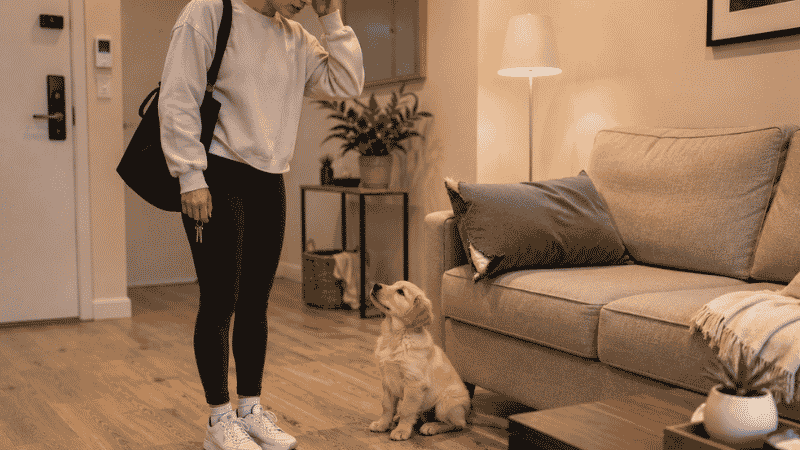
You’ve been gone for forty minutes. You come back to find your puppy has chewed through the corner of the sofa, knocked over the water bowl, and left a puddle in the hallway — despite being fully potty trained.
Your neighbor mentions, somewhat apologetically, that there was a lot of howling.
You feel guilty. You feel worried. You wonder if you’ve done something wrong, or if your puppy is broken, or if this is just going to be your life now — forty-minute maximum absences for the next fifteen years.
Here’s what you need to know: what you’re describing might be separation anxiety. Or it might be boredom, or insufficient crate training, or a puppy who hasn’t yet learned that being alone is survivable. These are different problems with different solutions — and confusing them is the most common reason treatment doesn’t work.
This guide untangles all of it. By the end, you’ll know whether your puppy actually has separation anxiety, what causes it, and exactly what to do — whether you’re working from home, heading back to the office, or somewhere in between.
Key Takeaways
- True separation anxiety is not the same as normal puppy distress. Most puppies whine, cry, or act out when first left alone — this is normal adjustment behavior, not a disorder. True separation anxiety is a genuine panic response that doesn’t resolve with time alone.
- The most reliable way to know if your puppy has separation anxiety is to record their behavior while you’re away. What you find will almost always surprise you.
- Prevention is significantly easier than treatment. Building independence from week one — even when it feels unnecessary — is the most important thing you can do.
- Separation anxiety is one of the top reasons dogs are surrendered to shelters, according to research published in the Journal of Applied Animal Welfare Science. It is also one of the most treatable behavioral conditions when addressed early.
- Some puppies need veterinary support — behavioral medication combined with training produces better outcomes than training alone for moderate to severe cases.
Normal Puppy Distress vs. True Separation Anxiety
This distinction is the most important thing in this guide. If you get it wrong, you’ll treat the wrong problem — and nothing will improve.
Normal puppy adjustment behavior
When a puppy first comes home, they have spent their entire life surrounded by their mother and littermates. Being alone is a genuinely new experience — they have no evidence yet that you’ll come back, that the house is safe without you, or that solitude is survivable. Some crying, whining, and distress when first left alone is not pathological. It’s a reasonable response to a genuinely unfamiliar situation.
Normal adjustment behavior typically looks like this: the puppy cries or whines when left alone, often intensely at first, then gradually settles over 10 to 30 minutes. The distress decreases over successive solo experiences as the puppy learns that being alone is temporary and not dangerous. Within 2 to 4 weeks of consistent, gradual alone-time practice, most puppies can be left for age-appropriate durations without significant distress.
True separation anxiety
True separation anxiety is a panic response. The puppy’s nervous system goes into genuine distress — heart rate elevates, cortisol spikes, the rational brain essentially goes offline. This is not a dog choosing to misbehave. This is a dog in the equivalent of a panic attack.
Characteristics that distinguish true separation anxiety from normal adjustment:
- Distress begins before you even leave — triggered by departure cues like picking up keys, putting on shoes, or reaching for your coat
- The distress does not diminish over time alone — it either sustains or escalates
- Destructive behavior is focused specifically on exit points: doors, windows, door frames
- The puppy cannot settle even briefly during your absence
- Behaviors stop almost immediately upon your return
- Symptoms persist despite weeks of consistent gradual alone-time practice
The intensity matters too. A dog with true separation anxiety can injure themselves trying to escape confinement — broken nails, damaged teeth, self-inflicted wounds. This is a level of distress that normal adjustment behavior doesn’t reach.
The recording test
The single most useful tool for determining which category your puppy falls into is a camera or phone recording of their behavior during your absence.
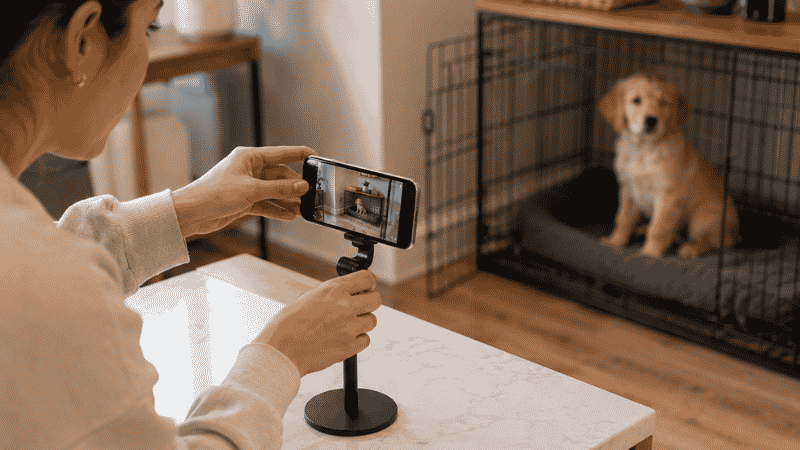
Set up a camera, leave the house, and watch the footage. What you find will tell you almost everything:
- If your puppy settles within 15 to 30 minutes and sleeps or plays calmly for most of your absence — this is normal adjustment behavior responding to time and consistency.
- If your puppy remains in sustained distress for the majority of your absence, particularly if the behavior escalates rather than settling — this is a red flag for true separation anxiety.
- If distress begins before you leave, triggered by your departure routine — this is a significant indicator of true separation anxiety.
Make this recording before drawing any conclusions. New owners frequently overestimate the severity of separation anxiety based on what they imagine is happening in their absence.
What Causes Puppy Separation Anxiety
Understanding the causes helps you both prevent it and treat it more effectively.
Breed predisposition
Some breeds are significantly more prone to separation anxiety than others. Breeds developed for close human partnership — working dogs, herding breeds, companion breeds — have been selectively bred over generations to pay close attention to and bond tightly with their humans. This same quality that makes them wonderful companions also makes independent alone-time harder.
Breeds with elevated separation anxiety risk include: Labrador Retrievers, Golden Retrievers, Border Collies, German Shepherds, Vizslas, Weimaraners, Cocker Spaniels, and most toy breeds.
Knowing your breed’s tendencies allows you to start independence training earlier and more proactively.
Insufficient alone-time practice
The most preventable cause. Puppies who spend the majority of their early weeks in constant human company — particularly during work-from-home situations or extended holidays — never learn that being alone is manageable. When the owner’s schedule changes and they’re suddenly alone for hours, the shock to their system is severe.
This is why independence training needs to start even when it seems unnecessary. Even if you work from home. Even if you’re on leave. Even if you could theoretically never leave your puppy alone for months.
Traumatic early experiences
A single frightening event during your absence — a thunderstorm, fireworks, a loud noise, a fall — can create a lasting association between your absence and danger. If your puppy was frightened while alone, they will remember.
This is also why some rescue dogs arrive with pre-existing separation anxiety — unknown but significant things happened in their history.
Overly reinforced clinginess
Well-meaning owners sometimes inadvertently train separation anxiety by consistently responding to clingy behavior with reassurance and presence. A puppy who learns that being near you at all times produces comfort, and that distance produces anxiety, has been accidentally trained into dependence.
This doesn’t mean you shouldn’t comfort your puppy — it means that deliberately practicing independence should be a regular, planned part of each day, not something that only happens when you have to leave.
Schedule disruptions
Separation anxiety can emerge or worsen following significant life changes: a return to office work after working from home, a family member moving out, a new baby arriving, or any major shift in the puppy’s established routine. The puppy’s previously predictable world becomes unpredictable, and their stress response increases.
The Signs of Puppy Separation Anxiety
Knowing what to look for — both when you’re present and in recorded footage from your absence — is essential for accurate diagnosis.
Signs visible before you leave (pre-departure anxiety)
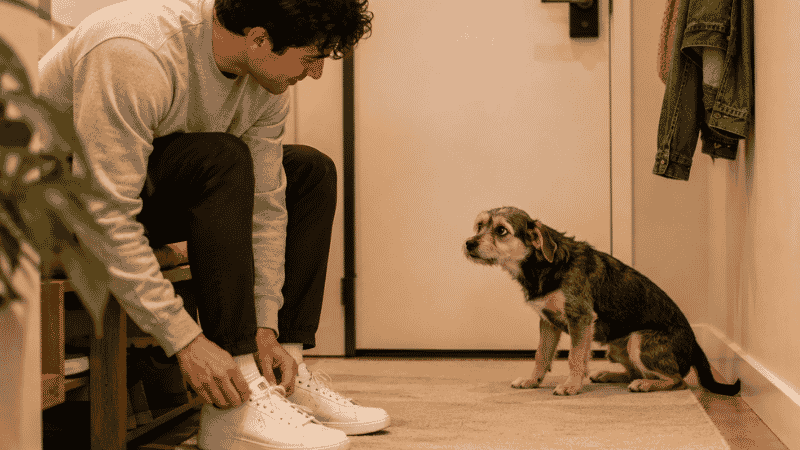
- Pacing as you move toward the door
- Excessive salivation or panting triggered by departure cues
- Whining or barking as you put on shoes or pick up keys
- Shadowing — following you from room to room with increasing intensity as you prepare to leave
- Refusing to eat or engage with toys when departure cues are present
Pre-departure anxiety is one of the clearest indicators of true separation anxiety rather than normal adjustment behavior. A puppy who is already in distress before you’ve left the house has made an association between your departure routine and danger.
Signs during your absence (from recording)
- Sustained vocalization — barking, howling, or whining that continues for more than 30 minutes
- Destructive behavior focused on exit points: scratching at doors, chewing door frames or window sills
- Pacing or circling without settling
- Inappropriate elimination in a puppy who is otherwise reliably potty trained
- Excessive salivation or drooling visible in footage
Signs when you return
- Extremely exuberant, prolonged greeting that takes several minutes to calm down
- Immediate cessation of all distress behaviors the moment you return
- Visible physical signs of prolonged stress: heavy panting, shaking, dilated pupils
Prevention: Building Independence From Day One
Prevention is dramatically easier than treatment. If your puppy is still young and hasn’t yet developed significant separation anxiety, these practices build the independence that makes your absence manageable.
Start alone-time practice immediately
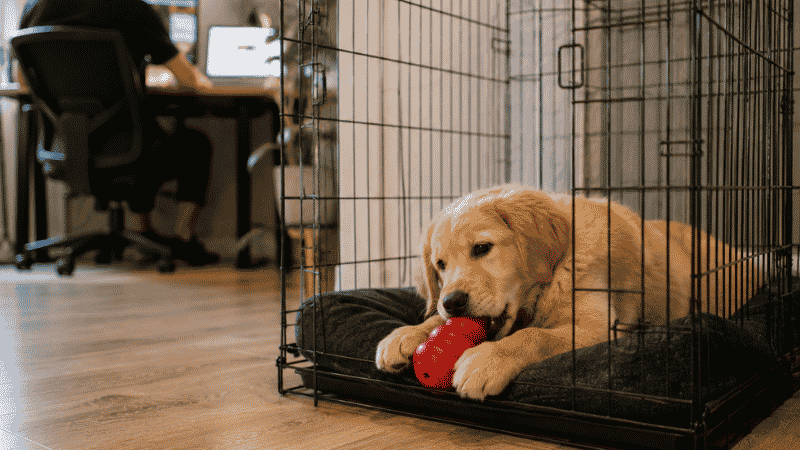
From your puppy’s first week home, build short, regular periods of planned solitude into every day — even when you don’t need to leave. Place your puppy in their kennel or a puppy-safe area with a Kong or chew, and leave the room. Start with 5 minutes. Build to 15, then 30, then an hour. Do this multiple times daily.
The message you’re teaching: you leave, and you come back. Your absence is temporary and not dangerous. Good things (the Kong, the chew) happen when you’re gone.
Never always be available
If your puppy is with you every moment of every day — following you to every room, sleeping on you, always within touching distance — they have no opportunity to practice being without you. Build micro-separations into every day, even at home. Go to another room for 10 minutes. Close the bathroom door. Work at a desk while your puppy rests in their kennel in the same room.
Small, frequent separations throughout the day are more valuable for building independence than occasional long absences.
Teach the kennel as a positive space
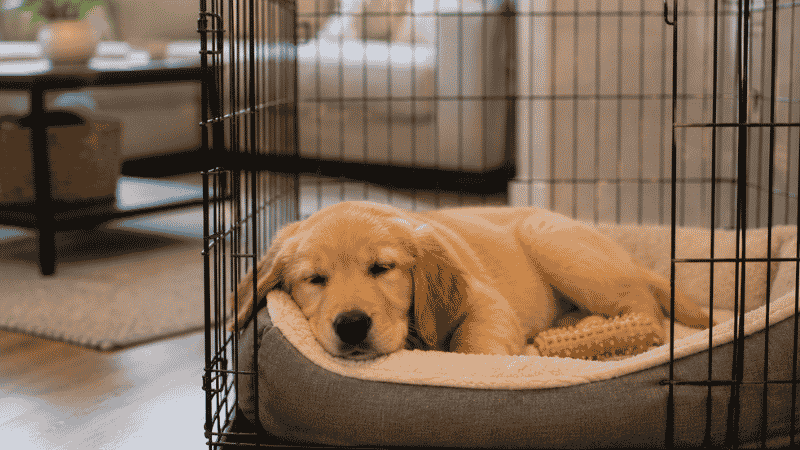
A puppy who loves their kennel has a safe, calm retreat during your absence. A puppy who hates or fears their kennel is confined in a space that amplifies anxiety. The kennel introduction process matters enormously for separation anxiety prevention — a rushed or forced introduction creates exactly the wrong association.
Feed meals in the kennel. Give high-value chews only in the kennel. Cover three sides to create a den-like environment. Never use the kennel as punishment. The kennel should predict good things — not confinement.
Desensitize departure cues
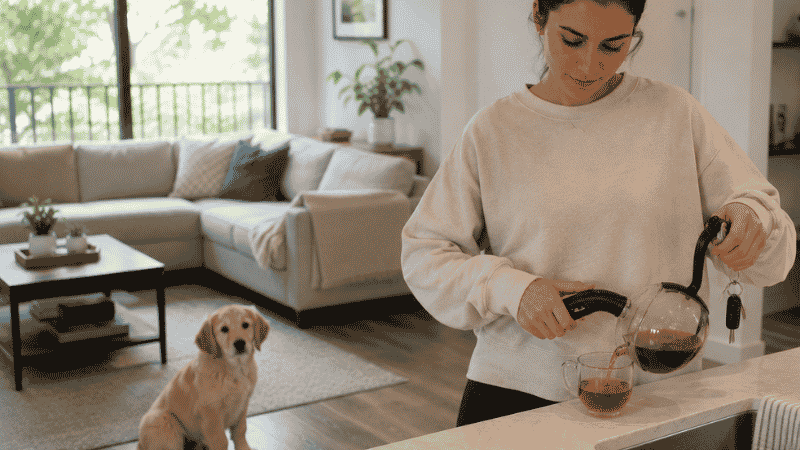
Pick up your keys and put them down without going anywhere. Put on your shoes and sit on the couch. Reach for your coat, then make tea. If your puppy learns that departure-associated objects don’t reliably predict your absence, they lose their power to trigger a stress response.
Do this dozens of times during the week before you have to return to any regular schedule that involves your absence.
Practice graduated departures
Leave for 30 seconds. Return calmly. Leave for 2 minutes. Return calmly. Build duration gradually over days and weeks. The goal is to keep every departure within your puppy’s tolerance window — the point at which anxiety begins. Staying just below that threshold, consistently, teaches your puppy that departure is manageable.
Never extend the duration faster than your puppy’s behavior indicates they’re ready for.
Treatment: If Your Puppy Already Has Separation Anxiety
If your puppy already shows signs of true separation anxiety, the approach requires more structure and patience than prevention — but it’s absolutely treatable.
Step 1: Establish a veterinary baseline
Before beginning any behavior modification program, rule out medical causes. Urinary tract infections, thyroid conditions, pain, and neurological issues can all produce symptoms that look like separation anxiety. A veterinary visit is the first step, not an optional one.
If the diagnosis is behavioral, discuss whether your specific puppy’s case warrants behavioral medication support. For moderate to severe separation anxiety, research consistently shows that training combined with medication produces better outcomes than training alone — not because medication fixes the problem, but because it reduces the anxiety enough that the puppy can actually learn during the training process.
Step 2: Reduce all departures to below the anxiety threshold
During active treatment, your puppy should not be left for longer than they can manage without distress. This sounds difficult — and for owners who need to work, it requires a plan.
Options for managing your puppy’s alone time during treatment:
- Dog walker or pet sitter for midday visits
- Puppy daycare during working hours
- Working from home for a period if your situation allows
- Having a trusted person check in during long absences
This is temporary. The goal is to prevent the repeated experience of full-scale panic during your absence, which worsens the anxiety rather than improving it.
Step 3: Systematic desensitization — restart from zero
Return to the beginning of the graduated departure process, starting with sub-threshold departures: opening the door and closing it without leaving, stepping outside for 10 seconds, building from there.
Record every session to track progress and to catch signs that you’ve moved too fast. Signs you’ve moved too fast include any of the anxiety indicators described above — even mild versions. If anxiety appears, reduce duration and try again.
Progress is not linear. Some weeks will look like regression. This is normal and expected. Maintain consistency regardless.
Step 4: Build independence behaviors simultaneously
While working on graduated departures, also work on building independence throughout the day. “Place” training — teaching your puppy to go to their bed and stay there with a chew while you move around the house — is particularly valuable. It teaches your puppy to be physically separated from you while you’re still present, which reduces the overall dependency that fuels separation anxiety.
Step 5: Manage arrivals and departures emotionally
Keep your departures completely low-key. No long goodbyes, no extended reassurance, no emotional escalation. A matter-of-fact departure — give the Kong, say a calm goodbye, leave — conveys that your absence is a normal, non-concerning event.
Return the same way. Greet your puppy calmly when you come home. Wait until they’re settled before engaging in extended affection. Exuberant “I missed you so much!” reunions, however well-intentioned, teach your puppy that your return is a major emotional event — which makes your departure equally major in the opposite direction.
The 9-to-5 Reality: Managing Separation Anxiety While Working Full Time
The most common situation new owners face: they had the puppy during a holiday or leave period, worked from home, or simply underestimated how much alone-time preparation a puppy needs — and now they have to return to full-time work.
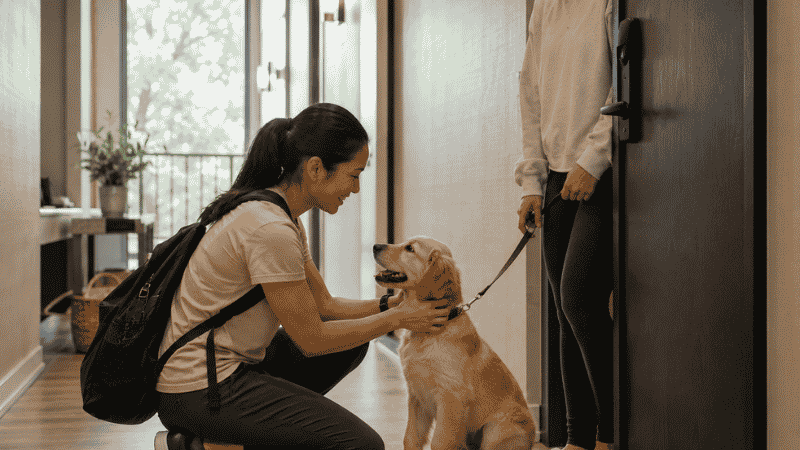
Realistic options:
A dog walker or midday pet sitter covers the critical middle-of-the-day gap and reduces the total consecutive alone time from 8 to 9 hours to two blocks of 3 to 4 hours. This alone significantly reduces the severity of anxiety experiences during the workday.
Puppy daycare eliminates alone-time anxiety entirely during working hours and provides important socialization. The tradeoff: some puppies find daycare overstimulating, and overstimulated puppies return home in a heightened arousal state that can make evening alone-time harder.
A pet camera lets you monitor your puppy’s behavior in real time during the workday and intervene — by calling them over a two-way audio function — if anxiety escalates. It also gives you the footage data you need to track progress over time.
Remote work flexibility, even partial — working from home two or three days per week — dramatically reduces the frequency of long absences during the critical early treatment period.
None of these options is perfect. Most families use a combination. The goal during active treatment is to prevent repeated full-scale anxiety experiences during your absence, not to achieve perfect management overnight.
When to Get Professional Help
Most mild to moderate separation anxiety responds to consistent at-home work using the steps above. Seek professional support when:
- Symptoms are severe: self-injury, extreme destructive behavior, complete inability to settle during any absence
- Your puppy shows no improvement after 4 to 6 weeks of consistent systematic desensitization
- Anxiety is escalating rather than improving
- You’re unsure whether what you’re seeing is separation anxiety or something else
A certified applied animal behaviorist (CAAB), a veterinary behaviorist (DACVB), or a certified professional dog trainer with specific separation anxiety credentials (CSAT — Certified Separation Anxiety Trainer) are the appropriate professionals for this specific issue.
FAQ: What New Puppy Owners Actually Search For
Is it normal for a puppy to cry when left alone? Some crying when first left alone is normal — it’s a new and unfamiliar experience. Normal adjustment crying typically decreases over 2 to 4 weeks of consistent gradual alone-time practice. Crying that doesn’t decrease, or that’s accompanied by sustained distress and destructive behavior specifically at exit points, may indicate true separation anxiety.
Should I let my puppy cry it out? For mild, normal adjustment crying in a puppy who settles within 30 minutes: allowing them to settle on their own teaches that distress is temporary and self-resolving. For a puppy with true separation anxiety: leaving them in sustained panic does not teach them to cope — it reinforces that being alone is dangerous. Know which situation you’re in before deciding.
How long does puppy separation anxiety last? With consistent treatment, most mild to moderate cases show meaningful improvement within 4 to 8 weeks. Severe cases may take several months. Separation anxiety doesn’t resolve on its own with time — it requires active, systematic intervention.
Can separation anxiety be prevented? Yes — and prevention is significantly easier than treatment. The key practices are: starting alone-time training from week one, never allowing your puppy to be with you every moment of every day, building a positive kennel association, and desensitizing departure cues before you need to use them.
Will getting a second dog fix my puppy’s separation anxiety? Rarely. Dogs with true separation anxiety are attached to their human, not to other dogs. A second dog may reduce boredom-based behavior but does not address the panic response of genuine separation anxiety. And it adds significant cost and responsibility.
Is medication safe for puppy separation anxiety? For moderate to severe cases, behavioral medication prescribed by a veterinarian — most commonly fluoxetine or clomipramine — is safe, well-studied, and significantly improves treatment outcomes. Medication doesn’t sedate or change your puppy’s personality. It reduces the anxiety enough that they can actually learn during training. Always discuss this with your veterinarian rather than attempting natural supplements without guidance.
The Bottom Line
Puppy separation anxiety exists on a spectrum. At one end: normal, temporary adjustment distress that resolves with patience and gradual alone-time practice. At the other: a genuine panic disorder that requires systematic behavior modification, veterinary support, and significant owner commitment.
The most important steps you can take are also the earliest ones. Start alone-time practice the week your puppy arrives. Build the kennel as a positive space before you need it. Desensitize your departure routine before it becomes a trigger. These early investments cost almost nothing in time or effort — and they prevent the months of difficult, intensive treatment that established separation anxiety requires.
If you’re already past that point: the problem is treatable. It takes time, consistency, and often professional support — but dogs recover from separation anxiety every day, and with the right approach, yours can too.
References
- ASPCA. (2024). Separation Anxiety. aspca.org
- American Kennel Club / Gibeault, S., CPDT. (2025). Separation Anxiety in Dogs: Causes, Prevention, and How to Solve It. akc.org
- Schwartz, S. (2003). Separation anxiety syndrome in dogs and cats. Journal of the American Veterinary Medical Association, 222(11), 1526–1532.
- Flannigan, G., & Dodman, N.H. (2001). Risk factors and behaviors associated with separation anxiety in dogs. Journal of the American Veterinary Medical Association, 219(4), 460–466.
- VCA Animal Hospitals. (2024). Separation Anxiety in Dogs. vcahospitals.com
- Overall, K.L. (2013). Manual of Clinical Behavioral Medicine for Dogs and Cats. Elsevier Mosby.