
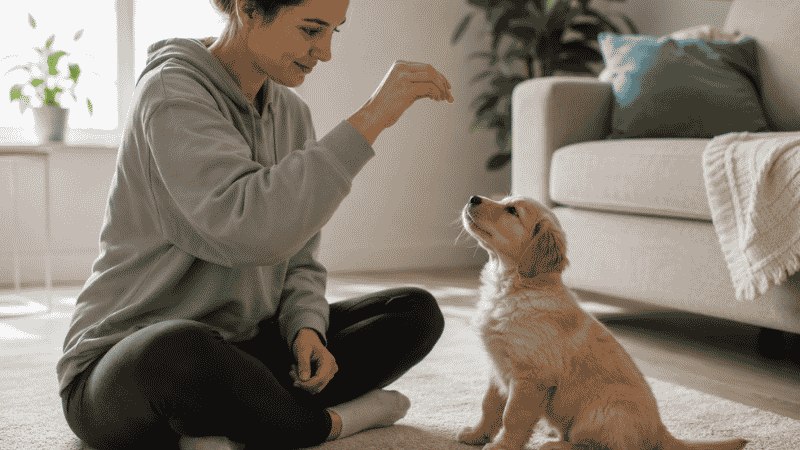
Here is the most common puppy training mistake new owners make: waiting.
Waiting until the puppy is “old enough.” Waiting until they’ve settled in. Waiting until after the vaccination series is done. Waiting until six months, when a trainer told them the puppy’s brain would be “more ready.”
By the time most new owners start formal training, they’ve already missed the single most powerful learning window in their puppy’s entire life — and they’ve spent weeks accidentally teaching habits they’ll spend months trying to undo.
The answer to “when should I start training my puppy?” is the same every time: the day they come home. Usually around 8 weeks old. Before they’ve learned that barking gets attention, jumping gets pets, and pulling on the leash gets them wherever they want to go.
This guide explains exactly why early training works, what your puppy’s brain is actually capable of at each age, and precisely what to teach — week by week — from 8 weeks through the first year.
Key Takeaways
- Start training the day your puppy comes home — typically 8 weeks old. There is no minimum age threshold for positive reinforcement training.
- The critical learning window for puppies runs from approximately 8 to 16 weeks. Experiences and patterns established during this period are among the most deeply encoded of their lives.
- Puppies can learn sit, come, and their name within the first week home. Most can reliably respond to 3 to 5 basic cues within 4 weeks of consistent daily practice.
- Training sessions should be 3 to 5 minutes — not 10 to 20 as many guides suggest. Puppies’ developing brains fatigue faster than owners realize.
- 6 months is the hardest training age, not the best time to start. Puppies entering adolescence lose impulse control and become selective listeners. Starting before this stage is not optional — it’s essential.
Why Your Puppy’s Brain Is Ready Right Now
The most persistent myth in puppy ownership is that training should wait until the puppy is older. This myth comes partly from outdated obedience culture (where formal training often didn’t begin until 6 months) and partly from a misunderstanding of puppy development.
Here is what’s actually happening in your puppy’s brain from 8 weeks onward.
The neurological truth
A puppy’s brain at 8 weeks is not a blank slate waiting to be filled. It is an extraordinarily active learning machine operating at peak neuroplasticity — the capacity to form new neural connections in response to experience. The very features that make puppies seem chaotic and overwhelming (constant exploration, short attention spans, intense reaction to everything) are the same features that make them exceptional learners when training is structured correctly.
Every interaction your puppy has from day one is teaching them something. The question is not whether they are learning — they are, continuously. The question is whether you are deliberately shaping what they learn, or leaving it to chance.
The socialization and learning overlap
The critical socialization window — the period when puppies most easily form positive associations with people, environments, and experiences — runs from approximately 3 to 16 weeks. Basic obedience training falls entirely within this window.
This overlap is not coincidental. The same neurological openness that allows a puppy to accept new environments and beings without fear is the same openness that allows them to learn behavioral patterns rapidly and durably. Training during this window creates associations that persist far more reliably than training started later.
What happens if you wait until 6 months
At approximately 5 to 7 months, most puppies enter adolescence — a period of hormonal change, increased independence, reduced responsiveness to previously learned cues, and significantly lower impulse control. Trainers frequently describe adolescent dogs as “selective listeners” — puppies who knew how to sit last month suddenly seem to have forgotten it existed.
This is not a coincidence or a training failure. It is a predictable developmental phase that every puppy goes through. A puppy that enters adolescence with 4 to 5 months of consistent training behind them navigates it significantly more smoothly than one for whom training is just beginning. Starting at 6 months doesn’t get you to the same place as starting at 8 weeks — it puts you behind before you’ve begun.
The 5-Minute Rule: Why Short Training Sessions Work
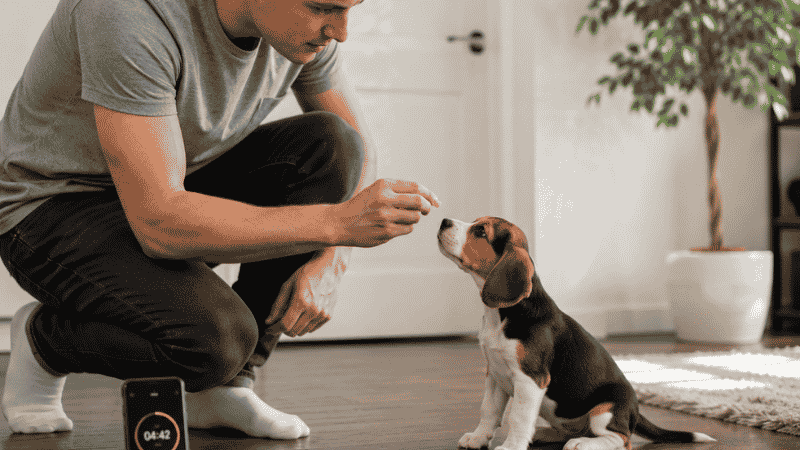
Before covering what to teach at each age, there is one principle that applies to every training session regardless of your puppy’s age: keep each session to 3 to 5 minutes maximum.
This feels wrong to most new owners. If the puppy is engaged and doing well, why stop? Surely longer is better?
Here is what’s actually happening neurologically. The prefrontal cortex — the brain region responsible for sustained attention, impulse control, and deliberate learning — is one of the last brain regions to fully mature in dogs (as it is in humans). In young puppies, it has very limited capacity. Sustained mental effort depletes it quickly, and once it’s depleted, the puppy can no longer process new information effectively. They lose focus, start making errors they weren’t making before, and may begin offering random behaviors or simply shutting down.
This is not the puppy being stubborn or distracted. This is a puppy whose learning capacity for that session is genuinely exhausted.
The correct approach: 3 to 5 minute sessions, 3 to 5 times per day, always ending on a success. Ten short positive sessions across a day will produce more learning than two extended ones — and it will be retained better. Build training into natural transitions: before meals, before going outside, during commercial breaks, while the kettle boils.
What to Teach at Each Age: The Complete Timeline
8 to 12 Weeks — Foundation Building
This is your most powerful window. Your puppy is at peak curiosity, minimal fear, and maximum neuroplasticity. Everything they learn now goes in deep.
What to prioritize:
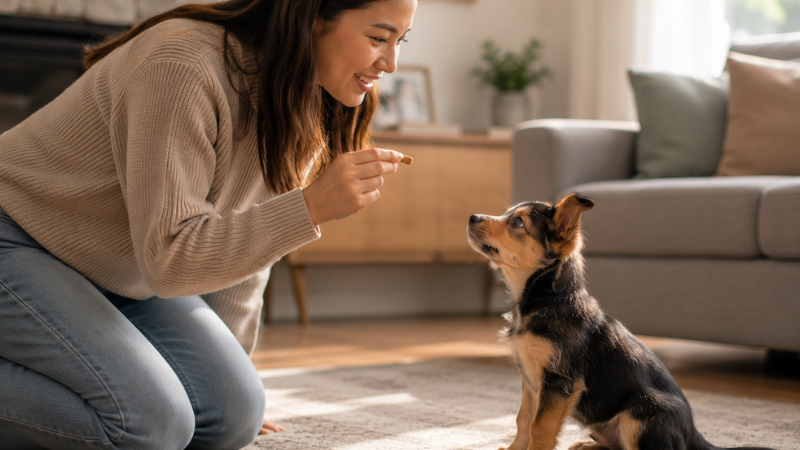
Name recognition — Teach your puppy their name before anything else. Say their name in a happy tone. When they look at you, immediately reward with a tiny treat or enthusiastic praise. Repeat dozens of times daily in varied situations. A puppy who reliably orients to their name is ready to learn everything else.
Sit — The foundation of all future training. Hold a small treat at your puppy’s nose, then slowly move it back over their head. As their head follows the treat upward, their bottom naturally drops. The moment it touches the ground, say “sit” and reward instantly. Within 3 to 5 sessions, most puppies understand the association. Within a week of consistent practice, most will sit reliably on cue.
Come — Begin indoors in a low-distraction environment. Crouch down, open your arms, say “come” in the most exciting voice you can manage, and reward enthusiastically when they reach you. Never call your puppy to come for anything unpleasant (nail trims, baths, being put in the crate). Come should predict only wonderful things.
Kennel introduction — Not just confinement, but building a genuine positive association with the kennel as a safe, comfortable space. Feed meals inside the kennel. Toss treats inside. Leave the door open and let your puppy explore freely. This groundwork pays dividends for years.
Potty training basics — Take outside immediately upon waking, 15 minutes after meals, after play, and every 1 to 2 hours during the day. Reward the moment elimination happens outdoors with genuine enthusiasm.
Handling practice — Touch ears, paws, mouth, and tail gently while rewarding. This makes every future veterinary visit and grooming session significantly easier. Build this habit now.
What not to worry about yet:
Stay (beyond a second or two), leash walking, down, leave it — these can begin, but don’t have high expectations for reliability at this age. The focus is on building positive associations with the training process itself.
Sample 5-minute morning session (8 to 10 weeks):
- 30 seconds: Name game — say name, reward when they look at you. 10 repetitions.
- 2 minutes: Sit practice — 8 to 10 repetitions, keeping it fun and reward-rich.
- 1 minute: Come practice — 4 to 5 short recalls across the room.
- 30 seconds: Handling — touch ears and paws while feeding treats.
- End before any sign of distraction or fatigue.
12 to 16 Weeks — Building on the Foundation
Your puppy’s attention span is slightly longer. They have some history of successful training sessions. This is the time to add complexity and begin working in more distracting environments.

What to add:
Down — From a sit, hold a treat at the nose and slowly lower it straight down between the front paws, then pull it along the floor away from the puppy. As they follow it down to reach it, their elbows touch the ground. Mark the moment and reward. “Down” is harder than “sit” for many puppies — be patient and keep sessions short.
Stay — Begin with a single second. Ask for a sit, say “stay,” wait one second, return to the puppy and reward. Build to five seconds, then ten. At this age, duration matters more than distance — the puppy should remain in position while you’re close, not across the room.
Leave it — Place a treat on the floor and cover it with your hand. When your puppy stops nosing at your hand, mark and reward with a different treat from your other hand. This is one of the most practically valuable commands you’ll ever teach — it can stop your puppy from eating something dangerous on a walk.
Leash introduction — First indoors without distractions. Put on the harness and leash, let the leash drag while you move around the room, reward your puppy for staying near you. Once comfortable, take short leash walks in low-distraction outdoor environments.
Working around distractions — Practice known commands in slightly more distracting environments: the garden, a quiet street, a friend’s house. Lower your expectations when distractions are higher — this is normal and temporary.
What you’ll notice:
By 16 weeks, a puppy with consistent daily training should reliably respond to their name, sit, come, and beginning stay. This is a meaningful foundation. Keep every session positive and end each one before the puppy shows signs of disinterest.
4 to 6 Months — Consolidation and Expanding
Vaccinations are complete or nearly so. New environments are now accessible. The adolescent phase is approaching — this period is crucial for consolidating what’s been learned before impulse control temporarily drops.
What to add:
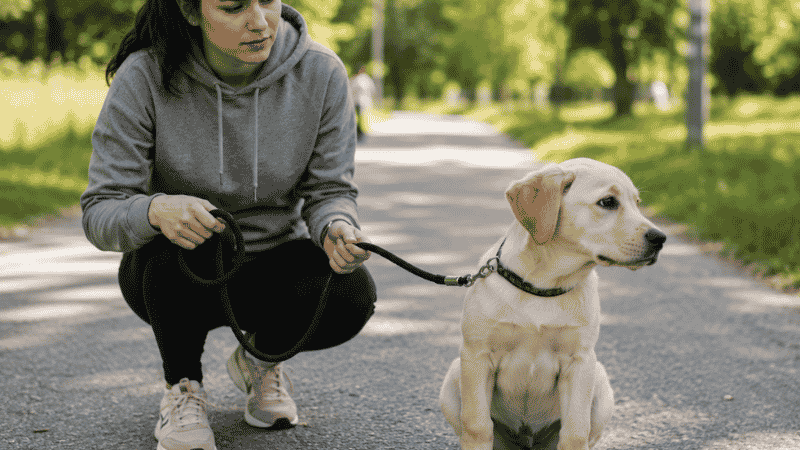
Loose leash walking — Real outdoor leash practice. The goal at this age is not a perfect heel but a loose leash — your puppy walking near you without pulling. Stop the moment pulling begins. Only move forward when the leash is loose. Reward generously when they check in with you voluntarily.
Proofing commands in new environments — A puppy that sits reliably in your living room needs to relearn the same sit at the park with dogs and people nearby. This is not regression — it’s a normal part of learning. Practice known commands everywhere you go.
Wait — Teaching the puppy to pause at thresholds (doors, car exits, stairs) before moving through. This is a practical safety behavior that pays off every single day.
Down-stay — Extending the stay from seconds to minutes. Begin adding distance once duration is solid.
What to expect:
Learning is still rapid at this stage. A puppy with a good foundation from the earlier months will be consolidating and generalizing that learning reliably. They may seem to “forget” commands in exciting environments — this is normal and responds to patient, consistent reinforcement.
6 to 12 Months — Navigating Adolescence
This is the phase that breaks many owners’ hearts — and tests their commitment. Adolescent puppies are hormonally driven, distractible, and infuriatingly selective in their responsiveness. A puppy that was sitting reliably at 4 months may suddenly seem to have lost all knowledge of the command at 7 months.
This is temporary. It is also survivable, and much more manageable for puppies with solid early training behind them.
What to focus on:
Consistency over everything — This is not the time to relax standards or skip training days. The routines established before adolescence are what carry your puppy through it. Maintain the same expectations, the same reward system, the same brief daily sessions.
Management over correction — An adolescent puppy has reduced impulse control. Rather than repeatedly correcting behavior they genuinely struggle to control right now, use management: keep the leash on, keep the kennel as a routine, keep valuable objects out of reach. This prevents practice of unwanted behaviors while their impulse control matures.
Reinforce recall heavily — Come is the command most likely to break down in adolescence, and it’s also the most important safety behavior your dog has. Counter this proactively: make coming to you the best thing that ever happens, every single time. Use the highest-value treats for recall practice.
Don’t stop training — Some owners respond to adolescent regression by stopping training, assuming it’s not working. This is exactly backwards. Consistent positive training is what gets you through adolescence, not what waits for it to end.
The light at the end:
Most dogs exit the adolescent phase by 12 to 18 months (later for large breeds). When they emerge on the other side, dogs with consistent early training typically have notably better manners, impulse control, and responsiveness than those who began training later.
The Daily Training Schedule That Works for New Owners
This is a realistic schedule for a working owner with an 8 to 12 week old puppy. Adjust to your specific schedule — the principle is brief, frequent, built into transitions.
| Time | Training Activity | Duration |
|---|---|---|
| Morning (before breakfast) | Name game + sit practice | 3–5 minutes |
| After breakfast | Potty outside + reward | Ongoing |
| Mid-morning | Come practice + handling | 3–5 minutes |
| After lunch | Potty outside + brief kennel practice | Ongoing |
| Afternoon | Down introduction + leave it | 3–5 minutes |
| Evening (before dinner) | Review of the day’s commands | 3–5 minutes |
| Before bed | Potty outside + kennel settling | Ongoing |
Total active training time: 15 to 20 minutes daily, broken into 4 to 5 sessions. Potty and kennel practice: Woven into every transition, not counted as separate training.
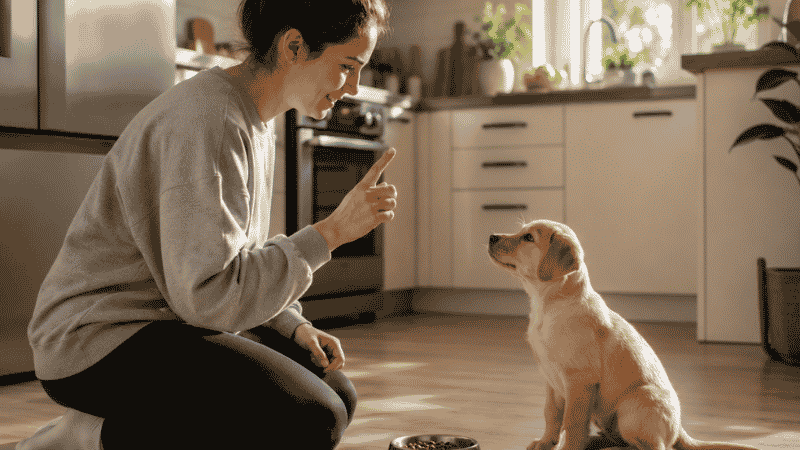
What Positive Reinforcement Actually Means — and Why It’s Not Just Being Nice
You will encounter the phrase “positive reinforcement” constantly in puppy training content. It’s worth understanding what it actually means, because the science behind it directly explains why it works better than alternatives.
Positive reinforcement training works by adding something desirable (a treat, praise, play) immediately after a behavior occurs, making that behavior more likely to repeat. This is not a philosophical preference — it is a description of how learning works at a neurological level in mammals.
When a behavior is followed immediately by something rewarding, the brain releases dopamine — which doesn’t just feel good but actively strengthens the neural pathway that produced the behavior. Over repetition, the behavior becomes more and more automatic.
Punishment-based training — aversive corrections, collar corrections, forcing behaviors — can suppress behaviors in the moment but does not build the strong, dopamine-reinforced neural pathways that positive training creates. It also introduces fear and anxiety into the training relationship, which further impairs learning. The American Veterinary Society of Animal Behavior has consistently stated that aversive training methods carry significant risks and are less effective than positive reinforcement for long-term behavior change.
This is why “but it works” is an incomplete argument for punishment-based methods. Yes, you can suppress a behavior through punishment. What you cannot build through punishment is a dog who genuinely understands and reliably offers the behavior you want — the dog that sits when you ask, every time, because sitting reliably produces wonderful things.
The Most Common Early Training Mistakes
Waiting for the puppy to “settle in” first. There is no settling-in period that benefits from training delay. A puppy who arrives at 8 weeks and begins gentle, positive training immediately is a puppy who settles in faster, not slower, because they quickly understand the rules of the household.
Sessions that are too long. Fifteen to twenty minutes feels productive but exceeds most puppies’ capacity. They start making errors, you start repeating cues, the session ends in frustration. Keep it to 3 to 5 minutes and end on a success.
Repeating cues when the puppy doesn’t respond. “Sit. Sit. Sit. Sit — sit!” teaches your puppy that the first cue is optional. Say the cue once. If no response, lure the behavior, reward, and practice more before asking again without the lure.
Using the puppy’s name as a correction. “No, Bailey!” teaches the puppy that their name precedes something unpleasant. Their name should only predict good things — attention, rewards, fun. Use a neutral interrupter (“ah-ah” or “oops”) for corrections.
Inconsistent household rules. If sitting on the sofa is sometimes fine and sometimes not, your puppy cannot learn the rule. Decide on household rules before your puppy arrives and apply them consistently from day one — every person in the household, every time.
Training when frustrated. Puppies read emotional states accurately. A frustrated, impatient trainer produces an anxious, shut-down learner. If you’re frustrated, end the session. Come back when you’re calm.
FAQ: What New Puppy Owners Actually Search For
Can you train a puppy at 8 weeks? Yes — absolutely. Eight weeks is not too young for positive reinforcement training. Puppies at this age can learn their name, sit, come, and begin kennel and potty training. The 8 to 16 week period is one of the most powerful learning windows of their lives.
What is the first thing to teach a puppy? Name recognition first — a puppy who reliably orients to their name when called is ready to learn everything else. Then sit, then come. These three form the practical foundation for all future training.
How long should puppy training sessions be? Three to five minutes per session, three to five sessions per day. Puppies have limited sustained attention capacity and learn better in brief, frequent, high-success sessions than in extended ones.
Is 6 months too late to start training a puppy? It is later than ideal — 6 months marks the beginning of adolescence, when impulse control decreases and response to training temporarily becomes less reliable. It is not too late, but starting at 8 weeks gives you 4 to 5 months of foundation-building before adolescence begins. If your puppy is 6 months, start now and be patient — progress will come.
How many commands can a puppy learn at once? Focus on one new command per week, while maintaining practice of previously learned commands. Most puppies can reliably learn 3 to 5 basic commands (sit, come, name, stay, down) in their first 4 to 6 weeks of training.
Should I train my puppy before or after meals? Training before meals uses food motivation most effectively — a slightly hungry puppy is more motivated by treats than a recently fed one. That said, training at any time works as long as the puppy is engaged and not exhausted.
My puppy keeps getting distracted during training — what do I do? Reduce distractions first: train indoors, away from windows, when other pets are not present. If your puppy is distracted even then, the session is too long — end it. Also increase your treat value. A puppy who isn’t engaging is either not motivated enough by the reward or has exceeded their capacity for that session.
The Bottom Line
The answer to “when should I start training my puppy?” has always been the same: now.
Not when they’ve settled. Not when vaccinations are done. Not when they’re six months old. The day they come home — the day you bring an 8-week-old puppy through your front door — that is when training begins.
It doesn’t look like a formal class. It looks like a 5-minute game before breakfast where your puppy learns that looking at you produces a treat. It looks like sitting at the door before going outside. It looks like coming from across the room and getting the most enthusiastic response your puppy has ever seen.
Small, consistent, daily. That’s the whole formula. The puppies who become genuinely well-mannered, easy-to-live-with adult dogs are not the ones who attended an expensive training program at six months. They’re the ones whose owners started on day one and kept going — five minutes at a time.

References
- American Veterinary Society of Animal Behavior. (2021). AVSAB Position Statement on the Use of Dominance Theory in Behavior Modification of Animals. avsab.org
- PetMD / Veterinary Review Team. (2025). Puppy Training Guide: How and When to Start. petmd.com
- American Kennel Club. (2026). Puppy Training Timeline: Teaching Good Behavior Before It’s Too Late. akc.org
- Overall, K.L. (2013). Manual of Clinical Behavioral Medicine for Dogs and Cats. Elsevier Mosby.
- Donaldson, J. (2013). The Culture Clash: A Revolutionary New Way of Understanding the Relationship Between Humans and Domestic Dogs (2nd ed.). Dogwise Publishing.
- Pryor, K. (2009). Reaching the Animal Mind: Clicker Training and What It Teaches Us About All Animals. Scribner.