
Imagine a world where you never have to smell a dusty litter tray or hunt for clumps again. For many cat parents in 2026, the automatic litter box has turned this dream into a reality. It’s the ultimate luxury in pet tech—providing a fresh bed of sand for your cat after every single use while you sit back and relax.
However, as we move further into the era of the “smart home,” we’ve learned that convenience shouldn’t come at the cost of safety. While an automatic cleaning litter box saves you time, it introduces mechanical variables into your cat’s most private ritual. From sensor blind spots to “pinch points,” the technology that cleans can also occasionally cause stress or even physical harm if not managed correctly.
As a health-focused pet blogger, I’ve spent the last year testing the latest AI-driven models. My goal isn’t to scare you away from pet tech—I love my auto-scooper! My goal is to help you navigate the “Wild West” of smart pet gear so you can find a failsafe solution. Let’s dive into why safety is the new gold standard for the modern automatic litter box.
The 2026 Safety Standard: Is Your Box “Active” or “Passive”?
Back in 2020, a “smart” box usually just meant it had a basic infrared sensor. If the beam was broken, it stopped. But cats are unpredictable; they jump in halfway through a cycle or stick a curious paw into a moving rake. In 2026, the industry has moved toward Active Safety Redundancy.
AI Vision vs. Traditional Infrared
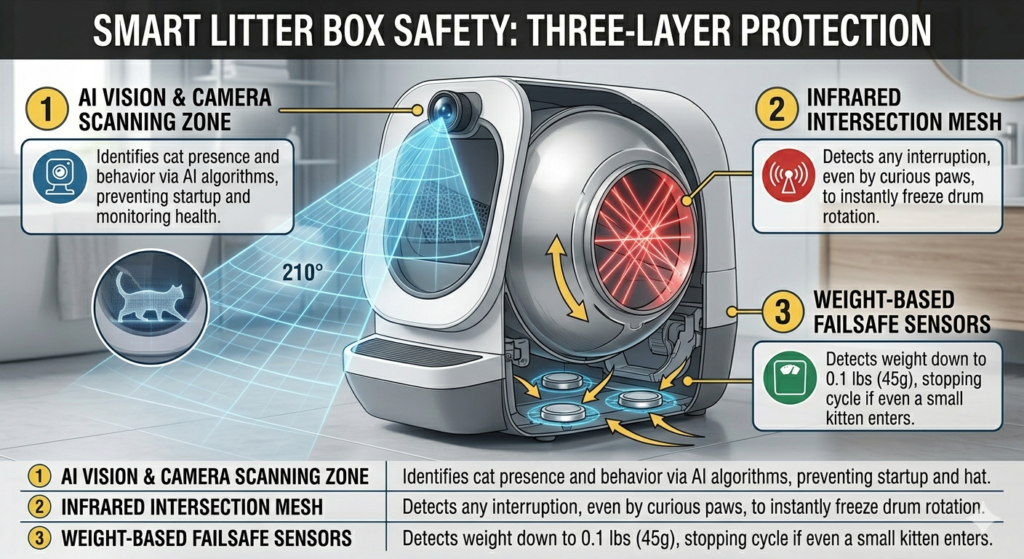
Traditional infrared sensors can be blinded by dust or stray litter. The latest high-end automatic cleaning litter box models now feature “AI Vision”—wide-angle cameras that recognize the shape of a cat. This means the machine knows the difference between a falling clump of waste and a kitten’s tail. According to a 2025 survey of feline veterinarians, AI-integrated units have reduced mechanical-related injuries by nearly 85% compared to legacy models.
Weight-Based Failsafes (The 0.1 lb Precision)
A reliable automatic litter box must have high-precision load cells at the base. In 2026, the standard is a sensitivity of 0.1 lbs (approx. 45g). This is crucial because even a tiny kitten—too light for older sensors—should trigger an immediate motor kill-switch if they step on the step or enter the drum mid-cycle.
5 Critical Safety Risks to Avoid This Year
Even with advanced engineering, no machine is 100% autonomous. The biggest mistake owners make is trusting the tech too much.
- The “Kitten Gap” (Under 3 lbs): Most manufacturers state that an automatic litter box should not be used in “Auto Mode” for kittens under 3 lbs. Their weight is often too light to reliably trigger safety sensors. Pro Tip: Keep the machine in “Manual Mode” until your kitten reaches 6 months old.
- The “Guillotine” Design Flaw: Avoid models where the waste port creates a “closing gap” or scissor effect. In 2026, the safest models use Open-Structure designs where no two moving parts can trap a limb.
- Sensor Blind Spots: Some drum-style boxes have a “dead zone” at the very back. If a cat enters through the side or hangs their head out, the sensors might not “see” them.
- Connectivity Glitches & Offline Logic: If your box relies entirely on the cloud to function, a Wi-Fi outage could leave the box stuck in a “dump” position. Ensure your model has Local Offline Logic so it stays safe even without internet.
- Dust & Respiratory Stress: Low-quality motors can kick up fine clay dust during rotation. For breeds like Persians or Ragdolls, this constant fine dust can lead to chronic respiratory irritation.
The Psychological Impact: Preventing Litter Box Aversion
We often focus on physical safety, but mental health is just as important. If an automatic cleaning litter box makes a sudden “clunk” or starts rotating while the cat is still nearby, it can trigger Litter Box Aversion—leading to “out-of-box” urination (乱尿).
The Noise Threshold
Cats hear frequencies we can’t. A motor that sounds “quiet” to you might sound like a jet engine to them. Look for models with a noise level under 45dB. If your cat associates the bathroom with a scary, moving monster, they may start finding “safer” places to go—like your laundry basket.
Scent and Territory
Cats use scent to feel secure. An automatic cleaning litter box that whisks away waste too quickly (e.g., within 1 minute) can sometimes leave a cat feeling disoriented. In 2026, the trend is moving toward 15-minute delayed cleaning cycles, giving the cat’s scent enough time to linger before the machine resets.
Decision Guide: What is the Best Automatic Litter Box for Your Home?
When readers ask me, “What is the best automatic litter box?”, I look at these three categories:
| Cat Profile | Recommended Type | Why? |
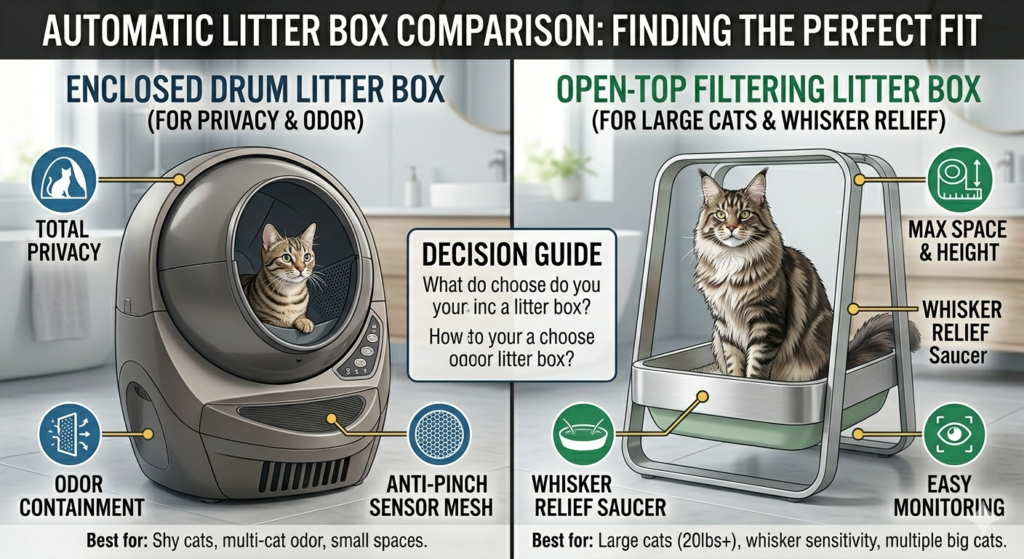
| Large Breeds (Maine Coons) | Open-Top/Extra Large | Prevents claustrophobia and “bad aim” issues. |
| Multi-Cat Households | AI Vision Rotating Drum | Best for tracking individual health data for each cat. |
| Elderly or Arthritic Cats | Low-Entry Front Loaders | Minimizes joint pain when stepping into the box. |
(The 14-Day Transition Protocol)
- The “Old Box” Anchor: Never throw away your old scoopable box on day one. Place the new automatic litter box next to it and stop cleaning the old one. Eventually, the cat will prefer the “clean” smart box over the “dirty” manual one.
- Monthly Deep Scans: Even with self-cleaning, bacteria and biofilms build up on the liner. Use a pet-safe enzyme cleaner to scrub the drum once a month to prevent urinary tract infections (UTIs).
- Weekly Sensor Wipe: Use a dry microfiber cloth to wipe the AI camera and infrared sensors. A single stray hair can block a sensor and cause a malfunction.
Frequently Asked Questions (FAQ)
Q: Can I use any litter in an automatic cleaning litter box? A: No. Most require high-quality clumping clay or specifically formulated “tofu” litters. Lightweight or non-clumping litters can jam the internal rake or rotation gears.
Q: Will the machine trap my cat inside if the power goes out? A: Reputable 2026 models feature a “Gravity-Fall” failsafe or an open-drum design that ensures a cat can always walk out, even if the motor loses power mid-cycle.
Q: Is it safe for a household with a curious dog? A: Look for “top-entry” or “shielded” models. Some smart boxes can detect a dog’s snout and lock the cleaning cycle to prevent “snack hunting” (coprophagia).
Conclusion: A Smart Move for a Healthier Home
An automatic litter box is more than just a gadget; it’s a commitment to a cleaner, more hygienic home for both you and your cat. By prioritizing Active Safety, respecting your cat’s psychological need for a quiet environment, and choosing a model with redundant sensors, you can enjoy the “scoop-free” life with total peace of mind.
Mild suggestion: Technology should serve the cat, not just the owner. If your cat seems genuinely terrified of the machine after a two-week trial, listen to them. Sometimes, a high-quality manual box is the ultimate act of love for a sensitive soul.