
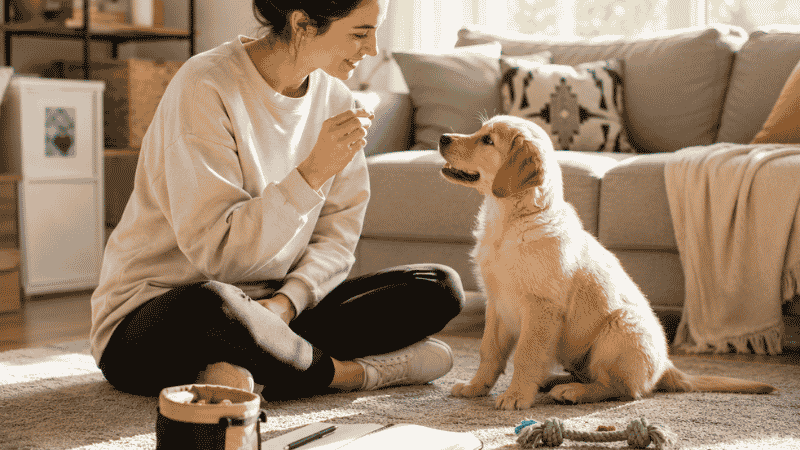
Everyone who has ever brought a puppy home has had this moment: you look at this small, chaotic, adorable creature standing in a puddle of their own making, chewing the corner of your phone charger, and you think — where do I even begin?
The answer is: here, and now. Not in a few weeks when they’ve “settled in.” Not at six months when you think they’ll be more ready. Right now, today, from the moment they came through your door.
Training a puppy is not about teaching them to perform tricks on command. It’s about giving them the communication tools and behavioral foundation they need to live happily in a human world — a world full of rules that make no instinctive sense to a dog. The earlier and more consistently you build that foundation, the easier everything else becomes: the vet visits, the house guests, the walks, the decade of life you’ll share together.
This is the guide that covers all of it. Not just sit and stay — but potty training, biting, crate training, leash walking, socialization, and what to do when nothing seems to be working. Use it as your complete training reference for the first year, and follow the links throughout to dive deeper into each topic.
Key Takeaways
- Start training the day your puppy comes home — around 8 weeks old. Every day of delay is a day of missed opportunity during the most powerful learning window of their life.
- Positive reinforcement is the only evidence-based training method. Reward what you want, ignore or redirect what you don’t. Punishment-based training produces fear and inconsistent results.
- Three to five minutes per training session, three to five sessions per day. Short, frequent, and always ending on a success.
- Consistency across every person in your home is the single most important factor. One person letting things slide undoes everyone else’s work.
- Training is a first-year commitment, not a two-week project. The puppies that grow into genuinely well-mannered adult dogs are the ones whose owners showed up consistently — five minutes at a time — for twelve months.
The Foundation: How Puppy Training Actually Works
Before the commands, the schedules, and the techniques, there are two principles that every training decision should be based on. Get these right and every other technique works better. Miss them and no technique will work reliably.
Principle 1: Positive reinforcement
Positive reinforcement means adding something desirable immediately after a behavior to make that behavior more likely to happen again. In practice: your puppy sits, you immediately give a treat. Over repetitions, sitting becomes an automatic, strongly reinforced behavior.
This is not the same as bribery. Bribery means your puppy only performs when they can see the treat first. Positive reinforcement means the behavior comes before the reward — and the puppy learns to offer the behavior reliably because it reliably pays off.
The alternative — punishment-based training — can suppress behaviors in the moment but does not build the strong, dopamine-reinforced neural pathways that make behaviors reliable under all conditions. It also introduces fear and anxiety into the training relationship, which directly impairs learning. The American Veterinary Society of Animal Behavior’s official position is that aversive training methods carry significant behavioral risks and are less effective than positive reinforcement for long-term outcomes.
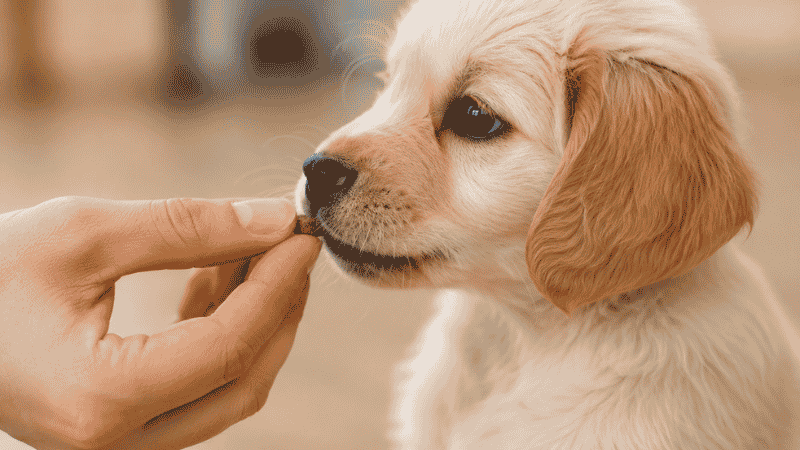
What positive reinforcement looks like in practice:
- A tiny, high-value treat delivered within 1 to 2 seconds of the correct behavior
- Enthusiastic verbal praise: “Yes! Good girl!” delivered in the moment
- A play session or toy as a reward for puppies who are more toy-motivated than food-motivated
- Life rewards: the door opens, the leash goes on, the food bowl goes down — all contingent on the requested behavior first
Principle 2: Timing and consistency
The reward must arrive within 2 seconds of the behavior to create a clear association. A treat delivered 10 seconds after your puppy sat is a treat for whatever your puppy was doing 10 seconds later — which might be standing, sniffing the floor, or looking at a bird.
This is why marker training — using a precise signal (“Yes!” or a click) at the exact moment of correct behavior, followed by the reward — is so effective. The marker bridges the gap between behavior and reward, giving you time to reach for the treat without losing the timing.
Consistency means: every person who interacts with your puppy uses the same cues, the same rules, and the same responses, every single time. A puppy who gets on the sofa sometimes and is corrected other times doesn’t learn the rule — they learn that the rule is unpredictable, which is the same as no rule at all.
When to Start: The Training Window You Cannot Afford to Miss
The answer to “when should I start training?” is always the same: the day your puppy comes home. Usually around 8 weeks old.
Puppies at 8 weeks are not too young. Their brains are in a period of extraordinary neuroplasticity — the capacity to form lasting behavioral patterns from experience is higher right now than it will ever be again. The same brain that makes a puppy seem chaotic and distractible is the same brain that encodes training experiences deeply and durably.
The critical socialization and learning window runs from 8 to approximately 16 weeks. During this period:
- New experiences are processed with curiosity rather than fear
- Behavioral patterns established now go in deep and are highly stable
- The groundwork for every future training success is laid
At approximately 5 to 7 months, most puppies enter adolescence — a hormonal phase of increased independence, reduced responsiveness to previously learned cues, and significantly lower impulse control. Puppies who arrive at adolescence with 4 to 5 months of consistent training behind them navigate it incomparably better than those for whom training is just beginning.
Waiting until 6 months doesn’t give you the same result as starting at 8 weeks. It puts you behind before you’ve begun.
→ For the complete age-by-age training timeline including what to teach at 8 weeks, 12 weeks, 4 months, and through adolescence, read: When to Start Training a Puppy
The 5-Minute Rule: The Most Important Training Mechanic
Keep each training session to 3 to 5 minutes. This is not a suggestion — it’s the single most evidence-aligned training practice for young puppies, and the most consistently ignored.
The prefrontal cortex — the brain region responsible for sustained attention, impulse control, and deliberate learning — is one of the last areas to mature in dogs. In young puppies, it fatigues rapidly. After 5 minutes of deliberate training, most puppies cannot process new information effectively. They lose focus, start making errors they weren’t making earlier, and the session becomes frustrating for both of you.
The correct structure:
- 3 to 5 minute sessions, 3 to 5 times daily
- Every session ends on a success — if your puppy is struggling, drop back to a simpler known behavior and reward that
- Build training into natural daily transitions: before meals, before going outside, during commercial breaks, while the kettle boils
Ten short positive sessions across a day produces more learning, better retained, than two long ones.
The Essential Training Areas: What to Teach and When
1. Potty Training — Start Immediately
Potty training is the first priority from day one, before any command training. It runs parallel to everything else in the first months and determines your home’s livability during the puppy period.
The core mechanics:
The schedule: Take your puppy outside immediately upon waking (every nap and every morning), within 15 minutes of every meal, after every play session, and every 1 to 2 hours during the day for puppies under 12 weeks. As bladder control develops (roughly 1 hour per month of age), the interval gradually extends.
The reward: The moment your puppy eliminates outdoors — not after you’ve walked back inside — deliver enthusiastic praise and a treat. The reward must be immediate to create the association.
Accidents: Say nothing when you find an accident after the fact. A puppy cannot connect your reaction to something that happened even 60 seconds ago. Clean thoroughly with enzymatic cleaner — standard household products leave scent residue that attracts your puppy back to the same spot.
The supervision rule: When your puppy is not outside and not confined, your eyes are on them. Watch for pre-elimination signals — circling, intense floor sniffing, stopping play suddenly — that give you the 10 to 15 seconds you need to get outside in time.
Most puppies are reliably house-trained between 4 and 6 months with consistent management. Small breeds often take until 7 to 9 months due to smaller bladder capacity.
→ For the complete potty training schedule by age, apartment-specific guidance, and accident clean-up protocol, read: How to Potty Train a Puppy
2. Crate Training — Building the Safe Space
The crate (kennel) is one of the most valuable tools in the first year — for potty training, for safe confinement when you can’t supervise, and for giving your puppy a calm retreat to decompress. But it only works if the crate is introduced as a positive space, not as a confinement measure.
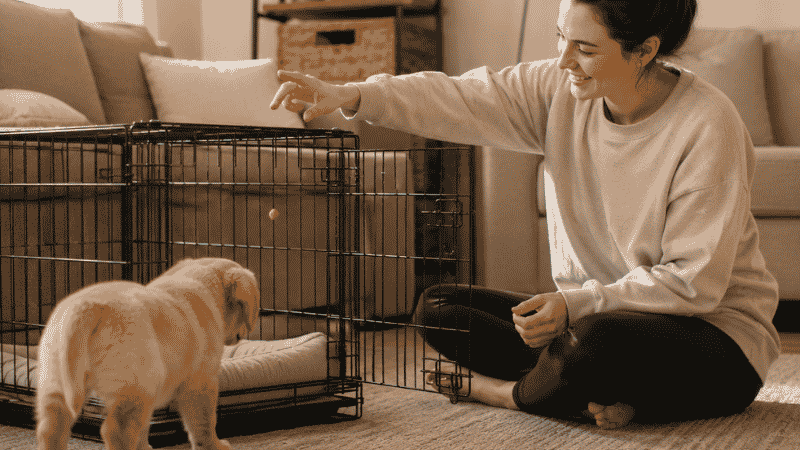
The introduction process:
Day 1: Leave the crate door open with a blanket inside that smells like you. Toss treats near, then inside, the entrance. No pressure to enter.
Days 2 to 3: Feed meals inside the crate. Still no closing the door.
Days 4 to 5: Begin closing the door briefly — 30 to 60 seconds — while you sit right next to the crate. Open before any distress. Give a Kong filled with peanut butter or a puppy chew to create a positive association with the door being closed.
Days 6 onward: Gradually increase duration. Most puppies are comfortably settling in a closed crate for 1 to 2 hours within the first 10 to 14 days of this process.
The cardinal rules:
- Never use the crate as punishment
- Never leave a puppy in the crate longer than their bladder capacity (1 hour per month of age, plus one)
- Place the crate where your family spends time — isolation in a laundry room or garage creates anxiety, not calm
→ For complete crate size guidance, type comparisons, and common crate training mistakes, read: What Puppy Kennel Do You Actually Need?
3. The 5 Basic Commands — In Order of Priority
These five commands form the behavioral foundation for everything else. Teach them in this order — each one builds on the previous.
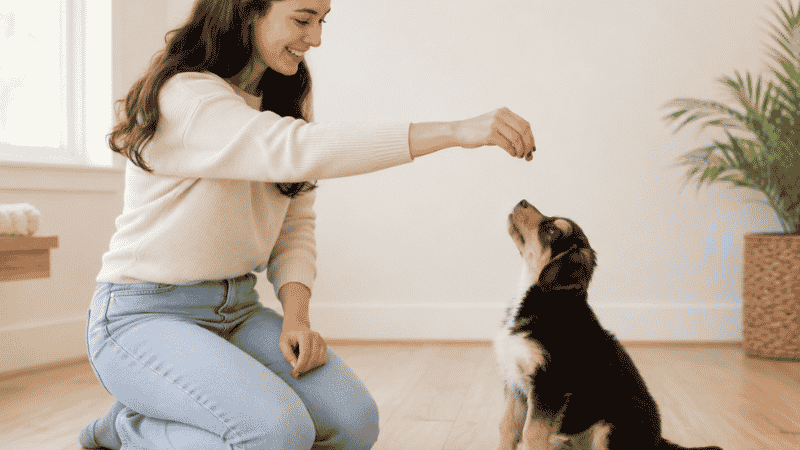
Command 1: Name Recognition Before anything else, your puppy needs to reliably orient to their name. Say their name in a happy tone. The moment they look at you, reward immediately. Practice dozens of times daily for the first week. Never use your puppy’s name as a correction (“No, Bailey!”) — their name should only predict good things.
Command 2: Sit Hold a small treat at your puppy’s nose. Slowly move it back over their head — as their head follows the treat upward, their bottom naturally drops. The moment it touches the ground, say “sit” and reward immediately. Within 3 to 5 sessions, most puppies understand the association. Within one week of consistent daily practice, most will sit reliably on cue.
Real-life value: Sit is the foundation for almost everything else — it’s the behavior you ask for instead of jumping on guests, instead of rushing through the door, instead of pulling toward other dogs on a walk.
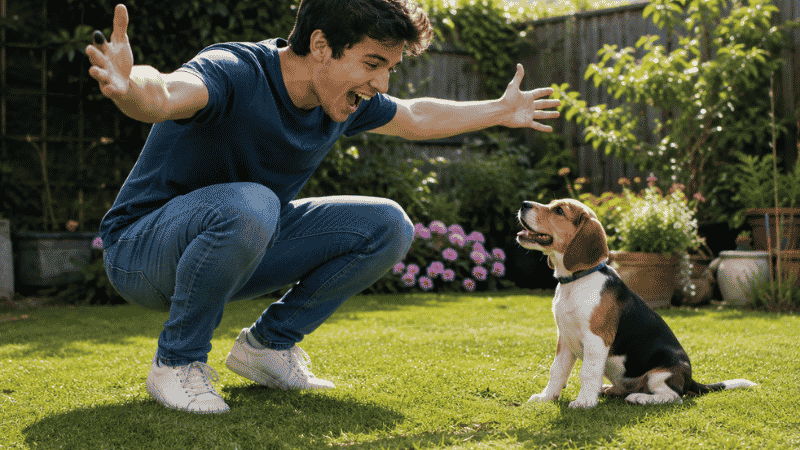
Command 3: Come Begin indoors, low distraction. Crouch down, open your arms, say “come” in the most exciting voice you have, and reward extravagantly when they reach you. Never call your puppy to come for anything unpleasant — nail trims, baths, being put in the crate. Come should predict only wonderful things, every single time.
Real-life value: A reliable recall is the most important safety behavior your dog will ever have. It can stop them from running into traffic, approaching an aggressive dog, or eating something dangerous. It deserves the highest rewards you have, every time.
Command 4: Stay Begin with a single second. Ask for a sit, say “stay,” pause one second, return to the puppy and reward — before they get up. Build duration before distance: your puppy should stay for 30 seconds with you right next to them before you try staying for 5 seconds from across the room.
Real-life value: Stay prevents your puppy from rushing through open doors, bolting from the car, or charging toward visitors when they arrive.
Command 5: Leave It Place a treat on the floor and cover it with your hand. When your puppy stops nosing at your hand and pauses, mark with “yes!” and reward with a different, higher-value treat from your other hand. Gradually progress to uncovered treats, then to items on the ground during walks.
Real-life value: Leave it can stop your puppy from eating something toxic on a walk, chewing a dangerous object, or engaging with something you don’t want them to. It is genuinely a safety command.
4. Stopping Puppy Biting — The Parallel Training Track
Biting is not aggression. It’s a normal developmental behavior — puppies use their mouths to explore, play, and relieve teething discomfort. But it requires consistent training that runs parallel to everything else in the first 16 weeks.
The core method:
The instant teeth make contact with skin: all movement stops, no eye contact, no reaction. Wait 3 to 5 seconds of calm, then offer a chew toy. When they take the toy, resume positive interaction. The message: biting ends the fun, the toy continues it.
For puppies who escalate rather than redirect: a brief time-out — 60 to 90 seconds behind a gate or in a puppy-safe room — communicates that biting ends the entire social situation.
Common mistake: rough play with hands. Wrestling your fingers, letting puppies bite hands during play, or allowing “just small bites because they’re little” teaches your puppy that hands are appropriate chew toys. They aren’t, and the behavior that’s cute at 10 weeks is painful at 5 months.
Most puppies show meaningful improvement within 2 to 4 weeks of consistent training and resolve fully between 4 and 7 months as teething ends and impulse control develops.
→ For the complete biting guide including the age-by-age breakdown, the family consistency plan, and when to seek professional help, read: How to Stop Puppy Biting
5. Leash Training — Walking Without Pulling
Leash training begins indoors, before you ever take a walk outside. The collar or harness goes on first, inside, where your puppy can get used to the sensation without external distractions.
Step 1: Let the puppy wear the harness indoors for short periods, pairing it with treats. The harness predicts good things.
Step 2: Clip the leash and let it drag indoors. Walk around, reward your puppy for staying near you.
Step 3: First outdoor walks in low-distraction environments — quiet streets, early mornings, areas without heavy dog traffic. Keep them short (5 to 10 minutes maximum for young puppies).
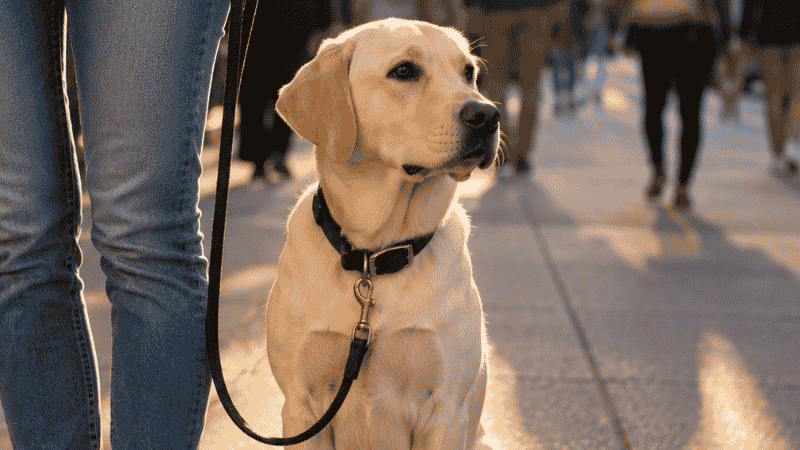
Step 4: Teaching the loose leash. The moment your puppy pulls: stop completely. Only move forward when the leash is loose. Reward generously when your puppy checks in with you voluntarily — turns their head to look at you while walking. This voluntary check-in is the behavior you’re building toward.
What leash training is not: jerking the leash, pinch corrections, or any aversive response to pulling. These don’t teach the puppy what to do — they only temporarily suppress what they’re doing.
Progress timeline: most puppies begin walking on a consistently loose leash by 5 to 6 months with daily practice. Some take longer. Large, high-energy breeds typically require more repetitions than calmer breeds.

6. Socialization — Training the Brain, Not Just the Behavior
Socialization is training — one of the most important forms of it — but most owners don’t think of it that way because it doesn’t involve commands.
Socialization means systematically and positively exposing your puppy to the full range of people, animals, environments, surfaces, and sounds they’ll encounter throughout their life. The goal isn’t to make your puppy love everything — it’s to make them neutral about everything. A puppy who encounters a child on a bicycle, a person in a hat, a slippery floor, or a thunderstorm with curiosity or indifference rather than fear is a puppy who has been socialized.
The window for this work closes at approximately 16 weeks. After that, the brain’s fear response matures, and the same experiences that would have been processed as neutral at 10 weeks may trigger genuine anxiety.
What socialization includes:
- People of all ages, appearances, and clothing styles
- Other vaccinated, friendly dogs
- Varied surfaces: hardwood, grass, gravel, grates, wet pavement
- Sounds: traffic, crowds, construction, thunder recordings at low volume
- Handling: ears, paws, mouth, tail — building tolerance for vet and grooming procedures
- Urban environments, cars, elevators, crowds (observed safely from your arms before vaccinations are complete)
The AVSAB is explicit that the behavioral risks of under-socialization outweigh the disease risks of careful, pre-vaccination exposure. Socialization should begin before the vaccine series is complete — with appropriate precautions.
→ For the complete socialization checklist, the safe pre-vaccination protocol, and how to read puppy stress signals, read: Puppy Socialization: The Complete Guide
The Daily Training Schedule That Works
Here is a realistic daily training structure for a working owner with a puppy 8 to 12 weeks old. Adjust timing to your schedule — the principle is brief, frequent, and built into natural transitions.
| Time | Activity |
|---|---|
| Morning wake-up | Outside immediately for potty |
| Before breakfast | 5-minute training: name recognition + sit |
| After breakfast | Outside for potty (15 minutes after eating) |
| Mid-morning | 5-minute training: come + handling practice |
| Midday | Outside for potty + short socialization outing |
| Afternoon | 5-minute training: stay introduction + leave it |
| Before dinner | 5-minute review: sit + come + anything learned this week |
| After dinner | Outside for potty |
| Before bed | Final potty outside + kennel settling |
Total training time: 20 to 25 minutes of active sessions. Potty and kennel: Woven into every transition — not counted separately.
As your puppy grows and sessions lengthen slightly (not dramatically), add complexity to each session rather than length. By 4 to 5 months, sessions of 5 to 8 minutes are appropriate. By 6 months, 10-minute sessions are manageable for most puppies.
Why Your Training Isn’t Working — A Diagnostic Checklist
This is the section most training guides don’t include. If you’ve been training consistently and not seeing progress, work through this checklist before concluding that your puppy can’t learn or that you’re doing it wrong.
Check 1: Are your sessions too long? If you’re training for 15 to 20 minutes at a stretch, your puppy is mentally exhausted before the session ends. The learning stops long before you do. Cut to 5 minutes and watch what changes.
Check 2: Is your treat valuable enough? A dry kibble in a distracting environment is not competitive with squirrels, other dogs, and interesting smells. In novel environments, use higher-value rewards — small pieces of boiled chicken, cheese, or commercial high-value training treats. The reward has to be worth more than whatever is competing for your puppy’s attention.
Check 3: Are you repeating cues? “Sit. Sit. Sit. Sit — come on, sit!” teaches your puppy that the first cue is optional and that you’ll keep repeating yourself until they respond. Say the cue once. If no response, lure the behavior, reward, and practice more before asking without the lure again.
Check 4: Is everyone in the house consistent? One person letting the puppy jump on them, or using a different cue word for the same command, or allowing behavior that others are correcting — this is training inconsistency, and it is the most common reason puppy training stalls. Sit down with everyone in the household and agree on the rules before they can be enforced.
Check 5: Are you training when your puppy is too excited or too tired? An over-aroused puppy (post-play, post-zoomies, right after waking from a deep nap) cannot focus effectively. A tired puppy is even less able. The best training moments are when your puppy is alert but calm — typically before meals rather than after activity.
Check 6: Are you ending sessions before failure? If you push past the point where your puppy is succeeding, the session ends on errors — which is the last thing your puppy experienced before training stopped. End every session with something your puppy knows well, even if it’s just their name, so the final experience of the session is always a win.
Check 7: Have you been training for at least two weeks consistently? Two days of training is not enough to evaluate whether it’s working. Most reliable behavior acquisition takes 2 to 4 weeks of consistent daily practice. If you’ve been genuinely consistent for four weeks and are seeing no progress, consult a certified professional dog trainer.
The Training Tools Worth Having
You don’t need much. But these items make a meaningful difference.
High-value training treats: Small (pea-sized), soft, and genuinely exciting. Boiled chicken, cheese, commercial training treats. Whatever your puppy finds most motivating — that’s your currency.
A treat pouch: Worn on your hip, keeping treats accessible within 1 second. Fumbling in your pocket during training destroys timing.
A correctly-sized kennel with a divider panel: The foundation of potty training and safe confinement. Size for your puppy’s adult dimensions, use the divider to make it smaller now.
A Y-shaped or H-shaped harness: For leash training and all outdoor activity. The leash clips to the harness, not the collar. The collar carries ID tags.
Enzymatic cleaner: For potty training accidents. Standard cleaners don’t break down urine compounds completely — enzymatic formulas do, eliminating the scent marker that attracts puppies back.
A long line (10 to 15 foot leash): For practicing recall in larger spaces while maintaining control. Invaluable for the come command.
Common Puppy Training Mistakes
Starting too late. By far the most consequential. Every week of the 8 to 16 week window that passes without training is a week of missed neurological opportunity.
Inconsistent household rules. If the puppy is sometimes allowed on the sofa and sometimes not, there is no rule. Decide before the puppy arrives and apply consistently.
Using punishment for accidents. Rubbing a puppy’s nose in a potty accident, yelling, or any physical correction for elimination indoors achieves nothing and damages trust. Puppies cannot connect punishment to something that happened more than a few seconds ago.
Rough play with hands. Teaching the puppy that hands are toys creates a problem you’ll spend months untangling. All play goes through toys.
Giving up during adolescence. At 5 to 7 months, many puppies seem to forget everything they learned. This is temporary. Maintaining training through adolescence is what produces reliable adult behavior — stopping training is the worst response to adolescent regression.
Training only when convenient. Sporadic training around a busy schedule produces sporadic results. Five minutes per day, every day, is worth more than 30 minutes twice a week.
When to Get Professional Help
Most puppies with consistent at-home positive reinforcement training develop into well-mannered adult dogs. Some situations benefit from professional support:
- Biting that breaks skin regularly in a puppy older than 4 months, despite 4+ weeks of consistent training
- Significant anxiety or fear responses that don’t improve with gradual exposure and desensitization
- Aggression signals: growling, snapping, or stiff body language around food, toys, or people
- Any behavior that feels unsafe or that you’re genuinely unsure how to address
A certified professional dog trainer (CPDT-KA credential) or certified applied animal behaviorist (CAAB) is the appropriate professional for training issues. For severe behavior problems or suspected anxiety disorders, a veterinary behaviorist (DACVB) — who can combine behavioral medication with training — is the highest level of specialist available.
FAQ: What New Puppy Owners Actually Ask
What is the first thing to train a puppy? Name recognition first, then sit, then come. These three form the practical communication foundation for everything that follows.
How long does it take to train a puppy? Basic commands can be reliably learned within 2 to 4 weeks of consistent daily practice. House training takes 4 to 6 months for most puppies. Full behavioral maturity — the point where training feels truly complete and reliable — typically arrives around 18 to 24 months, though most of the hard work is done by 12 months.
What is the hardest thing to train a puppy to do? For most new owners: recall (come), because it requires the highest level of real-world reliability in high-distraction situations. A sit at home is easy. A sit at a dog park with other dogs running around is the result of months of work.
Should I use a clicker for training? A clicker is a useful marker — it produces a precise, consistent sound that marks the exact moment of correct behavior. It is not necessary. “Yes!” spoken consistently and enthusiastically works equally well. If you enjoy using a clicker and are good at timing it accurately, use it. If it adds complexity, skip it.
How do I train a puppy that isn’t food motivated? Try different food types — some puppies are picky. Boiled chicken, cheese, and hot dog pieces tend to work for puppies that don’t respond to kibble or commercial treats. If food truly doesn’t motivate your puppy, use toys — a brief game of tug or a toss of a ball as a reward. Find what your specific puppy values most and use that.
Can you over-train a puppy? Yes — in the sense that sessions that are too long or too frequent without adequate rest produce diminishing returns and sometimes avoidance of the training context. The solution is shorter, higher-quality sessions with rest between them, not more training.
My puppy knows a command at home but ignores it outside — why? This is called a lack of “proofing” — the behavior has been learned in one context (home) but not generalized to other contexts. It is not regression and it is not defiance. Practice known commands in gradually more distracting environments, lowering your expectations each time you introduce a new location, and building back up. This process takes time and is completely normal.
The Bottom Line
Training a puppy is not a single project with a completion date. It’s a first-year commitment that happens in five-minute increments, built into the texture of your daily life together.
The puppies that grow into genuinely easy-to-live-with adult dogs are not the ones who attended the most expensive training program. They’re the ones whose owners started the day they came home, stayed consistent through the exhausting parts, maintained training through adolescence when it felt like it wasn’t working, and kept going until it did.
You don’t need to be a professional trainer. You don’t need expensive equipment. You need to understand how your puppy learns, commit to five minutes a day, and keep every interaction working toward the dog you want to be living with in five years.
That’s it. That’s the whole thing.

Go Deeper: The Full Puppy Training Library
This guide covers the foundation. These articles go deeper into each topic:
- When to Start Training a Puppy: Age-by-Age Guide — Exactly what to teach at 8 weeks, 12 weeks, 4 months, and through adolescence
- How to Stop Puppy Biting: The Positive Reinforcement Guide — The most urgent training challenge of the first 16 weeks
- Puppy Socialization: The Complete Guide — The socialization checklist, pre-vaccination protocol, and stress signal guide
- New Puppy Checklist: Everything You Need Before Day One — Supplies, vet booking, and setup to have ready before training begins
References
- American Veterinary Society of Animal Behavior. (2021). AVSAB Position Statement on the Use of Dominance Theory in Behavior Modification of Animals. avsab.org
- American Veterinary Society of Animal Behavior. (2021). AVSAB Position Statement on Puppy Socialization. avsab.org
- American Kennel Club / Lunchick, P., RVT KPA-CTP. (2026). Teach Your Puppy These 5 Basic Cues. akc.org
- Overall, K.L. (2013). Manual of Clinical Behavioral Medicine for Dogs and Cats. Elsevier Mosby.
- Donaldson, J. (2013). The Culture Clash (2nd ed.). Dogwise Publishing.
- Pryor, K. (2009). Reaching the Animal Mind. Scribner.
- Certification Council for Professional Dog Trainers. (2024). Standards for Professional Dog Training. ccpdt.org