
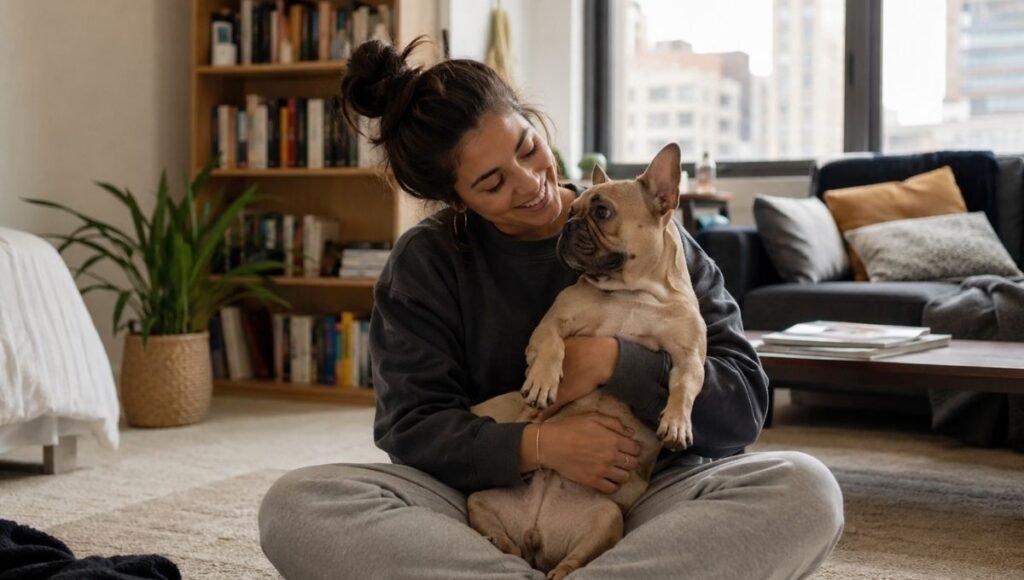
You’ve wanted a dog for years. And now you finally have your own place — even if “your own place” is a one-bedroom apartment on the fourth floor with thin walls and neighbors who can definitely hear everything.
So you’ve been doing the research. You know about French Bulldogs and Cavalier King Charles Spaniels. You’ve watched approximately forty YouTube videos. And you’ve developed a nagging suspicion that most breed recommendation articles were written by people who either don’t live in apartments or don’t work full-time jobs.
Here’s what those articles usually miss: it’s not just about whether a dog can physically fit in your apartment. It’s about whether they’ll be genuinely content there — whether they’ll handle being alone while you work, whether they’ll coexist peacefully with the family next door, and whether their care requirements will actually fit into a normal adult life.
This guide gives you the honest version. Ten breeds that are genuinely well-suited to apartment living for first-time owners, with real talk about what makes each one work — and what doesn’t.
Key Takeaways
- Size matters less than temperament and energy level. A calm 60-pound Greyhound is a better apartment dog than an anxious 10-pound Chihuahua in the wrong hands.
- Barking is the apartment-specific dealbreaker. A dog who barks at hallway sounds, elevator dings, and neighboring cooking smells will create genuine problems in shared buildings.
- The “low maintenance” label is relative. Every dog on this list needs daily walks, mental stimulation, and human connection. What varies is how much and what kind.
- Alone time tolerance is the working owner’s primary concern. No dog should be alone for more than 6 to 8 hours regularly — but some handle it significantly better than others.
- French Bulldogs are the most popular choice but come with the highest vet bills. Budget $1,000 to $3,000+ per year for health-related costs if you go this route.
What Actually Makes a Dog “Apartment-Friendly”
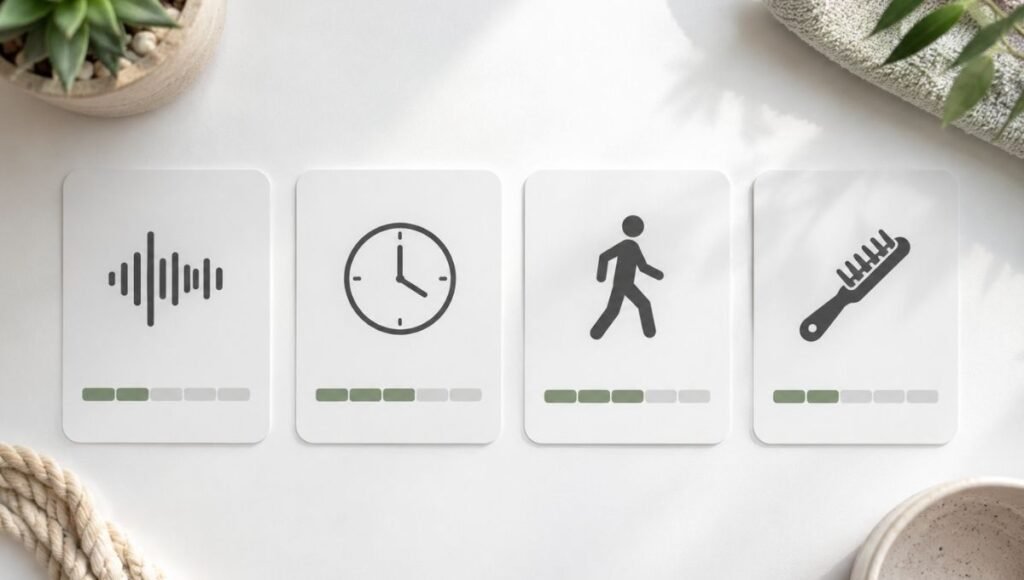
Before diving into specific breeds, it’s worth establishing what you’re actually evaluating — because most people focus on size and miss the three factors that actually determine success.
Energy level is the most important. A high-energy dog in a small space without adequate exercise becomes anxious, destructive, and vocal. You’re looking for breeds whose energy requirements you can realistically meet with two or three daily walks and some indoor play — not breeds that need two hours of running to be manageable.
Barking tendency is the apartment-specific factor that other living situations can absorb but yours cannot. A dog who barks at every sound in a hallway, at neighbors’ cooking smells, at the elevator, or at squirrels on the window ledge will create genuine conflicts with neighbors and landlords. Some breeds are naturally quiet. Others bark to communicate and need significant training to modulate this.
Alone time tolerance is the working owner reality. If you work outside the home, your dog will spend 8 to 9 hours alone on weekdays. Not every dog handles this. Breeds with higher separation anxiety don’t just bark when alone — they can become destructive, refuse to eat, or develop stress-related health issues over time.
Everything else — grooming, exercise intensity, training difficulty — is manageable. These three are the filters.
The 10 Best Dog Breeds for Apartments
1. French Bulldog — The Urban Standard (With a Caveat)
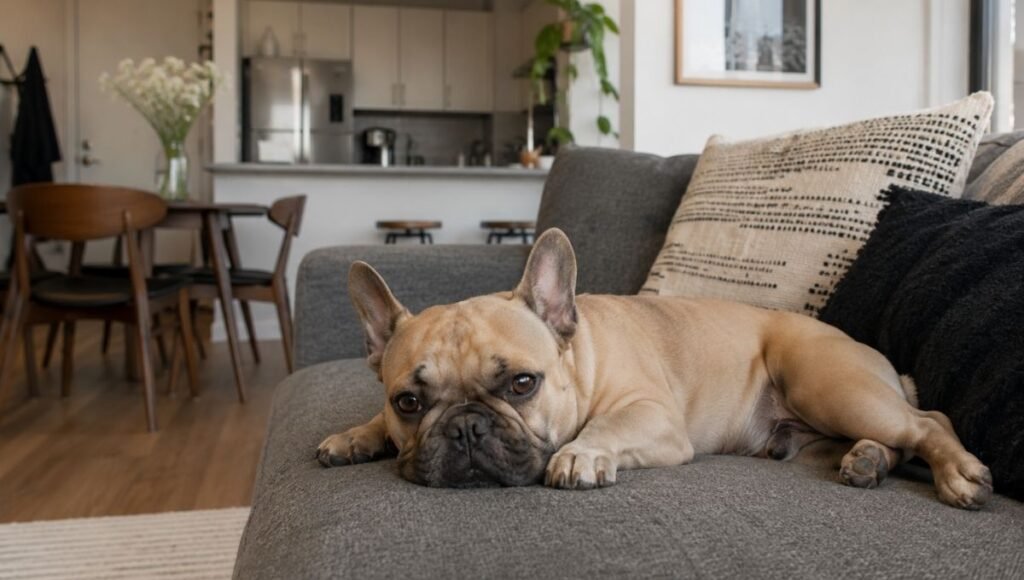
There’s a reason French Bulldogs are the most popular breed in North America, and most of those reasons apply directly to apartment living. They require minimal exercise — two short walks daily, some indoor play — are naturally quiet, and have a calm, adaptable temperament that doesn’t destabilize easily. They handle apartment sounds well. They’re affectionate without being clingy to the point of anxiety. They’re genuinely content in a small space.
The caveat, and it’s a significant one: Frenchies are brachycephalic. Their flat faces create real respiratory issues, especially in heat, which limits exercise duration and makes summer walks more complicated. More significantly, the vet bills are consistently higher than average — health issues including breathing problems, spinal conditions, and skin fold infections are common in the breed. Budget $1,000 to $3,000 per year for vet care beyond routine costs, and consider pet insurance from day one.
If you can absorb the health costs, French Bulldogs are genuinely among the best apartment dogs available. If the budget is tight, read the rest of this list.
Alone time tolerance: Moderate — they prefer company but manage Barking level: Low — not a reactive breed Exercise need: 30 to 45 minutes daily Grooming: Minimal — weekly wipe-down, skin fold cleaning
2. Cavalier King Charles Spaniel — The Gentle Option
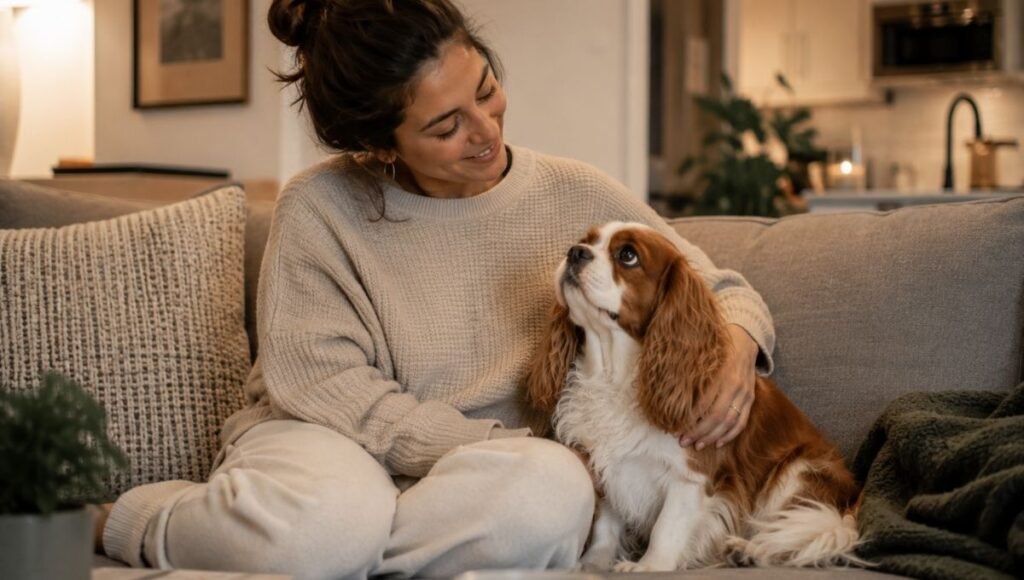
Cavaliers are the soft recommendation in this list — gentle, adaptable, naturally quiet, and genuinely happy to be wherever their person is. They’re not anxious dogs, they don’t bark at hallway sounds, and their exercise needs — one good walk daily plus some indoor play — are eminently manageable for working owners.
They’re also one of the most trainable small breeds, which matters more than people think. A dog that learns quickly means fewer accidents, faster leash training, and a smoother overall first-year experience.
The honest note: Cavaliers have documented heart issues — mitral valve disease affects a significant percentage of the breed by middle age. This is not hypothetical or rare. Budget for regular cardiac checks from age five onward and factor potential cardiac medication into long-term costs. For a first-time owner willing to understand this going in, a Cavalier is an exceptional apartment companion.
Alone time tolerance: Moderate — they bond closely but adapt Barking level: Low Exercise need: 30 to 45 minutes daily Grooming: Medium — their silky coat needs regular brushing
3. Greyhound — The Surprising Apartment Dog
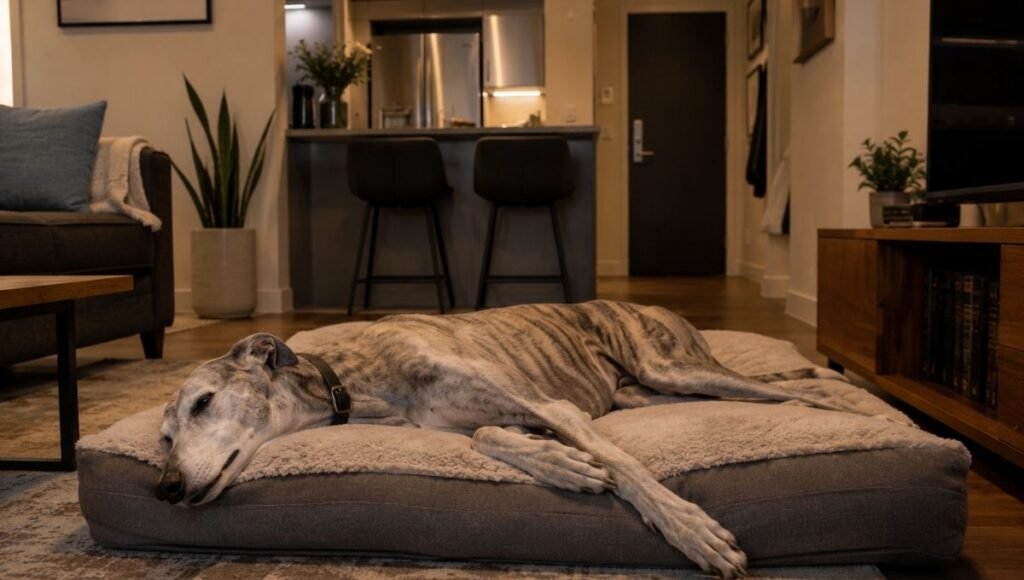
This recommendation surprises people every time, and it’s correct every time. Greyhounds — including retired racing Greyhounds — are among the most functional apartment dogs that exist. They sleep 18 to 20 hours a day. They are naturally quiet. They’re not reactive to sounds, not territorial, and have essentially no herding or guarding instincts. Indoors, they’re serene.
The exercise requirement is real but manageable: they need to sprint, which means access to a fenced area or dog park for a 20 to 30 minute run several times a week. After that, they return home and achieve a level of horizontal contentment most dogs would envy. For an owner who can meet this specific exercise need, a Greyhound is one of the most low-maintenance large dogs that exists.
Retired racing Greyhounds (available through breed-specific rescues) are already house-trained, socialized, and calm. They often adapt to apartment life within days. For a first-time owner willing to manage the sprinting requirement, they’re an extraordinary option.
Alone time tolerance: High — not prone to separation anxiety Barking level: Very low — naturally quiet breed Exercise need: Short bursts in fenced area, low daily walking needs Grooming: Minimal — short coat, minimal shedding
4. Shih Tzu — The Low-Key Companion
Shih Tzus were literally bred to be palace companions — their entire evolutionary history is “live indoors and make humans happy.” They need very little exercise, are calm by temperament, and handle apartment life naturally because they were designed for exactly this kind of existence.
They’re quiet dogs. They don’t have the reactive barking of many small breeds. They bond warmly with their people without the anxiety levels that make some companion breeds difficult. For a first-time owner who wants a genuinely low-key dog, a Shih Tzu is among the most straightforward options on this list.
The grooming consideration: their long coat requires regular brushing or professional grooming every 4 to 6 weeks if kept long. Most apartment owners opt for a practical short “puppy cut” that dramatically reduces maintenance. Factor grooming costs — $50 to $80 per appointment — into your monthly budget.
Alone time tolerance: Moderate — manage well with enrichment Barking level: Low Exercise need: Two short walks daily is sufficient Grooming: High long coat / Low short coat
5. Bichon Frise — The Hypoallergenic Pick
If allergies are a factor for you or anyone in your household, the Bichon Frise belongs near the top of your list. They produce minimal dander, shed very little, and their curly coat doesn’t release allergens the way straight-coated breeds do. They’re also cheerful, trainable, quiet, and genuinely adaptable to apartment living.
Bichons handle being alone reasonably well relative to other companion breeds — they don’t have the high separation anxiety levels of, say, a Velcro-dog breed — though they still prefer company and benefit from a predictable schedule. They’re smart enough to train easily and small enough that their exercise needs are genuinely manageable in a small space.
Grooming requires regular professional trims every 4 to 6 weeks, similar to the Shih Tzu. Budget accordingly.
Alone time tolerance: Moderate Barking level: Low to moderate — can be alert Exercise need: 30 minutes daily Grooming: High — professional trimming required
6. Basenji — The Barkless Dog
If noise is your primary concern, the Basenji is a genuinely unique option: they cannot bark. Literally cannot. They produce a yodel-like sound called a barou, which is rare and quiet. For an owner in a building with strict noise policies or particularly sound-sensitive neighbors, this is significant.
Basenjis are also self-cleaning in a way that resembles cats — they groom themselves, produce minimal doggy odor, and require almost no grooming maintenance. They’re independent by temperament, which makes them one of the breeds that handles alone time best on this list.
The honest note: their independence means they’re not particularly interested in pleasing you during training, which makes them more challenging for first-time owners. They also have significant prey drive and should never be trusted off-leash in unsecured areas. These traits require conscious management but don’t prevent apartment living — they just require understanding.
Alone time tolerance: High — independent by nature Barking level: None (produces different vocalizations) Exercise need: Moderate — daily walks plus mental stimulation Grooming: Minimal — self-cleaning breed
7. Boston Terrier — The Middle Ground
Boston Terriers occupy a useful middle ground: more trainable and people-pleasing than many small breeds, less exercise-intensive than medium breeds, naturally sociable in the apartment building environment without being reactive. They adapt well to urban living, handle meeting new people in elevators and hallways with ease, and their exercise needs — 30 to 45 minutes daily — are workable for most schedules.
They’re also naturally entertaining and genuinely affectionate, which matters for first-time owners who want a dog that actively engages with them rather than merely tolerating coexistence.
Like Frenchies, Boston Terriers are brachycephalic — flat-faced — which creates similar respiratory considerations in heat and limits high-intensity exercise. Their health issues are generally less severe than French Bulldogs’, but the same awareness applies.
Alone time tolerance: Moderate Barking level: Low to moderate Exercise need: 30 to 45 minutes daily Grooming: Minimal — short coat, easy maintenance
8. Pug — The Character Dog
Pugs are committed apartment dogs: they overheat easily (which limits outdoor exercise to cool hours), are naturally quiet, deeply human-focused without destructive anxiety, and genuinely content with a couch and proximity to their person. For a first-time owner who wants a companion animal with significant personality and minimal exercise demands, Pugs deliver consistently.
The health note applies here as well: brachycephalic breed, with documented issues including breathing difficulties, eye problems, and joint issues. Vet costs are above average. Many owners find they’re worth it; it’s information you should have before committing.
Their face and skin folds require regular cleaning to prevent infection — a simple routine that new owners sometimes underestimate. Factor this into daily care.
Alone time tolerance: Moderate Barking level: Very low Exercise need: Very low — heat limits outdoor time Grooming: Low coat / Regular fold cleaning required
9. Maltese — The Small and Quiet Option
Maltese are naturally quiet, genuinely small (rarely exceeding 7 pounds), and have been companion dogs for literally thousands of years — their temperament for indoor life with humans is deeply embedded. They don’t need much exercise, adapt to apartment sounds without becoming reactive, and are trainable despite the “small dog” stereotype.
Their white, silky coat is beautiful and requires significant grooming to maintain — most apartment owners opt for the practical puppy cut that reduces maintenance to a manageable level. They can be prone to separation anxiety if not properly trained for alone time from an early age, which is why crate training and a consistent solo departure routine from puppyhood matters particularly for this breed.
For a first-time owner who wants a very small, quiet, low-exercise dog and is prepared to invest in grooming and early alone-time training, a Maltese is an excellent choice.
Alone time tolerance: Lower — needs training from puppyhood Barking level: Low to moderate Exercise need: Very low Grooming: High — professional trimming or regular home brushing
10. Dachshund — The Bold Small Dog
Dachshunds are curious, playful, and surprisingly adaptable to apartment life — their exercise needs are manageable, they’re genuinely engaging to live with, and they handle smaller spaces without obvious distress. They’re also considerably bolder in personality than their size suggests, which makes them less fragile-feeling than some toy breeds.
The honest consideration: Dachshunds can be vocal. They were bred to hunt burrowing animals, which required persistent vocal communication — that instinct persists. With consistent training from puppyhood and adequate mental stimulation, many Dachshunds live quietly in apartments. Without this, they can be reactive barkers. It’s breed-specific management, not an inherent disqualifier.
The other Dachshund consideration: their elongated spine makes them prone to back problems (intervertebral disc disease), which can be expensive to treat and requires weight management and care around jumping throughout their lives.
Alone time tolerance: Moderate Barking level: Moderate — requires consistent training Exercise need: 30 to 45 minutes daily Grooming: Low (smooth coat) to moderate (wire/long coat)
The “Working All Day” Reality Check
Most breed guides are written for people who are home during the day. Most first-time dog owners are not.
If you work outside the home, here’s the honest framework:
No dog should regularly spend more than 6 to 8 hours alone. This isn’t negotiable — it’s not about the breed, it’s about the social and biological needs that all domestic dogs share. For a dog spending 9 to 10 hours alone, behavioral problems, anxiety, and indoor accidents are predictable outcomes regardless of breed.
What working owners in apartments actually need:
A midday solution. Dog walker, pet sitter, neighbor, or partner — someone who breaks the alone time in the middle of the day. This is not optional for a puppy under 6 months, who cannot hold their bladder long enough to make it through a workday regardless of effort or training.
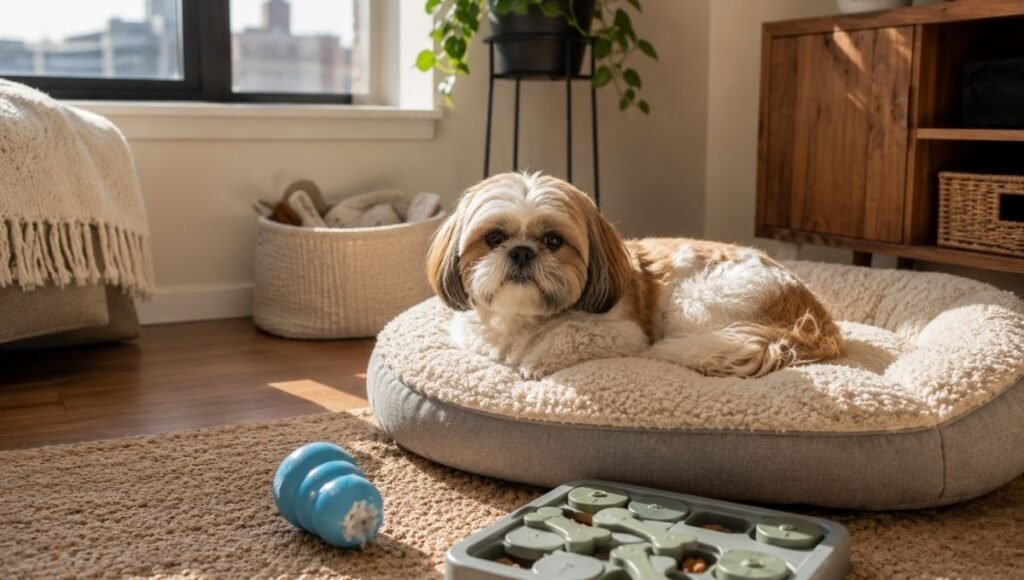
Mental enrichment. A stuffed frozen Kong when you leave, puzzle feeders, rotating toy selection — mental tiredness is as effective as physical tiredness for keeping a dog settled.
A morning routine. A 20 to 30 minute walk before you leave significantly reduces the restlessness and anxiety of the day ahead.
The breeds on this list that handle alone time best: Basenji, Greyhound, Shih Tzu, and Bichon Frise. The breeds that need the most alone-time management: Maltese, Cavalier (without early training), and Dachshund.
What to Consider Before You Choose

Your building’s rules. Many apartments have weight limits (common cutoffs: 25 lbs, 50 lbs) and breed restrictions (often targeting specific large breeds). Check your lease and building policy before falling in love with a specific breed.
Your budget. Beyond food and routine vet costs, budget for:
- Pet deposit and monthly pet rent ($25 to $100/month in many buildings)
- Grooming ($50 to $80 per appointment, every 4 to 8 weeks for some breeds)
- Dog walker ($15 to $25 per midday walk)
- Pet insurance ($30 to $60/month, more for brachycephalic breeds)
- Emergency vet fund ($1,000 minimum)
Puppy vs. adult. A puppy requires significantly more time, patience, and management than an adult dog in the first 6 months — a reality that’s harder in an apartment than in a house. An adult dog from a rescue often comes house-trained, with a known temperament, and adapts to apartment life quickly. For a first-time owner, this is worth serious consideration.
FAQ: What Apartment Owners Actually Search For
What is the best low-maintenance dog for an apartment? For genuine low maintenance in an apartment, the Greyhound (retired racing), Shih Tzu (in puppy cut), and Basenji consistently rank highest. They have minimal grooming, low to moderate exercise needs, and handle apartment sounds without reactive barking.
Can large dogs live in apartments? Yes — temperament and energy level matter far more than size. A calm, low-energy large breed like a Greyhound or Basset Hound is a better apartment dog than a high-energy small breed. The practical considerations are elevator navigation, space for a large bed, and weight restrictions in your lease.
What is the quietest dog breed for apartments? Basenjis cannot bark. Greyhounds, Shih Tzus, and Cavalier King Charles Spaniels are naturally low-vocal breeds. French Bulldogs and Pugs are also generally quiet. The breeds to avoid for noise-sensitive buildings: Beagles, most terriers, and Chihuahuas without significant early socialization and training.
Which dogs are best for owners who work full time? Greyhounds, Basenjis, and adult Shih Tzus or Basset Hounds tolerate alone time better than most breeds. No dog should be alone more than 6 to 8 hours regularly — a midday walk or visit is necessary regardless of breed for most working schedules.
Is a French Bulldog worth it for an apartment? Yes, if the budget accommodates health costs. Frenchies are exceptional apartment dogs — quiet, adaptable, low-energy, and affectionate. The trade-off is above-average vet costs (budget $1,500 to $3,000/year beyond routine care) and heat sensitivity. Pet insurance from day one is strongly recommended.
What dog breeds are good for apartments with no yard? Every breed on this list manages without a yard. The key is consistency: regular daily walks replace the yard’s function. Two to three walks daily — morning, midday if possible, and evening — provides the outdoor time dogs need regardless of yard access.
The Bottom Line
The best apartment dog for you is the breed whose specific needs you can actually meet — not the one that looks best on paper or gets the most recommendations online.
French Bulldog if you want the easiest overall temperament and can manage the health costs. Greyhound if you’re fine with sprint sessions and want a surprisingly mellow large dog. Shih Tzu if you want a quiet, low-exercise companion with minimal drama. Basenji if noise is your primary constraint and you appreciate independent personality. Cavalier if you want warm, trainable, and gentle and can plan for cardiac health monitoring.
None of these dogs will merely tolerate your apartment. With the right match and consistent care, they’ll be genuinely content there — which is the actual goal.
What to Read Next
- Best Puppy Breeds for First-Time Owners — The complete breed guide for new owners, including larger breeds that may not suit apartments but might be right for your next move
- New Puppy Checklist: Everything You Need Before Day One — What to have ready before your puppy or new dog arrives, including apartment-specific setup
- Puppy Separation Anxiety: What’s Normal and How to Fix It — Building alone-time tolerance from day one — critical for apartment dogs whose owners work full time
- How to Potty Train a Puppy: The Step-by-Step Guide — The apartment potty training timeline and what to expect without a yard
- Puppy Development Stages: Week-by-Week Guide — Understanding the first year of development helps set realistic expectations for your new apartment companion
References
- American Kennel Club. (2026). Best Dogs for Apartment Dwellers. akc.org
- Wild Earth. (2026). Best Dogs for Apartments. wildearth.com
- BusyPetParent. (2026). 15 Best Dog Breeds for Apartment Living. busypetparent.com
- American Veterinary Medical Association. (2024). Selecting a Pet. avma.org
- Serpell, J. (Ed.). (2017). The Domestic Dog: Its Evolution, Behavior and Interactions with People (2nd ed.). Cambridge University Press.