
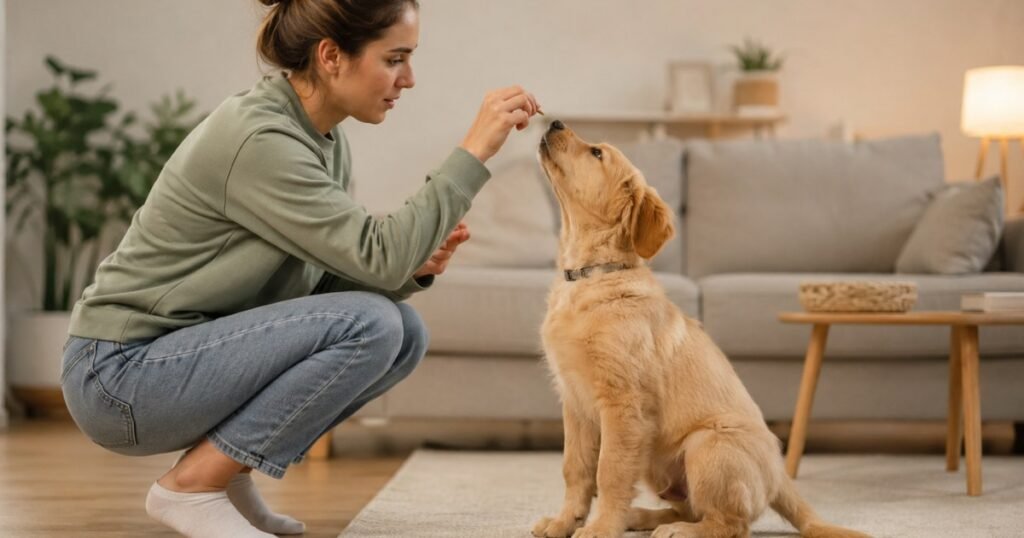
Teaching your puppy to sit sounds like it should be simple.
You hold a treat above their nose, move your hand back, their little bottom touches the floor, and everyone celebrates.
At least, that is how it looks in most training videos.
Real puppies are not always that predictable.
Some jump up trying to reach the treat. Some walk backward across the room. Some get so excited about the reward that they forget there was even a lesson happening.
If that sounds familiar, your puppy is not being stubborn or trying to ignore you. They may simply need the lesson explained in a way that makes sense to them.
This guide will walk you through the classic step-by-step sit method — but also what to do when that method does not work.
Because teaching “sit” is not just about getting your puppy into one position.
It is about creating the first small moment where your puppy looks at you and thinks:
“I understand what you’re asking me.”
And that is where real training begins.
Why Teaching Your Puppy to Sit Is So Important
Sit is the foundation. Not because it’s impressive — no one is particularly dazzled by a dog who sits — but because of what it enables.
A puppy who responds reliably to “sit” has something more valuable than a trick: they have a behavior that interrupts almost everything you don’t want them to do. Jumping on guests? Ask for a sit. Charging toward the door? Ask for a sit. Pulling toward another dog on leash? Ask for a sit. The command becomes a reset button — a way of giving your puppy something specific to do with their body when their instinct is to do something you’d rather they didn’t.
It also builds the communication foundation that everything else is built on. A puppy who learns that certain body positions produce certain outcomes — that they have genuine agency over what happens through their own choices — is a puppy who learns subsequent commands dramatically faster. Sit isn’t just sit. It’s the introduction to the system.
From a practical safety standpoint: a puppy who will sit on cue is a puppy you can manage outdoors, at the vet, at the door, and in any situation where you need stillness and focus. That reliability is worth every minute of training.
When Can You Start Teaching a Puppy to Sit?
Best Age to Start
Earlier than most people think: 8 weeks. Young puppies have short attention spans and limited frustration tolerance, but they are absolutely capable of learning sit. The key is that sessions stay short — 3 to 5 minutes maximum — and always end on a success.
The idea that you need to wait until 6 months to begin training is one of the most persistent myths in puppy ownership, and it costs owners months of the most neurologically receptive learning window a puppy will ever have. Start now.
Newly Adopted Puppy Adjustment Period
If your puppy just came home — particularly in the first 3 to 7 days — cut yourself some slack if training isn’t going smoothly. A puppy who has just left their mother and littermates, arrived in a completely unfamiliar environment, and is processing an enormous amount of new sensory input is not in an optimal learning state. They’re in adjustment mode.
This comes up constantly on forums: “I got my puppy three days ago and she won’t focus on anything.” That’s not a training problem — that’s a puppy whose nervous system is working overtime processing their new world. Give them a few days to settle, establish the basic routine, and then begin short training sessions once they seem genuinely comfortable in the environment. Most puppies are ready to engage meaningfully with training by day 5 to 7.
What You Need Before Starting Sit Training
Soft, Small Training Treats
This is not negotiable. The treats you use for sit training need to be:
Small — pea-sized or smaller. You’re going to use a lot of them in a single session. Full-sized treats lead to a puppy who fills up fast and loses motivation within minutes.
Soft — crunchy treats take time to chew, which interrupts the training rhythm. Soft treats are eaten in under a second, keeping your puppy’s attention on you rather than on chewing.
High value — something your puppy genuinely wants, not their regular kibble. Boiled chicken, soft commercial training treats, small pieces of cheese. The treat needs to be worth working for.
Training treat pouches that clip to your waist are a genuine convenience — both hands stay free, the treats are immediately accessible, and you’re not fumbling with a bag when the timing matters.
A Clicker (Optional but Useful)
A clicker is a small device that makes a distinct clicking sound when pressed. In training, it’s used to mark the exact moment your puppy does the right thing — a precision tool for communication.
You don’t need a clicker to teach sit. The word “yes” said at the right moment works the same way. But clickers are consistent — they always produce the same sound at the same volume — which makes the timing easier and the communication clearer for many puppies.
If you use a clicker, charge it first: click once, immediately give a treat, ten times in a row. Your puppy learns that the click means a treat is coming. Then the click becomes your marker.
A Quiet Training Space
Not the living room when the household is active, not near the window with squirrels, not right before dinner when your puppy is at peak energy. A quiet, low-distraction space — a bedroom, a hallway, a corner of the kitchen — removes the competition for your puppy’s attention.
A yoga mat or a piece of carpet can help for puppies who are reluctant to sit on smooth, cold floors. More on that later.
How to Teach a Puppy to Sit: Step by Step
Step 1: Get Your Puppy’s Attention
Before any training happens, you need your puppy’s focus. Crouch to their level if possible. Say their name once — just once — and wait for eye contact. When they look at you, that’s your starting point.
Don’t begin a training rep when your puppy is already distracted, mid-sniff, or moving away from you. Wait for the moment of attention, then proceed.
Step 2: Hold the Treat Near Their Nose
Let your puppy sniff the treat in your closed hand, then hold it just at nose level — close enough that they can smell it clearly, not so close that they can grab it.
The goal here is to capture their attention with the treat before you start moving it. A puppy who is tracking the treat is a puppy who is set up for the next step.
Step 3: Move the Treat Slowly Over Their Head
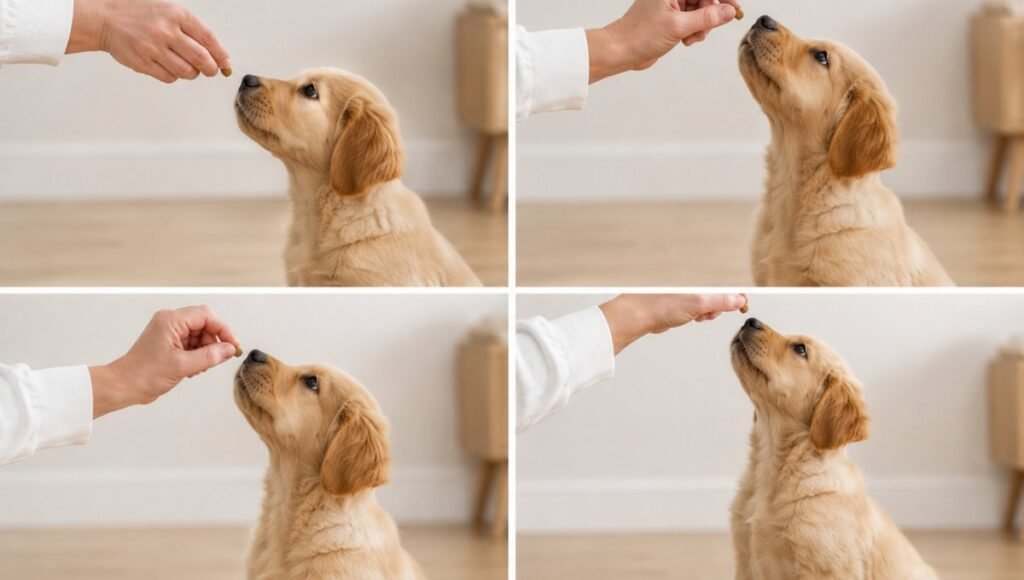
Here’s where most people go wrong: they move the treat too high, too fast.
Move the treat slowly — slower than you think you need to — from nose level back over the top of your puppy’s head, following the line of their skull. The physics of this: as the treat moves backward and upward, your puppy’s nose follows it, their head tilts back, and their bottom naturally goes down toward the floor to maintain balance.
The treat should stay close to the head — not an arm’s length above it. If the treat is too far up, your puppy jumps. If the treat moves backward too fast, they back up. Slow and close is the key.
Step 4: Mark the Moment They Sit
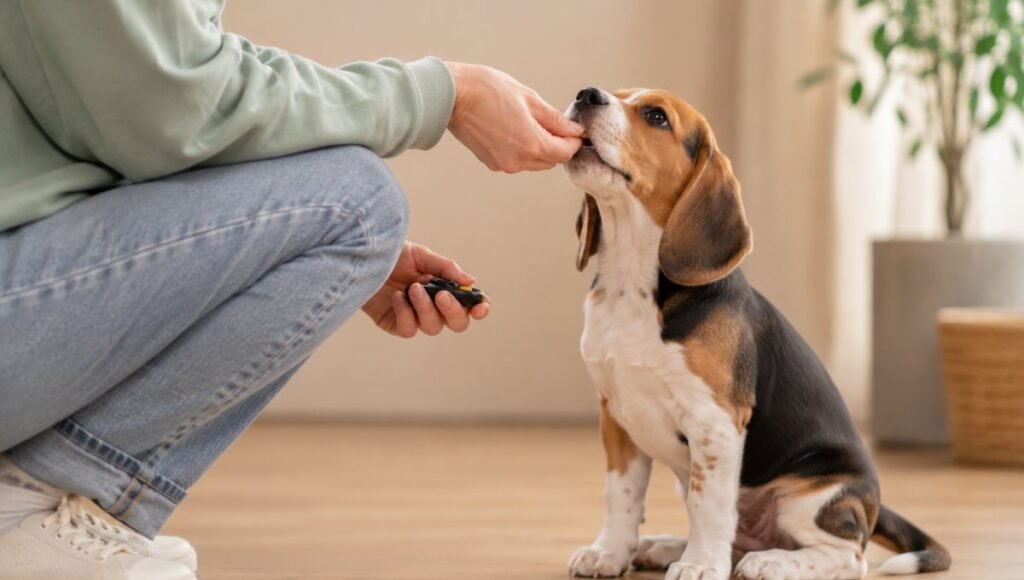
The instant — and this timing matters — the instant your puppy’s bottom touches the floor, click (or say “yes”) and deliver the treat. Not a second later. The mark and the reward need to happen within 1 to 2 seconds of the correct behavior.
If your timing is off by 3 or 4 seconds, you’re marking whatever the puppy is doing at the moment the reward arrives, which may no longer be sitting. Precision here is what makes the method work.
Step 5: Add the Word “Sit”
Here’s the counterintuitive part: don’t say “sit” yet.
Most people say “sit, sit, sit, sit” throughout the luring process and wonder why their puppy eventually tunes it out. The word should be introduced only after your puppy is reliably following the treat lure into the sitting position — typically after 10 to 20 successful reps where they’re doing it predictably. Then say “sit” once, just before you begin the lure movement.
Over repetitions, the word becomes a cue that predicts the movement sequence and the reward. Eventually, the word alone is enough — the lure isn’t needed. But adding the word too early just turns it into noise.
Step 6: Practice Short Sessions Daily
Three to five minutes, two or three times per day. That’s it.
Ending the session when your puppy is still engaged — still getting things right, still motivated — produces faster learning than grinding through a long session until they’ve checked out. Always end on a success.
Consistency over days produces results. Intensity in a single session does not.
Why the Treat Method Doesn’t Work for Some Puppies
If the lure method isn’t producing the sit you expected, one of three things is almost certainly happening.
The puppy is too excited. A highly aroused puppy — one who is bouncing, barking, or doing zoomies — cannot process and execute a precise behavior. You can’t lure a puppy into a sit when their body is in a state of high arousal. The fix is to settle the energy first: go for a short walk, do some free sniffing time, let the excitement level drop, then try the session.
The treat is in the wrong position. If the treat is too far above the puppy’s head, they jump. If it moves too fast, they back up. This is mechanics, not intelligence. Slow down, bring the treat closer to the head, and try again.
The treats aren’t good enough. If your puppy can take or leave the treat, they’ll take or leave the training. Upgrade to higher-value food and watch what happens.
What to Do If Your Puppy Jumps Up Instead of Sitting
Jumping when you hold a treat above them is one of the most common responses and is entirely fixable.
Lower your treat position. The treat should move back over their head, not up in the air above it. If the treat is at any point higher than their forehead, they’re going to jump for it.
Slow down. The movement needs to be slow enough that your puppy’s body has time to respond. Fast movement triggers the instinct to lunge rather than to follow.
Work on impulse control first. If your puppy is too excited to focus on a stationary treat, they may need some basic “leave it” or hand-targeting practice before sit is accessible to them. Impulse control is the foundation; sit is built on top of it.
What If Your Puppy Backs Away Instead of Sitting?
This is the luring problem nobody talks about, and it happens constantly with puppies who are either uncertain about the treat’s direction or uncomfortable with the hand movement coming toward them.
Try Training Near a Wall or Corner
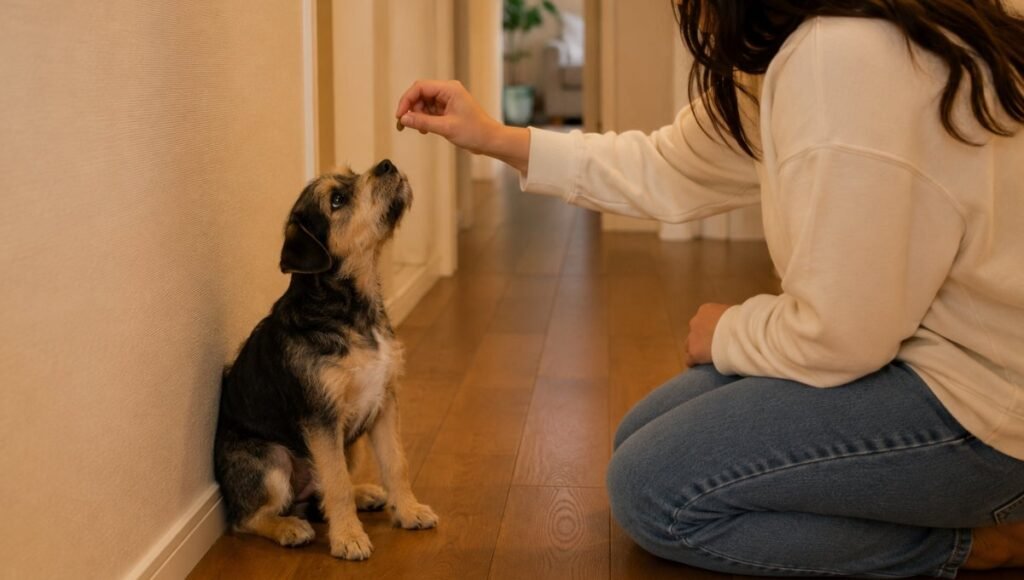
Position your puppy with their back end gently toward a wall or in a corner. When they can’t move backward, the only way to follow the treat is to move their nose up and their bottom down — which is exactly what you want. Many puppies who back away constantly on open floor will sit immediately when given a gentle physical boundary behind them.
Use a Smaller Hand Movement
Your hand movement may be too large and therefore slightly threatening or confusing. Practice smaller, more subtle lure movements — move the treat just a few inches rather than sweeping it in a wide arc. Less movement, less uncertainty.
Reward Smaller Progress
If your puppy won’t give you a full sit, reward any approximation: a slight weight shift backward, a small dip of the back end, any movement toward sitting. You’re shaping toward the goal rather than requiring the complete behavior from the first rep.
Try the Capturing Method When Luring Fails
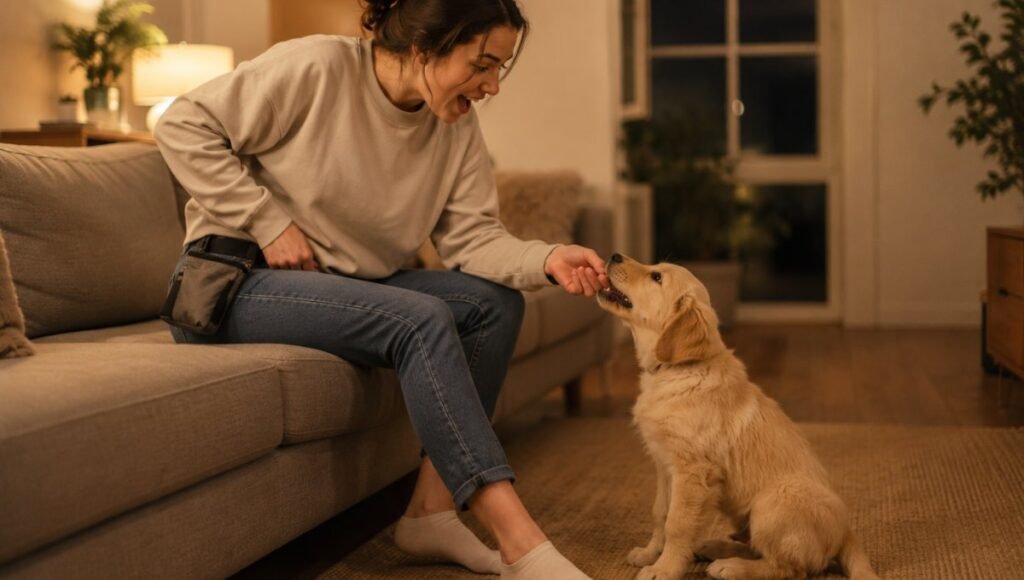
This is the most underused sit training method and often works best for puppies who can’t focus on the lure.
The concept: instead of physically guiding your puppy into a sit, you wait for them to do it naturally — which they will, constantly, throughout a normal day — and capture it the moment it happens.
How it works:
Keep treats in your pocket all day. Have a clicker ready or practice your verbal marker. Go about your normal activities. The moment your puppy sits naturally — in between play, looking up at you, settling down — click and treat immediately.
At first, say nothing. Just mark and reward the behavior every time it happens naturally. After many repetitions (this takes several days of consistent attention), your puppy is deliberately sitting more often because it reliably produces a treat. At that point, add the word “sit” just before they do it.
For puppies who get too excited or too frustrated with the lure method, capturing removes all the movement and mechanics and lets the puppy arrive at the correct behavior on their own terms. It takes longer to build, but the understanding that emerges is often more reliable.
Should You Push Your Puppy’s Bottom Down?
Short answer: no, not as your primary method.
Physical pushing can work in the sense that you end up with a puppy in a sitting position. But the puppy doesn’t learn anything from it except that your hand on their back means something happens. There’s no understanding of the behavior, no communication about what they’re doing that caused the reward, and often some confusion or resistance that makes subsequent training harder.
Some puppies actively dislike the pressure and become tense or avoidant. A puppy who is bracing against your hand is not learning — they’re managing discomfort.
Use guiding and capturing instead. Both methods teach the puppy to choose the position themselves, which produces a more durable understanding and maintains the trust and engagement that makes training work.
Why Your Puppy Still Refuses to Sit
If you’ve tried the methods above and your puppy consistently won’t sit regardless of approach, there may be an underlying reason worth investigating.
The Floor Feels Uncomfortable
Cold tile and smooth hardwood floors are genuinely uncomfortable for some puppies to sit on, particularly small breeds or young puppies who haven’t developed much muscle. A yoga mat, a low-pile rug, or a training mat gives them a surface that makes sitting physically comfortable.
Your Puppy Is Overexcited
A puppy at peak energy literally cannot perform precise learned behaviors as reliably as a settled puppy. Train after exercise, not before. Wait until the bouncing has settled.
Your Puppy Is Tired or Stressed
A puppy who is too tired or stressed can’t learn effectively either. The optimal training state is calm but engaged — not frantic, not exhausted. If your puppy is yawning, looking away, or moving slowly, end the session and try again later.
Possible Pain Issues
If your puppy consistently refuses to sit and shows any other signs of discomfort — reluctance to move normally, whimpering when touched in certain areas, holding their back legs stiffly — a veterinary check is warranted. Joint pain, hip discomfort, or injury can make the sitting position genuinely uncomfortable. This is rare in young puppies but worth ruling out if nothing else explains consistent refusal.
Common Puppy Sit Training Mistakes
Repeating “sit” multiple times. If you say “sit, sit, sit, siiiit,” you’re teaching your puppy that “sit” means a word that gets repeated until something happens. Say it once. If they don’t respond, help them with the lure, reward, and try again.
Rewarding too late. If the treat arrives more than 2 seconds after the bottom touches the ground, you’re rewarding whatever the puppy is doing at the moment of delivery. Timing is the most important technical skill in training.
Training sessions that are too long. A puppy who has checked out — sniffing around, walking away, lying down — is not learning. End the session before this point.
Moving the treat too high. The most common luring error. Keep the treat close to the puppy’s head throughout the movement.
Giving up after two sessions. Most puppies take 3 to 10 days of consistent short daily sessions to develop a reliable sit. Two sessions of frustration is not enough data to conclude your method isn’t working.
How Long Does It Take to Teach a Puppy to Sit?
Most puppies make meaningful progress within 3 to 7 days of consistent daily training — typically 3 to 5 minute sessions, two to three times per day. Some puppies get it in a single session. Some take two to three weeks.
The variables: breed (some breeds are more biddable than others), age (older puppies often progress faster than 8-week-olds), individual temperament, and consistency of the training sessions.
What’s consistent: daily short sessions always outperform occasional long ones. Three minutes today and three minutes tomorrow will produce faster results than twenty minutes once a week.
If your puppy hasn’t made any progress after two weeks of consistent daily sessions, review the common mistakes above and consider whether the treat value is high enough, the sessions are short enough, and the environment is quiet enough. One of those three things is almost always the issue.
Best Tools That Make Sit Training Easier
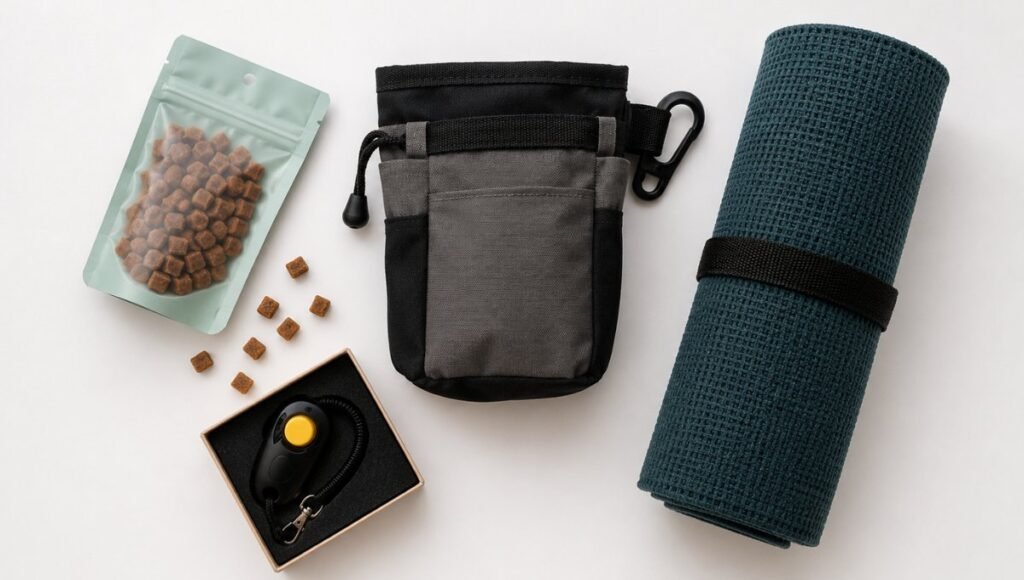
The right equipment won’t train your puppy for you — consistency and timing matter most. However, a few simple tools can make sit training easier, especially if your puppy gets distracted, jumps for treats, or struggles on slippery floors.
| Tool | Best For | Why |
|---|---|---|
| Soft treats | distracted puppies | faster reward |
| Clicker | timing problems | precise marker |
| Treat pouch | daily training | hands free |
| Mat | dogs refusing sit | comfort |
Training treats: Small, soft, and high-value. Zuke’s Mini Naturals, Wellness Soft WellBites, or small pieces of boiled chicken are consistently effective. Avoid anything that requires chewing.
Treat pouch: A pouch that clips to your waist keeps treats accessible without fumbling. Essential for sessions where timing matters.
Clicker: A basic box clicker works fine. i-Click and Karen Pryor clickers are reliable and widely available. If you prefer not to use a clicker, a consistent verbal marker (“yes”) works equivalently with practice.
Training mat or yoga mat: Worth having for puppies who resist sitting on hard floors. Creates a consistent training surface that also becomes a location cue over time.
Puppy training books: “The Power of Positive Dog Training” by Pat Miller and “Don’t Shoot the Dog” by Karen Pryor are the most consistently useful resources for first-time owners who want to understand the principles behind the methods.
FAQ
Why does my puppy jump when I try to teach sit? The treat is too high. Keep it at your puppy’s nose level and move it slowly backward over their head rather than upward. The moment the treat rises above head height, jumping becomes the natural response.
Why does my puppy walk backward instead of sitting? They’re uncertain about the hand movement coming toward them, or the treat is moving too quickly. Try training with your puppy’s back near a wall — this removes the backward escape route and naturally produces the sitting position.
Can I teach sit without treats? Yes, using the capturing method — watching for natural sits throughout the day, marking them with “yes,” and eventually pairing the word. It takes longer than luring but works well for puppies who aren’t treat-motivated in training contexts or who get too excited to focus on food.
What are the best treats for teaching a puppy to sit? Small, soft, and high-value treats usually work best because they let you reward your puppy quickly without interrupting the training session. Soft training treats, tiny pieces of chicken, or other motivating rewards often work better than regular kibble, especially for puppies who lose focus easily. The goal isn’t more treats — it’s better timing and clearer communication.
Is a clicker worth using for puppy training? Yes, a clicker can be useful because it marks the exact moment your puppy does the correct behavior. This helps your puppy understand that sitting — not jumping, backing away, or moving around — is what earned the reward. A clicker isn’t required, though; a consistent verbal marker like “yes” can work just as well when used correctly.
Should I push my puppy into sitting? Not as a primary method. Physical pushing doesn’t communicate what you want your puppy to understand — it just puts them in a position without teaching the association. Luring and capturing are more effective and maintain the trust that makes training work.
Why won’t my puppy sit on hardwood floors? Cold, hard surfaces are genuinely uncomfortable for some puppies. Try a yoga mat or low-pile rug and see if the response changes — many owners are surprised at the immediate difference.
Is my puppy too young to learn sit? No. Puppies can begin sit training at 8 weeks. Keep sessions very short — 2 to 3 minutes — end on a success, and match your expectations to their developmental stage. Young puppies learn faster than most people expect.
Final Thoughts
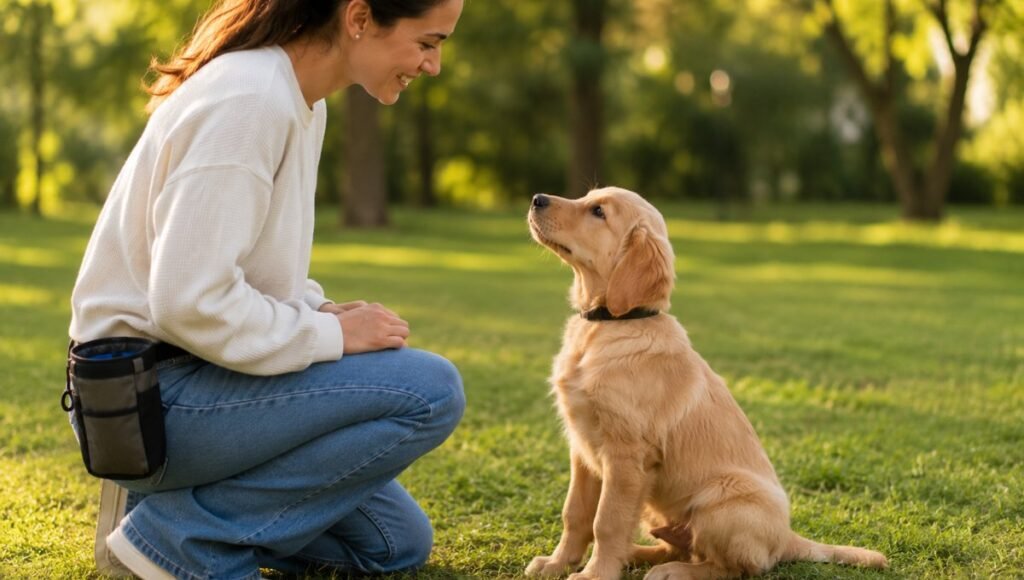
Teaching your puppy to sit might seem like a small first lesson, but it is really the beginning of learning how to communicate with each other.
Some puppies understand the treat lure right away. Others jump, back away, get distracted, or need a different approach before everything finally clicks.
That does not mean the training is failing — it simply means your puppy is learning in their own way.
The most important things are not perfect timing or a perfect training session. They are patience, consistency, and paying attention to the little moments when your puppy starts to understand you.
Because the real goal is not just a puppy who sits when asked.
It is a puppy who trusts you, listens to you, and enjoys learning with you.
🐾 PurrliPaw Training Notes: The Approach Behind This Guide
Every puppy learns differently.
Some puppies sit within minutes. Others jump for treats, walk backward, or need a little more time to understand what we are asking.
Good training is not about forcing perfect behavior — it is about building trust, communication, and confidence one small step at a time.
This guide is based on:
🦴 Positive Puppy Training
Reward-based methods that help puppies learn through encouragement, clear timing, and patience.
🐶 Real Puppy Challenges
Solutions for everyday problems new owners face — from overexcited puppies to training methods that simply don’t work.
🎯 Better Training Habits
Guidance inspired by professional training principles, including marker training, proper rewards, and consistent practice.
Because teaching “sit” is more than a command.
It is the beginning of better communication with your puppy.
What to Read Next
- How to Train a Puppy: The Complete First-Year Guide — The full training system for the first year, of which sit is the first building block
- When to Start Training a Puppy: Age-by-Age Guide — What to teach at each developmental stage and why starting early matters
- How to Stop Puppy Biting: The Positive Reinforcement Guide — The other training challenge that runs parallel to sit in the first months
- Puppy Development Stages: Week-by-Week Guide — Understanding your puppy’s developmental stage helps calibrate training expectations
- New Puppy Checklist: Everything You Need Before Day One — Including the training treats and tools to have ready before your puppy arrives
Sources & References
Karen Pryor Academy — Positive reinforcement and clicker training principles
American Kennel Club (AKC) — Puppy training guidance
Certification Council for Professional Dog Trainers (CCPDT) — Humane training standards