

The first time I put my puppy on a kitchen scale, she weighed 4.2 pounds at 9 weeks. I immediately Googled, “Is 4.2 pounds normal for a 9-week-old puppy?” Instead of reassuring me, the conflicting answers left me more anxious than before I started.
What I didn’t understand then—and what many puppy growth guides fail to explain—is that one number rarely tells the whole story. A puppy’s growth trend matters more than a single weigh-in, and body condition often matters more than either. Appetite, energy, breed, and steady development all help complete the picture.
A puppy growth chart is a useful reference, not a report card. Once you know how to read it, weekly weigh-ins become less about chasing a “perfect” number and more about spotting meaningful changes.
In this guide, you’ll learn how to compare your puppy’s weight by age and breed size, estimate their adult weight, assess body condition, and decide what to do when their growth falls outside the expected range.
In a hurry? Jump to the puppy growth chart below to compare your puppy’s age and current weight.
Quick Overview
Not sure if your puppy is growing normally? Here’s what you’ll learn in this guide.
✅ Compare your puppy’s weight by age and breed size using an easy-to-read growth chart.
✅ Estimate your puppy’s adult weight with simple formulas and practical examples.
✅ Learn when puppies stop growing and what milestones to expect during the first year.
✅ Understand why body condition is often more important than the number on the scale.
✅ Find out what to do if your puppy is growing too quickly, too slowly, or falls outside the expected range.
Understand Your Puppy’s Growth in Less Than One Minute
Before diving into charts and timelines, here’s the five-step process that this entire guide is built around. Come back to this whenever you’re not sure what to do with the information in front of you.
Step 1: Find your puppy's current age
         ↓
Step 2: Identify their breed size category
         (Toy / Small / Medium / Large / Giant)
         ↓
Step 3: Compare their current weight to the chart range
         (Look for the range, not a single "correct" number)
         ↓
Step 4: Assess body condition — feel the ribs, check the waist
         (This is more reliable than the scale)
         ↓
Step 5: Use the result to decide what to do next
         (Within range + good BCS = keep going)
         (Outside range + good BCS = watch and recheck)
         (Outside range + poor BCS = call your vet)
That’s the whole system. Everything below fills in the details.
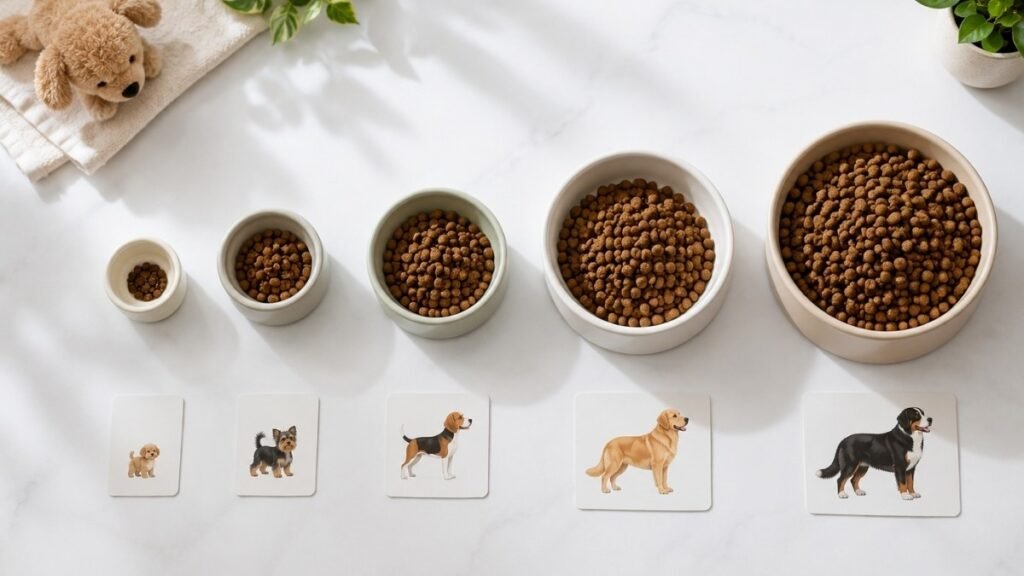
Puppy Growth Chart by Breed Size
Weight ranges below represent healthy averages. Individual puppies vary — these are reference ranges, not precise targets. Always consider your specific breed’s standard and your vet’s guidance.
Toy Breeds
Under 12 lbs adult weight — Chihuahua, Yorkshire Terrier, Maltese, Pomeranian, Toy Poodle
| Age | Weight Range |
|---|---|
| 8 weeks | 1 – 2.5 lbs |
| 12 weeks | 1.5 – 3.5 lbs |
| 4 months | 2 – 4.5 lbs |
| 6 months | 3 – 7 lbs |
| 9 months | 4 – 9 lbs |
| 12 months | 4 – 12 lbs |
Expected adult weight: 4 – 12 lbs Growth speed: Fast early, slows significantly by 6 months When growth slows: 6 – 8 months Adult age: 9 – 12 months
Small Breeds
12 – 25 lbs adult weight — Beagle, Shih Tzu, French Bulldog, Boston Terrier, Miniature Schnauzer
| Age | Weight Range |
|---|---|
| 8 weeks | 2 – 5 lbs |
| 12 weeks | 4 – 8 lbs |
| 4 months | 6 – 12 lbs |
| 6 months | 9 – 17 lbs |
| 9 months | 12 – 22 lbs |
| 12 months | 12 – 25 lbs |
Expected adult weight: 12 – 25 lbs Growth speed: Moderate and consistent When growth slows: 8 – 10 months Adult age: 10 – 12 months
Medium Breeds
25 – 50 lbs adult weight — Border Collie, Cocker Spaniel, Bulldog, Australian Shepherd, Whippet
| Age | Weight Range |
|---|---|
| 8 weeks | 5 – 10 lbs |
| 12 weeks | 8 – 16 lbs |
| 4 months | 14 – 26 lbs |
| 6 months | 20 – 35 lbs |
| 9 months | 26 – 44 lbs |
| 12 months | 28 – 50 lbs |
Expected adult weight: 25 – 50 lbs Growth speed: Steady through 9 months, then slows When growth slows: 9 – 11 months Adult age: 12 – 14 months
Large Breeds
50 – 90 lbs adult weight — Labrador Retriever, Golden Retriever, German Shepherd, Boxer, Siberian Husky
| Age | Weight Range |
|---|---|
| 8 weeks | 8 – 16 lbs |
| 12 weeks | 14 – 26 lbs |
| 4 months | 24 – 42 lbs |
| 6 months | 35 – 58 lbs |
| 9 months | 48 – 74 lbs |
| 12 months | 52 – 82 lbs |
| 18 months | 55 – 90 lbs |
Expected adult weight: 50 – 90 lbs Growth speed: Rapid through 6 months, steady through 12 When growth slows: 12 – 14 months Adult age: 14 – 18 months
Giant Breeds
90+ lbs adult weight — Great Dane, Saint Bernard, Newfoundland, Bernese Mountain Dog, Irish Wolfhound
| Age | Weight Range |
|---|---|
| 8 weeks | 12 – 22 lbs |
| 12 weeks | 22 – 38 lbs |
| 4 months | 38 – 60 lbs |
| 6 months | 55 – 90 lbs |
| 9 months | 75 – 120 lbs |
| 12 months | 85 – 140 lbs |
| 18 months | 95 – 160 lbs |
| 24 months | 100 – 180 lbs |
Expected adult weight: 90 – 180+ lbs Growth speed: Sustained and dramatic — these dogs are still actively growing at 18 months When growth slows: 18 – 20 months Adult age: 18 – 24 months
Editor’s note: I’ve seen owners get genuinely stressed because their puppy is at the lower end of the weight range for their age. What I’ve learned — and what I wish someone had told me earlier — is that a trend of consistent weekly gains matters far more than where a single measurement sits on a chart. A puppy who weighs 14 pounds at 12 weeks and 18 pounds at 14 weeks is growing beautifully, even if the chart says they “should” be 16 pounds at 12 weeks. Watch the trend over three to four weeks, not a single data point.
Puppy Growth Timeline: What Changes Month by Month
Every puppy grows at their own pace, but the first year follows a series of predictable milestones. Understanding what typically happens at each stage—from rapid early growth to slower physical development—can help you tell the difference between normal changes and signs that may need extra attention.
8–12 Weeks — The Foundation Phase
This is the phase most new owners experience first, and it’s one of the most active growth periods of your puppy’s life. Weight gain during this window can be dramatic — some large breed puppies are gaining half a pound or more per day. The skeletal system is developing rapidly, which is why nutrition matters so much here.
Alongside physical growth: the socialization window is open, the first vaccine series begins, and food intake is at its most frequent — four meals per day for most puppies this age. Appetite can be irregular during the first week home due to stress and adjustment, which often causes unnecessary alarm about weight. Give it 5 to 7 days before worrying about whether your puppy is eating enough.
3–4 Months — The Gangly Phase
If your puppy is starting to look like they have legs that don’t quite match the rest of their body, you’re in this phase. The limbs grow faster than the torso during this period, producing the adorable-but-slightly-uncoordinated look that most puppy owners are familiar with. Coordination catches up over the following months.
Baby teeth are falling out and adult teeth are coming in — you might find small teeth on the floor or in toys. Chewing increases. Exercise tolerance is growing, but growth plates are still open, which is why high-impact exercise should be kept moderate.
Feeding transitions from four meals to three meals daily around 12 to 16 weeks as stomach capacity increases.
5–6 Months — Approaching Halfway
By six months, most puppies are approaching approximately 50% of their projected adult weight. This is also when adolescence begins — hormonal changes, selective hearing, and the temporary behavioral regression that surprises owners who thought training was going well. The physical growth and the behavioral shift are happening simultaneously, which makes this one of the more demanding periods.
Small breeds are getting close to their adult size now. Medium breeds are visibly approaching it. Large and giant breeds have a lot more growing left to do, which is why large breed puppy formula remains important through this period — switching to adult food at six months for a large breed is premature.
7–12 Months — Slowing Down (For Some)
For toy and small breeds, this is essentially the final stretch — they’re reaching or approaching adult size and weight. For medium breeds, the growth rate is slowing significantly. For large and giant breeds, meaningful growth continues through this entire period.
Behaviorally, this is peak adolescence for most breeds — the period most owners find most challenging. The growth chart during this phase is less concerning than the behavioral changes, which are temporary and predictable.
12–24 Months — Adult Status (Depends on the Dog)
Small breeds: done. Medium breeds: essentially done, with minor muscle development continuing. Large breeds: skeletal growth largely complete, muscle development continuing. Giant breeds: still actively developing — a Great Dane at 14 months is still a puppy in every meaningful sense.
“When is my dog fully grown” is a question with a genuinely different answer depending on which dog you’re asking about. A Chihuahua is a full adult at 10 months. A Saint Bernard may still be developing at 24 months.
Puppy Weight Calculator: Estimate Adult Size
These formulas provide useful estimates. They’re not guarantees — genetics, nutrition, and individual variation all affect the outcome.
Small & Medium Breeds
The most commonly used formula:
Adult Weight = (Puppy Weight at 16 weeks) × 2
This works reasonably well for breeds expected to reach 25 to 50 pounds as adults. Example: a puppy weighing 14 pounds at 16 weeks will likely reach approximately 28 pounds as an adult.
A variation used for slightly more accuracy:
Adult Weight = (Current weight ÷ Current age in weeks) × 52
Use this cautiously — it assumes linear growth, which isn’t accurate after 6 months.
Large Breeds
Large breed growth curves are more complex because rapid early growth slows significantly in the second half of the first year. A simpler estimate:
Adult Weight ≈ (Weight at 6 months) × 1.5
Example: a Labrador who weighs 48 pounds at 6 months will likely reach approximately 70 to 72 pounds as an adult.
Mixed Breed Puppies

This is where most guides fall short — they either skip mixed breeds entirely or give vague advice. The honest answer is that estimating mixed breed adult size is genuinely less precise than estimating purebred size, and here’s why that matters and what actually helps.
Paw size: The popular belief that large paws predict a large adult dog has some truth but a lot of noise. Many puppies — especially those with retrieving or working breed ancestry — have disproportionately large paws relative to their eventual adult size. I’ve seen owners convinced their mixed-breed puppy would hit 80 pounds because of enormous 10-week-old paws, and the dog topped out at 45. Paw size is a rough signal at best, not a reliable predictor.
Bone thickness: The density and thickness of the leg bones — particularly at the joints — is a more reliable physical indicator than paw size. Thicker, denser bones correlate more consistently with larger adult size.
Parent estimate: If you know the size of both parents, the puppy will usually land somewhere between the two, often closer to the larger parent in male puppies. If only one parent is known, that provides a partial anchor.
DNA testing limitations: Breed DNA tests identify ancestry but don’t predict adult size with precision. Two puppies from the same litter with identical DNA results can reach meaningfully different adult weights. DNA tests are interesting; they’re not a substitute for veterinary growth assessment.
The most useful approach for mixed breed puppies: have your vet assess bone structure at the 12-week and 16-week visits, track growth trends consistently, and hold predictions loosely until you’re past 6 months with a clearer curve.
Weight Isn’t Everything: Use the Body Condition Score Instead
This is the section I wish every first-time owner would read twice, because it changes how you think about the entire growth chart conversation.
Body Condition Score (BCS) is the assessment veterinarians actually use to evaluate whether a dog is at a healthy weight — not the number on the scale, but the distribution and proportion of fat and muscle on the dog’s body. A dog can weigh exactly what a chart says and be in poor condition. A dog can be above the chart range and be perfectly healthy and well-muscled.
The BCS system runs from 1 to 9, with 4 to 5 being the target for most puppies.
How to Feel the Ribs

Run your fingers firmly along your puppy’s rib cage from the spine outward. In a healthy puppy, you should be able to feel individual ribs with moderate pressure — they’re there, they’re distinct, but you don’t need to press hard to find them. You should not be able to count ribs visually from across the room.
If you have to press firmly to find any ribs at all, your puppy is carrying too much weight regardless of what the scale says. If the ribs are immediately obvious without touching, or visible through the coat, your puppy may be underweight.
How to Spot a Healthy Waist

Look at your puppy from above. There should be a visible narrowing behind the rib cage — a waist. Not dramatic, but present. Look from the side: the belly should tuck up slightly from the bottom of the rib cage rather than hanging level or sagging.
This visual assessment is genuinely useful and gets easier with practice. I check it every time I groom my dog — takes ten seconds and tells me more than the weekly weigh-in.
Signs Your Puppy Is Too Thin
- Ribs visible without touching
- Spine visible or easily felt as sharp ridges
- Hip bones prominent
- No visible fat covering
- Waist extremely pronounced, bordering on sunken
Signs Your Puppy Is Overweight
- Ribs require firm pressure to locate
- No visible waist from above
- Belly rounds downward rather than tucking up
- Fat deposits visible around the neck, behind the shoulders, or at the tail base
- Reluctance to exercise or tires unusually quickly
What If Your Puppy Is Above or Below the Growth Chart?
Not every healthy puppy follows the growth chart perfectly. Small differences are often normal, but significant changes in weight or growth rate can sometimes point to feeding issues, parasites, illness, or breed-related differences. Here’s how to tell the difference and decide on the right next step.
Growing Faster Than Expected
The most common causes of above-chart growth are straightforward and fixable:
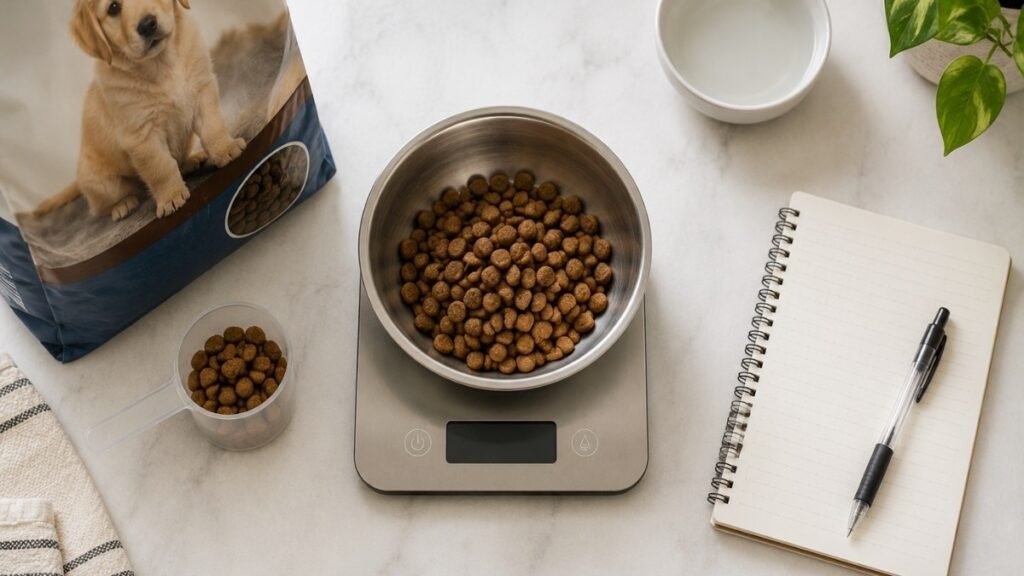
Overfeeding is the most frequent culprit. The feeding chart on the bag is a starting point, not a guarantee — some puppies need less than the recommended amount. If your puppy is consistently above the weight range, check whether you’re measuring portions accurately or feeding the upper end of the recommended range when the lower end would be more appropriate.
Too many treats is the second most common cause. Training-intensive periods can involve significant treat calories that owners don’t account for in daily intake. The 90/10 rule: treats should make up no more than 10% of daily caloric intake. On heavy training days, reduce meal portions accordingly.
Large breed genetics expressing later can produce unexpected growth curves, particularly in puppies from large litters or with working breed ancestry. If your puppy’s body condition is good despite above-chart weight, this is less concerning than above-chart weight with poor condition.
High-calorie food can produce faster growth than intended, particularly in large breed puppies where rapid growth creates joint risk. Verify that you’re feeding a large breed puppy formula if your puppy is expected to exceed 50 pounds as an adult.
Growing Slower Than Expected

Slow growth that persists is worth investigating. The most common causes:
Intestinal parasites are extremely common in puppies and directly impair nutrient absorption. A puppy can eat adequate food and still grow poorly because parasites are competing for the nutrition. A fecal exam at the first vet visit identifies this — if it wasn’t done, request one.
Illness of various kinds can redirect the body’s resources away from growth. A puppy who is fighting an infection, dealing with a chronic condition, or who has been through significant stress may show growth slowdown.
Low appetite or food refusal produces genuine nutritional deficit over time. If your puppy is consistently eating 50% or less of recommended amounts, the cause needs investigation — behavioral pickiness, underlying illness, or food palatability issues all require different responses.
Wrong feeding amount in the other direction — consistently underfeeding — is less common but real. If you’ve been feeding below the chart recommendation because you thought it seemed like too much, reconsider.
Stress genuinely affects growth. A puppy who has been through significant upheaval — multiple home changes, chaotic environments, inadequate sleep — may show below-chart growth that improves dramatically with stabilization.
When It’s Time to Call Your Veterinarian
The growth chart is a monitoring tool. These are the situations where monitoring stops being enough:
- Weight loss over two or more consecutive weeks (not just slower gain — actual loss)
- Consistent weight below chart range across four or more weeks despite adequate feeding
- Weight above chart range that is accelerating rather than leveling off, combined with poor body condition
- Any weight change alongside other symptoms: lethargy, appetite changes, digestive symptoms, or behavioral changes
- A puppy under 12 weeks who is not gaining weight week over week
- Giant breed puppies who show joint stiffness, reluctance to move, or lameness alongside above-chart growth
Feeding Tips That Support Healthy Growth
The growth chart and the feeding plan are the same system — what goes in determines what comes out in terms of development.
Calories by Age
Caloric needs relative to body weight are highest in the first three months and decline gradually as growth rate slows. A 10-week-old puppy needs significantly more calories per pound of body weight than a 9-month-old puppy of the same breed. This is why the feeding chart amounts increase through the peak growth phase and then begin to decrease — something many owners miss when they stop checking the chart regularly.
Meal Frequency
Four meals per day under 12 weeks. Three meals from 12 to 16 weeks. Two meals from 6 months onward for most breeds. Small breeds may benefit from staying on three meals until 9 to 12 months due to blood sugar regulation.
Choosing Puppy Food by Breed Size
This is not marketing differentiation. Large breed puppy formulas have controlled calcium and phosphorus levels designed to produce steady growth rather than rapid growth. Standard puppy formulas have mineral ratios appropriate for smaller breeds — when fed to large breed puppies, the excess calcium accelerates bone growth in ways that increase the risk of developmental orthopedic disease.
If your puppy will exceed 50 pounds as an adult: large breed puppy formula from 8 weeks until switching to adult food at 14 to 18 months. Non-negotiable.
Common Feeding Mistakes
Adding food when growth is slow is the one I see most often in online forums. A puppy who is growing slowly is not automatically a puppy who needs more food — they may have parasites, an absorption problem, or an inadequate feeding frequency. More food on top of an unaddressed underlying issue doesn’t help and can harm.
Free feeding makes growth monitoring essentially impossible because you can’t track intake. Scheduled measured meals let you see exactly how much your puppy is eating and correlate that with growth data.
Not adjusting portions as the puppy grows means you’re either underfeeding a puppy in a rapid growth phase or overfeeding one who has slowed down. Check the chart monthly and adjust portions to match current age and weight.
Common Puppy Growth Myths
“Bigger paws mean a bigger adult dog.” Partly true, mostly overstated. Paw size correlates loosely with adult size but is not reliable for prediction. I’ve watched too many owners be certain their puppy would be enormous based on puppy paws and end up with a medium-sized dog. Bone thickness and overall frame are better indicators.
“More food means faster, healthier growth.” Not true, and actively harmful for large breeds. Controlled, steady growth produces healthier skeletal development than rapid growth. Overfeeding a large breed puppy doesn’t make them bigger as adults — it makes them grow faster in ways that damage developing joints.
“Chubby puppies are healthier.” This one is genuinely harmful. An overweight puppy puts stress on developing joints, is more prone to orthopedic disease, and develops habits and metabolic patterns that persist into adulthood. The Association for Pet Obesity Prevention reports that over 59% of adult dogs in the US are overweight or obese. Many of those trajectories start in puppyhood.
“Neutering stops growth.” Neutering before skeletal maturity may actually extend the growth period slightly — some research suggests that early neutering in large breeds delays growth plate closure and leads to slightly taller but sometimes less structurally stable skeletal development. This is an evolving area of veterinary research; the key point is that early neutering does not stop growth, and the timing discussion is worth having with your vet.
“If the weight is normal, the puppy is fine.” Weight is one data point. Body condition, energy level, appetite, coat quality, and development trajectory together are what “fine” looks like. A puppy can be within the normal weight range and be undernourished if their body condition is poor.
Frequently Asked Questions
Is my puppy too skinny even if their weight matches the chart? Possibly, yes. The chart gives a weight range; body condition tells you whether that weight is composed of appropriate muscle and fat. Use the rib check and waist assessment alongside the chart. If ribs are visible or the puppy seems bony despite normal chart weight, a veterinary assessment is worth scheduling.
Can mixed-breed puppies use a growth chart? Use the chart for the breed size category that most closely matches the puppy’s expected adult size based on parent size and bone structure. Mixed breed charts are less precise than purebred charts, so weight ranges are starting points rather than reliable benchmarks. Body condition assessment becomes more important when breed-specific expectations aren’t available.
How often should I weigh my puppy? Once a week during the first six months. Monthly from six months to adult size. Weekly weighing gives you the trend data needed to identify changes early, but daily weighing creates unnecessary anxiety — normal daily fluctuations in food and water intake can move the scale by half a pound or more without any meaningful change in growth.
At what age do puppies stop growing? Toy and small breeds: 9 to 12 months. Medium breeds: 12 to 14 months. Large breeds: 14 to 18 months. Giant breeds: 18 to 24 months. These are skeletal growth timelines; muscle development and body filling-out continue for several months after height and length have stabilized.
Can I predict adult size from my puppy’s paws? Loosely, and with significant uncertainty. Paw size has some correlation with adult body size but is not a reliable predictor — many puppies have disproportionately large paws early in development that scale down relative to body size as they grow. Bone thickness at the joints and overall frame assessment by a vet at 12 to 16 weeks is more informative.
Why is my puppy growing faster than the chart? Check feeding amount first — measure portions against the bag’s chart for your puppy’s current weight. Check treat volume — heavy training periods can add significant calories. Check food calorie density — switch to a lower-calorie formula if overweight is a consistent issue. If above-chart growth is happening with good body condition, it may simply reflect normal genetic variation. If body condition is also deteriorating, talk to your vet.
Should I feed more if my puppy is below average weight? Not automatically. First rule out parasites (fecal test), assess meal frequency (is four meals per day happening for a puppy under 12 weeks?), and evaluate food quality (AAFCO growth statement present?). Adding volume on top of an absorption or frequency problem doesn’t solve the underlying issue. If a fecal test is clean, frequency is appropriate, and the food is suitable, then a moderate increase in portion size is reasonable.
When should I worry about slow puppy growth? Worry — and call your vet — when: weight loss happens over consecutive weeks (not just slow gain), growth is consistently below chart range over four or more weeks despite adequate feeding, or slow growth is accompanied by other symptoms like lethargy, digestive issues, or appetite changes.
Final Thoughts
A puppy growth chart is a helpful guide — not a report card.
Healthy puppies don’t all grow on the exact same schedule. What matters is steady progress, good body condition, balanced nutrition, and regular veterinary care. The chart helps you spot trends. The rib check tells you what the trend means. And your vet fills in the gaps that neither tool can cover.
If your puppy is active, eating well, gaining consistently, and passing the body condition assessment — you’re on the right track, regardless of where exactly they fall in the weight range.
Every puppy grows at their own pace, and every new owner figures it out along the way. At PurrliPaw, the goal has always been practical advice that helps you make confident daily decisions — from reading a growth chart to choosing the right food, building a training routine, and knowing when to call the vet. Not a perfect puppy. A happy, healthy one.
🐾 PurrliPaw Editor’s Notes
This guide is built around the topics that matter most to new puppy owners:
🐶 Healthy Growth Milestones
Know what to expect from 8 weeks through adulthood.
⚖️ Weight & Body Condition
Learn why healthy shape matters more than a single number on the scale.
🍖 Feeding & Growth Tips
Support steady development with age-appropriate nutrition and routines.
Because raising a healthy puppy isn’t about chasing the perfect weight.
It’s about understanding your puppy’s unique growth journey.
What to Read Next
- Puppy Development Stages: Week-by-Week Guide — How physical growth connects to behavioral development and what to expect at each stage
- How Much to Feed a Puppy: Complete Chart by Age and Weight — The feeding amounts that support healthy growth at every stage
- How Often to Feed a Puppy: Complete Schedule by Age — Meal frequency from 8 weeks through adulthood and how it affects growth
- When to Switch Puppy to Adult Food: Complete Guide by Breed Size — How growth timeline determines the right moment to transition
- Puppy Not Eating: Causes, What to Do & When to See a Vet — When appetite affects growth and what to do about it
🐾 From the PurrliPaw Editorial Team
Behind every healthy adult dog is a series of small, everyday decisions made during puppyhood.
That’s why we create practical, research-backed guides that help new dog owners feel less overwhelmed and more confident—from understanding growth charts to feeding, training, and everyday care.
Thanks for letting PurrliPaw be part of your puppy’s journey.