
How Often to Feed a Puppy: The Complete Feeding Schedule by Age
You brought your puppy home, opened the bag of food, and then realized: nobody told you how many times a day to actually fill the bowl.
The bag says “follow feeding guidelines,” but that only tells you how much — not how often. Your breeder said “three times a day,” but your friend said “four times.” The internet gives you five different answers depending on which article you land on first.
Here is the straightforward truth: how often you feed your puppy matters just as much as what you feed them. The right feeding frequency supports healthy growth, keeps blood sugar stable, helps with potty training, and prevents digestive problems. Get it wrong — either too few meals or too many — and you’ll see the consequences in your puppy’s energy, their bathroom habits, and their overall development.
This guide gives you the exact feeding schedule for every age, explains why the frequency changes as your puppy grows, and addresses the real-world complications — working a full-time job, managing small breeds, transitioning from puppy to adult meals — that most guides skip entirely.

Key Takeaways
- Puppies under 3 months need 4 meals per day. Their stomachs are small and their blood sugar drops quickly without regular food.
- Between 3 and 6 months, reduce to 3 meals per day as stomach capacity increases and blood sugar stability improves.
- From 6 months onward, most puppies do well on 2 meals per day — the schedule most adult dogs stay on for life.
- Small and toy breeds need more frequent meals for longer due to their higher risk of hypoglycemia — low blood sugar that can become a medical emergency.
- Meal timing directly affects potty training. Puppies typically need to eliminate within 15 to 20 minutes of eating. A consistent feeding schedule creates a predictable elimination schedule.
- Free feeding — leaving food out all day — is not recommended for most puppies. It makes potty training harder, makes it impossible to monitor food intake, and can contribute to overeating.
Why Feeding Frequency Matters More Than You Think
Most new owners focus on what to feed their puppy and how much. Feeding frequency gets treated as an afterthought — three times, four times, whatever works. But the number of meals per day has direct consequences for several aspects of your puppy’s health and development.
Blood sugar stability
Puppies have high metabolic rates and small energy reserves. Unlike adult dogs, who can comfortably go 8 to 12 hours between meals, young puppies experience blood sugar drops relatively quickly when they go too long without food. This is particularly true for small and toy breeds, where the risk of hypoglycemia — dangerously low blood sugar — is a genuine medical concern.
Signs of low blood sugar in puppies: weakness, wobbliness, disorientation, pale gums, trembling, and in severe cases, seizures or loss of consciousness. For small breed puppies especially, going more than 4 to 5 hours without food during the day is a risk not worth taking in the first few months.
Digestive capacity
A puppy’s stomach is small relative to their body size and caloric needs. Three to four smaller meals allow each meal to be properly digested before the next arrives. Larger, less frequent meals put more demand on a developing digestive system — and can contribute to vomiting, loose stools, or in large and giant breeds, an increased risk of bloat (gastric dilatation-volvulus), a life-threatening condition.
Potty training accuracy
This is the connection most guides miss entirely: your puppy’s feeding schedule is your potty training schedule. Puppies typically need to eliminate within 15 to 20 minutes of eating. If you know exactly when your puppy eats, you know exactly when to take them outside. A consistent, predictable feeding schedule creates a consistent, predictable elimination schedule — which is the foundation of effective potty training.
Free feeding (leaving food available all day) makes potty training dramatically harder, because there’s no predictable window to anticipate and no clear signal to watch for.
The Complete Puppy Feeding Schedule by Age
8 to 12 Weeks — 4 Meals Per Day
This is the most intensive feeding period, and the one where most new owners underestimate the frequency needed.
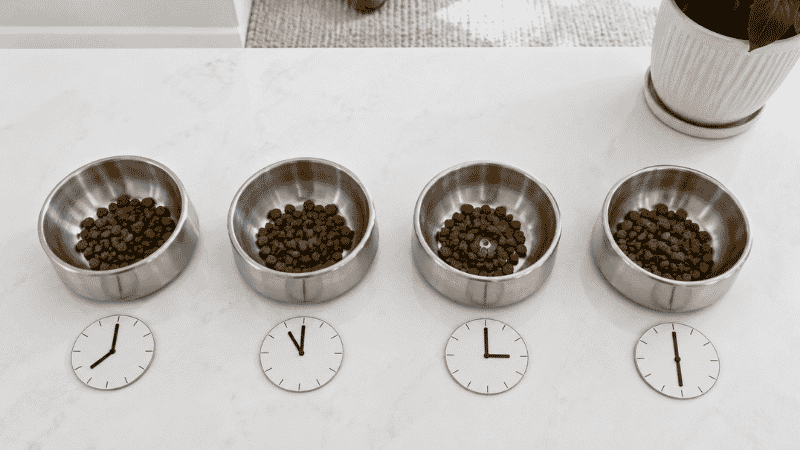
At 8 weeks, your puppy’s stomach holds a small amount of food, their metabolic rate is at its highest relative to body size, and their blood sugar regulation is still immature. Four meals per day — spaced roughly 4 hours apart during waking hours — gives them consistent fuel without overwhelming their digestive system.
Sample 4-meal schedule:
- 7:00 AM — Morning meal (immediately after waking up and going outside)
- 11:00 AM — Midday meal
- 3:00 PM — Afternoon meal
- 6:00 PM — Evening meal (ideally no later than this, to allow digestion before bedtime)
Why the last meal should be no later than 6 to 7 PM: Feeding your puppy too close to bedtime means a full stomach going into the night — which means a bladder and bowel that will need emptying in the middle of the night, and will do so whether you’re awake to take them outside or not. A last meal at 6 PM gives 3 to 4 hours for digestion before your final pre-bed potty trip, significantly reducing overnight accidents.
What about overnight? No overnight feeding for most puppies from 8 weeks onward. If your puppy is waking overnight crying, this is almost always about bladder capacity and the need for a bathroom trip — not hunger. A puppy who ate adequately across their four daytime meals does not need a 2 AM feeding.
Large breed considerations at this stage: Large and giant breed puppies (those expected to weigh more than 50 lbs as adults) should be eating a large breed puppy formula during this entire period. Standard puppy food has too much calcium for their developing skeletal system, increasing the risk of developmental orthopedic disease. Feeding frequency is the same, but food choice is specific to their size.
3 to 6 Months — 3 Meals Per Day
At around 12 to 16 weeks, your puppy’s stomach has grown enough to accommodate slightly larger meals, their blood sugar regulation has improved, and three meals per day becomes both sufficient and practical.
This is also when most puppies begin to show more predictable behavior — the chaotic first weeks have settled into something resembling a routine, and the feeding schedule begins to feel manageable.
Sample 3-meal schedule:
- 7:00 AM — Morning meal
- 12:00 PM — Midday meal
- 5:30 PM — Evening meal
The working owner challenge at this stage: Three meals per day with a midday meal is straightforward if you work from home or have a flexible schedule. If you work full-time outside the home, the midday meal requires a plan.
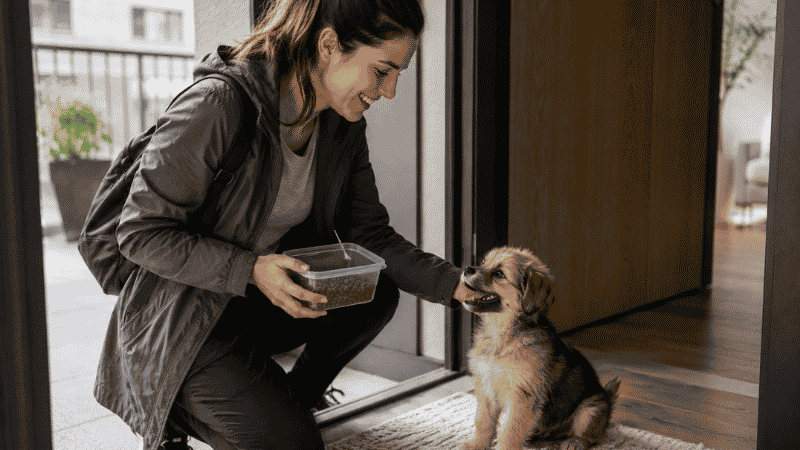
Practical options:
- A neighbor, friend, or family member who can stop by for the midday feed
- A professional dog walker or pet sitter scheduled for a midday visit (this person can also provide a bathroom break, which puppies this age still need during the day)
- A doggy daycare facility for full working days during this period
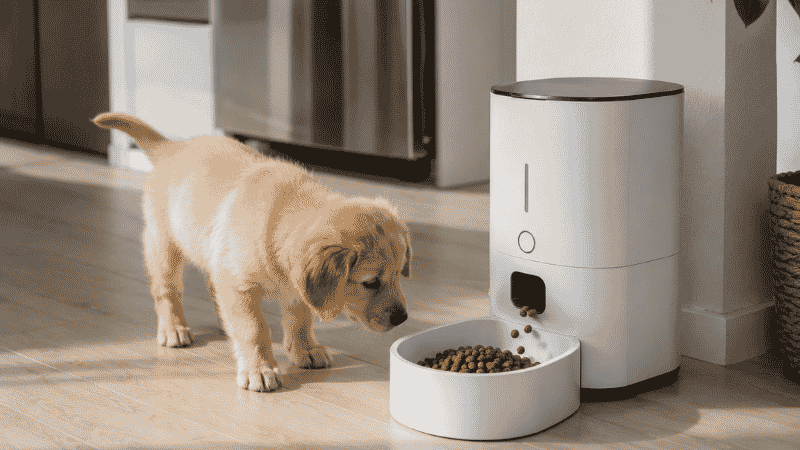
An automatic feeder is another option — devices that dispense a measured portion at a scheduled time. They work reasonably well for this purpose, though they require monitoring to ensure your puppy is actually eating and to catch any digestive changes promptly.
What not to do: Simply skipping the midday meal and feeding two larger meals at this stage is not recommended. At 3 to 4 months, most puppies don’t yet have the digestive capacity or blood sugar stability for two-meal-a-day schedules. The transition to two meals comes later.
6 to 12 Months — 2 Meals Per Day
By 6 months, most medium and large breed puppies are ready to transition to two meals per day — the schedule that most adult dogs maintain for life. Morning and evening, spaced roughly 10 to 12 hours apart.
Sample 2-meal schedule:
- 7:00 AM — Morning meal
- 5:30 PM — Evening meal
This schedule is significantly more practical for working owners and aligns naturally with most human household routines.
Important: Small breeds may need to stay on 3 meals until 9 to 12 months. Toy and small breeds — Chihuahuas, Yorkshire Terriers, Maltese, Toy Poodles, and similar — have smaller stomachs and faster metabolisms than larger breeds, and their risk of hypoglycemia persists for longer. Don’t rush the transition to two meals for small breeds; let your puppy’s body condition and energy levels guide the timing.
Signs your puppy is ready to move from 3 to 2 meals:
- Consistently finishing all three meals without skipping or leaving food
- Stable, consistent energy throughout the day
- No signs of excessive hunger or blood sugar drops between meals
- Weight and body condition appropriate for their age and breed (confirmed at a vet visit)
Signs to stay on 3 meals a little longer:
- Skipping meals or eating inconsistently
- Energy crashes in the afternoon
- Body weight lower than expected for their age and breed
- Your veterinarian recommends it based on their growth assessment
12 Months and Beyond — 2 Meals Per Day
At 12 months, most small and medium breeds are essentially adults from a feeding schedule perspective. Large breeds continue to develop physically until 14 to 18 months, and giant breeds until 18 to 24 months — but the two-meal-a-day schedule established at 6 months typically continues through this period.
At 12 months (or when your vet advises, which may be later for large breeds), the transition from puppy food to adult food begins. This should happen gradually — over 7 to 10 days — to avoid digestive upset.
Small and Toy Breeds: A Separate Set of Rules
If you have a small or toy breed puppy, the standard feeding frequency guidelines are a starting point, not a prescription. Here is what’s different:
Higher meal frequency for longer. Many small breed puppies benefit from 4 meals per day until 12 to 16 weeks, and 3 meals per day until 9 to 12 months. The transition to two daily meals often happens later than for medium or large breeds.
Snacks between meals may be appropriate. For very small breeds (under 4 lbs adult weight), a small, nutritious snack between meals during the first few months provides additional blood sugar support. A small piece of high-quality kibble or a pea-sized amount of wet food is sufficient.
Know the signs of hypoglycemia. In small breed puppies, low blood sugar can develop quickly — especially after exercise, stress, or missing a meal. Signs include:
- Weakness or wobbliness
- Excessive sleepiness or difficulty waking
- Disorientation or glassy eyes
- Trembling or muscle twitching
- Pale or white gums
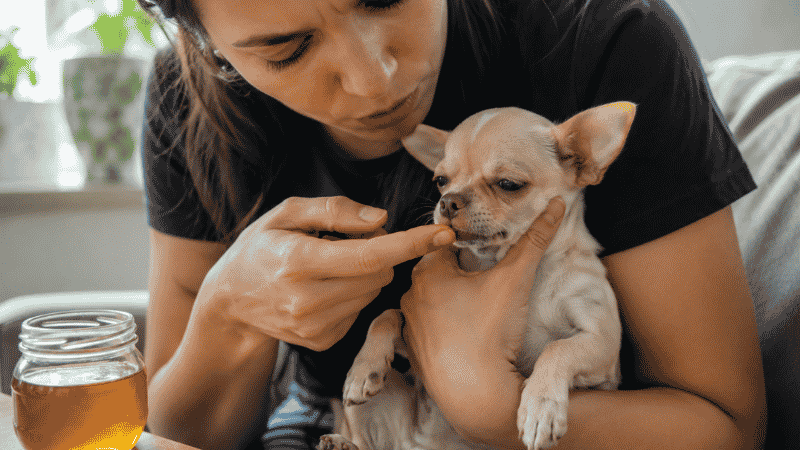
If you see these signs: a small amount of honey or corn syrup rubbed directly onto the gums provides rapid glucose absorption. Follow immediately with food and contact your veterinarian. Do not wait to see if they improve on their own.
How to Transition Between Feeding Frequencies
The transition from 4 meals to 3, and from 3 meals to 2, should be gradual — not an abrupt overnight change.
From 4 to 3 meals (around 12 to 16 weeks):
Week 1: Drop the 3 PM meal. Instead, add a small amount to the morning and midday meals to maintain the same daily total.
Week 2: Monitor your puppy’s energy, appetite, and stool consistency. If all looks stable, the transition is complete. If you notice afternoon energy crashes or persistent hunger, add a small snack at the 3 PM slot for another week before trying again.
From 3 to 2 meals (around 6 months, or later for small breeds):
Week 1: Eliminate the midday meal. Divide the daily food allowance between morning and evening, slightly increasing each meal’s portion to maintain the same daily total.
Week 2: Monitor energy, stool consistency, and weight. A puppy doing well on two meals will have consistent energy throughout the day with no obvious energy crashes between meals. If you notice consistent lethargy between meals or significant weight loss, return to three meals and consult your veterinarian.
Free Feeding vs. Scheduled Meals: The Honest Answer
Free feeding means leaving food available in the bowl at all times, allowing your puppy to eat whenever they choose. It’s common because it’s convenient, but for most puppies during the first year, it creates more problems than it solves.
Why scheduled meals work better:
Potty training. As discussed, meal timing creates predictable elimination timing. Free feeding makes the “eliminate 15 to 20 minutes after eating” guideline meaningless, because you never know when the last meal happened.
Intake monitoring. When you measure and serve meals, you know exactly how much your puppy ate at each meal. A puppy who is off their food is often the first sign of illness — and you’ll notice it immediately on a scheduled feeding routine. Free feeding makes this impossible to detect.
Body weight management. The Association for Pet Obesity Prevention reports that over 59% of dogs are overweight or obese. Free feeding is a significant contributor, as many dogs will eat past their caloric needs when food is continuously available.
The one exception: some very small breed puppies, or puppies with specific veterinary-advised conditions, may benefit from having food available more consistently during the first weeks to prevent hypoglycemia. If your veterinarian recommends this for your specific puppy, follow their guidance.
Feeding Schedule and Potty Training: The Direct Connection
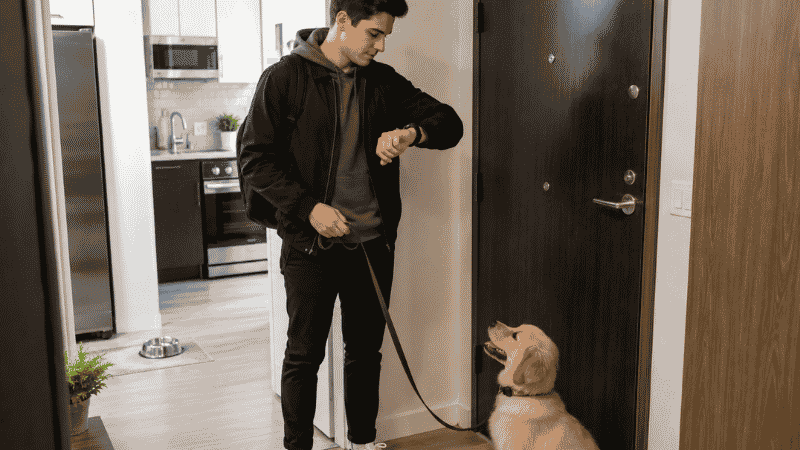
This deserves more attention than most feeding guides give it.
Your puppy’s digestive system moves food through at a relatively predictable rate. Most puppies need to defecate within 15 to 30 minutes of eating — sometimes faster in very young puppies. This is not a coincidence or an inconvenience. It is a predictable biological rhythm you can use to your advantage.
A consistent feeding schedule creates consistent elimination windows. If your puppy eats breakfast at 7 AM every day, you know to take them outside at 7:15. If they eat dinner at 5:30 PM, outside time at 5:45 is the expectation.
This predictability is one of the most powerful tools in potty training — and it only exists when feeding happens on a consistent schedule. Free feeding eliminates this predictability entirely.
Practical tip: Take your puppy outside immediately after every meal during potty training — not 15 to 20 minutes later, but immediately. Walk around, wait, and let the natural post-meal elimination reflex do its work. The moment they eliminate outdoors, reward enthusiastically. Over repetitions, the association between eating, going outside, and eliminating in the right place becomes deeply established.
Common Feeding Frequency Mistakes
Starting two meals too early. Moving to two meals at 8 or 10 weeks because four meals feels like too much work is one of the most common errors new owners make. A puppy that age genuinely needs more frequent feeding, and skipping meals has real consequences for their blood sugar and development.
Inconsistent meal times. Feeding at 7 AM some days and 9 AM others, or skipping the midday meal when you forget, disrupts the biological rhythms your puppy is trying to establish. Set specific meal times and keep them consistent — your puppy’s digestion, energy, and bathroom schedule all depend on it.
Not adjusting portion size when reducing meal frequency. When you transition from 4 meals to 3, the total daily food amount stays the same — only the number of meals changes. Many owners forget to redistribute the portions, accidentally underfeeding their puppy during the transition.
Using treats without adjusting meal portions. Training treats are essential in the first year — but they contain calories. If you’re using significant quantities of treats during training sessions, reduce the meal portion accordingly. Treats should make up no more than 10% of total daily caloric intake.
Feeding too close to bedtime. The last meal of the day should be given at least 3 hours before bedtime. A puppy with a full stomach going to bed will almost certainly need to eliminate overnight — setting back potty training progress and disrupting everyone’s sleep.
FAQ: What New Puppy Owners Actually Search For
How many times a day should I feed my puppy? Four times per day for puppies 8 to 12 weeks old. Three times per day from 3 to 6 months. Two times per day from 6 months onward for most breeds. Small and toy breeds may stay on three meals per day until 9 to 12 months.
Can I feed my puppy twice a day from the start? Not recommended for most puppies under 12 to 16 weeks. Young puppies need more frequent meals to maintain blood sugar stability and support their high metabolic rate. Starting with two meals too early can lead to energy crashes, digestive issues, and hypoglycemia in small breeds.
What time should I feed my puppy? Space meals evenly through the day, with the last meal at least 3 hours before bedtime. For a 4-meal schedule: 7 AM, 11 AM, 3 PM, 6 PM. For a 3-meal schedule: 7 AM, 12 PM, 5:30 PM. For a 2-meal schedule: 7 AM, 5:30 PM.
Is it okay to free-feed a puppy? Not recommended for most puppies. Free feeding makes potty training harder, prevents monitoring of food intake, and can contribute to overeating. Scheduled, measured meals are more effective for both health and training.
How long should I leave food down for my puppy? 15 to 20 minutes maximum. Put the bowl down, allow your puppy to eat, then remove whatever remains. This reinforces meal time as eating time, prevents the bowl from being a source of anxiety, and helps you monitor intake accurately.
My puppy skips meals — should I be worried? Occasional meal skipping is not always alarming. Puppies in a new environment may eat inconsistently for the first few days. However, a puppy who consistently refuses meals, or who suddenly goes off food after eating normally, warrants a call to your veterinarian.
When do I switch from puppy food to adult food? Small breeds at 9 to 12 months. Medium breeds at 12 months. Large breeds at 12 to 18 months. Giant breeds at 18 to 24 months. Always transition gradually over 7 to 10 days.
The Bottom Line
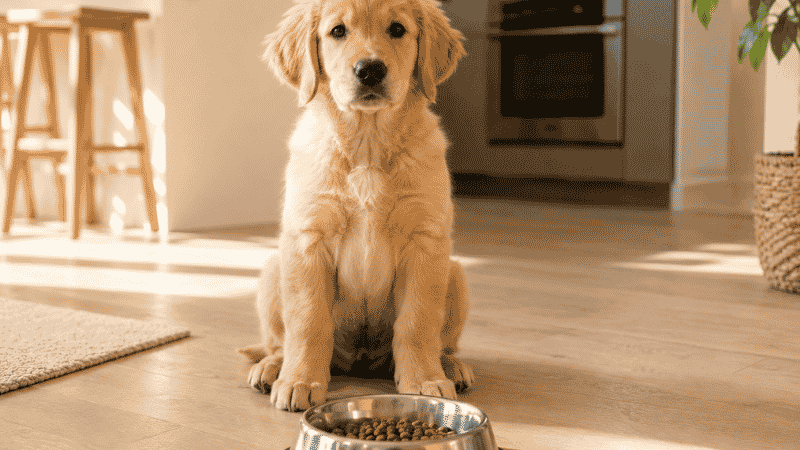
The feeding frequency question has a clear answer — it just changes as your puppy grows.
Four meals a day for the first 12 weeks. Three meals from 12 weeks to 6 months. Two meals from 6 months onward, though small breeds often need to stay on three meals a little longer.
Within each stage: consistent timing, measured portions, no food left out between meals, and the last meal of the day at least 3 hours before bedtime. That’s the system. It’s simple in principle — the challenge is the consistency required to make it actually work.
The payoff: a puppy whose blood sugar stays stable, whose digestion runs smoothly, whose potty training moves faster because elimination is predictable, and who develops the healthy eating habits that serve them well for the rest of their life.
What to Read Next
Feeding frequency is one part of getting puppy nutrition right. These guides cover the rest:
- What to Feed a Puppy: The No-Confusion Food Guide — How to choose the right puppy food, what the AAFCO label means, and when to switch to adult food
- How to Potty Train a Puppy: The Step-by-Step Guide — How to use your feeding schedule to build a predictable potty routine
- New Puppy Checklist: Everything You Need Before Day One — The complete preparation guide including feeding supplies and the vet appointment to book in week one
- Puppy Development Stages: Week-by-Week Guide — How your puppy’s nutritional needs change alongside their physical and behavioral development
References
- American Kennel Club. (2026). Puppy Feeding Fundamentals: Timeline for Puppy Feeding. akc.org
- PetMD / Veterinary Review Team. (2026). How Much to Feed a Puppy. petmd.com
- Chewy / Patton, R., PhD. (2025). Puppy Feeding Guide: How Much to Feed a Puppy. chewy.com
- Association for Pet Obesity Prevention. (2024). National Pet Obesity Prevalence Survey. petobesityprevention.org
- Purina / Millican, A., PhD. (2026). How Much to Feed a Puppy Chart. purina.com
- JustFoodForDogs / Veterinary Team. (2026). How Much to Feed a Puppy. justfoodfordogs.com