
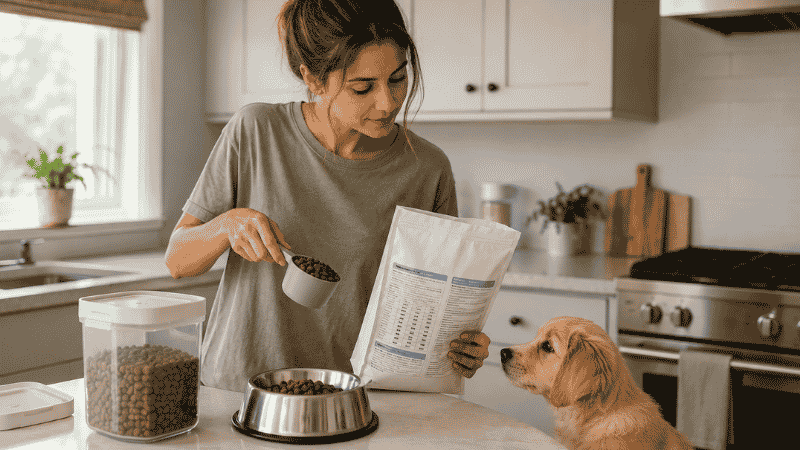
You’ve got the food. You’ve got the bowl. And now you’re standing in the kitchen holding a measuring cup, staring at the back of the bag, trying to figure out if the chart they’ve printed there is actually meant for your specific puppy or just a dog that happens to weigh the same.
Then you Google “how much to feed a puppy” and find seventeen different charts that all give slightly different numbers.
Here’s what nobody tells you upfront: there is no single universal answer. How much your puppy needs depends on their age, their current weight, their projected adult weight, their breed size, their activity level, and the calorie density of the specific food you’re feeding. The numbers on a generic chart are a starting point — not a prescription.
This guide explains exactly how to find the right amount for your specific puppy, how to adjust as they grow, what signs tell you the portion is too much or too little, and how to use the feeding chart on your food bag correctly — because that chart, specific to your food’s calorie content, is always more accurate than any generic guide.
Key Takeaways
- The feeding chart on your specific food’s packaging is your primary reference. Generic charts are estimates — the chart on your bag accounts for your food’s actual calorie density.
- Puppy feeding amounts are based on projected adult weight, not current weight. A 10-week-old Labrador and a 10-week-old Chihuahua need very different amounts even if they weigh the same right now.
- Portion needs change constantly in the first year — what’s right at 8 weeks is too little at 16 weeks, and what’s right at 4 months is too much at 9 months.
- Treats count. The 90/10 rule: 90% of daily calories from complete puppy food, maximum 10% from treats. This matters for training-heavy periods.
- Body condition score — not the number on a scale — is the most reliable ongoing indicator of whether your puppy is eating the right amount.
Why “How Much” Is More Complicated Than It Looks
Most new owners expect a simple answer: “Feed your puppy X cups per day.” The reality is that the right amount varies based on several factors that change simultaneously as your puppy grows.
Calorie density varies by food
A cup of one puppy food might contain 340 calories. A cup of another might contain 450 calories. If you use the same cup measurement for both foods, you’re feeding very different amounts of energy. This is why generic feeding charts — which don’t account for the calorie content of your specific food — can be significantly off.
The calorie content (kcal per cup or kcal per kilogram) is printed on every bag of puppy food. This number is the foundation of accurate portioning.
Projected adult weight drives puppy portions
Puppy feeding charts use projected adult weight — the size your puppy will be fully grown — not their current weight. This is because the growth rate and nutritional needs of a puppy destined to weigh 70 lbs are very different from one who will weigh 12 lbs, even if both currently weigh 8 lbs.
Purebred puppy owners can look up typical adult weights for their breed. For mixed breeds, your veterinarian can estimate projected adult size based on the puppy’s current weight, paw size, and known parent breeds.
Needs change faster than most owners expect
A puppy’s caloric requirement relative to body weight is highest in the first few months and decreases as growth slows. A 3-month-old puppy needs more food per pound of body weight than a 9-month-old. And a 9-month-old needs more than an adult. The portion that was right last month is often wrong this month — which is why regular weigh-ins and periodic portion adjustments matter.
How to Read the Feeding Chart on Your Food Bag
This is the most practical skill in puppy feeding, and most owners skip it.
Every reputable puppy food bag includes a feeding chart. It typically looks like a grid with age across one axis and projected adult weight across the other, with daily cup amounts in each cell. Here’s how to use it correctly.
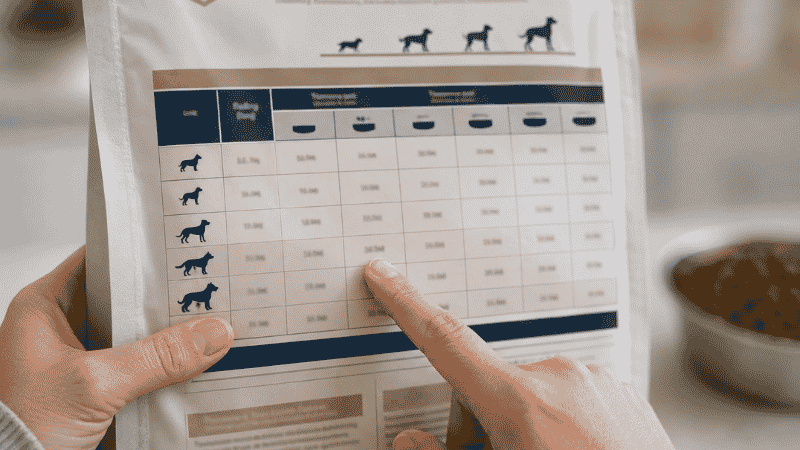
Step 1: Find your puppy’s projected adult weight. Not their current weight — how much they’ll weigh as a fully grown adult. For purebred dogs, breed standards give you this. For mixed breeds, ask your vet.
Step 2: Find your puppy’s current age. Most charts have age ranges: 8 to 12 weeks, 3 to 4 months, 5 to 6 months, and so on.
Step 3: Find where the two intersect. That cell gives you the daily amount recommended for that food specifically.
Step 4: Divide by number of meals. If the chart says 1.5 cups per day and you’re feeding three meals, that’s half a cup per meal.
Step 5: Reassess monthly. As your puppy ages, move down the age row on the chart. As they gain weight, confirm you’re still in the right weight column.
One important caveat: the amounts on feeding charts are guidelines, not guarantees. They assume average activity level and average metabolism. Your puppy may need slightly more or less — which is why body condition monitoring (covered below) matters as much as the chart itself.
Puppy Feeding Chart by Breed Size and Age
The following table provides general daily feeding guidelines based on projected adult weight. These figures assume a standard puppy kibble with approximately 380 to 420 calories per cup. If your food has significantly more or fewer calories per cup, adjust proportionally.
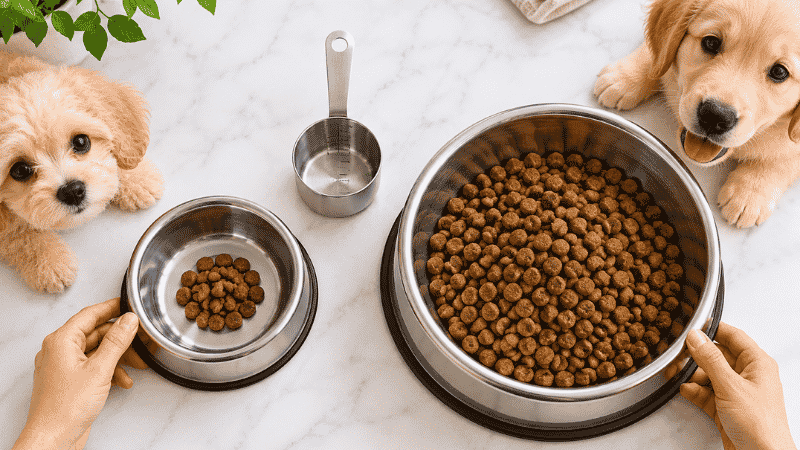
Always cross-reference with the chart on your specific food’s packaging.
Toy and Small Breeds (Projected Adult Weight Under 20 lbs)
Examples: Chihuahua, Yorkshire Terrier, Maltese, Toy Poodle, Shih Tzu
| Age | Daily Amount |
|---|---|
| 8–12 weeks | ¼ to ½ cup |
| 3–4 months | ½ to ¾ cup |
| 5–6 months | ½ to ¾ cup |
| 7–9 months | ⅓ to ½ cup |
| 10–12 months | ⅓ to ½ cup |
Note: Small breed puppies have higher metabolic rates per pound and higher hypoglycemia risk. Never skip meals or allow more than 4 to 5 hours between meals during the first few months.
Medium Breeds (Projected Adult Weight 20–50 lbs)
Examples: Beagle, Cocker Spaniel, Border Collie, Bulldog, Whippet
| Age | Daily Amount |
|---|---|
| 8–12 weeks | ¾ to 1¼ cups |
| 3–4 months | 1 to 1¾ cups |
| 5–6 months | 1¼ to 2 cups |
| 7–9 months | 1 to 1¾ cups |
| 10–12 months | ¾ to 1½ cups |
Large Breeds (Projected Adult Weight 50–90 lbs)
Examples: Labrador Retriever, Golden Retriever, German Shepherd, Boxer
| Age | Daily Amount |
|---|---|
| 8–12 weeks | 1 to 2¼ cups |
| 3–4 months | 1½ to 3 cups |
| 5–6 months | 2 to 3½ cups |
| 7–9 months | 2½ to 4 cups |
| 10–12 months | 2 to 3½ cups |
Critical note for large breeds: Large breed puppies must be fed a large breed puppy formula, not a standard puppy food. Standard puppy foods have higher calcium content that can cause developmental orthopedic disease in rapidly growing large breeds. The feeding amounts above assume a large breed specific formula.
Giant Breeds (Projected Adult Weight 90+ lbs)
Examples: Great Dane, Saint Bernard, Newfoundland, Irish Wolfhound
| Age | Daily Amount |
|---|---|
| 8–12 weeks | 2 to 3½ cups |
| 3–4 months | 3 to 4½ cups |
| 5–6 months | 3½ to 5 cups |
| 7–9 months | 4 to 6 cups |
| 10–12 months | 4 to 5½ cups |
Giant breed puppies are the highest risk group for growth-related skeletal problems. Controlled, steady growth is the goal — not rapid growth. Consult your veterinarian for specific guidance on giant breed portioning, and never free feed.
How to Measure Accurately
One of the most common puppy feeding errors is inconsistent measuring. “A cup” means very different things depending on whether you’re using a proper 8-ounce measuring cup, a coffee mug, or scooping from the bag with whatever’s handy.
Use a proper dry measuring cup — the kind used for cooking, not a drinking cup. Level the top rather than heaping it.
Consider a kitchen scale. Weighing food in grams is more accurate than cup measurements because dry kibble varies in how densely it packs. Most premium puppy foods list both cup amounts and gram weights on their packaging. If yours does, use grams.
Keep the measuring cup near the food. The easier it is to measure accurately, the more likely you are to do it consistently.
Adjusting Portions: When and How
The feeding chart gives you a starting point. Real-world portioning is an ongoing process of observation and adjustment.
Signs you may be feeding too much
- Weight gain that seems faster than expected for the age
- A rounder, less defined belly between meals (not just right after eating)
- Consistently leaving food in the bowl
- Stools that are soft, large, or more frequent than typical
Signs you may be feeding too little
- Finishing every meal extremely quickly and looking for more
- Visible ribcage without needing to look carefully (you should be able to feel ribs with gentle pressure, but not see them)
- Lower energy than typical for the age
- Slower weight gain than expected
The body condition score method
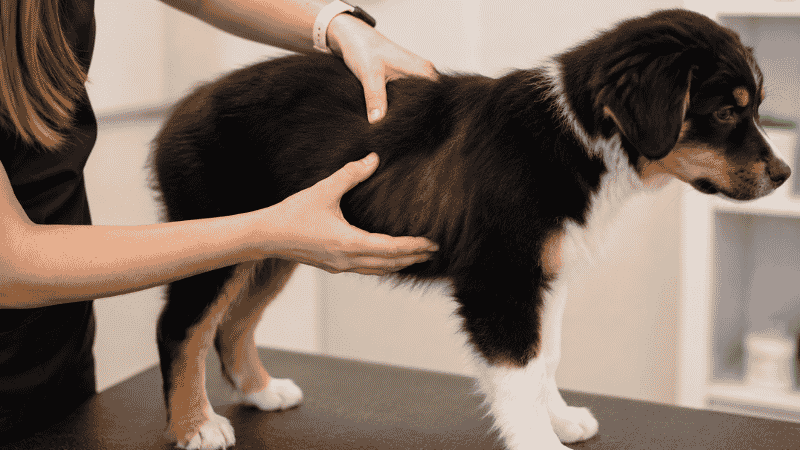
Rather than relying solely on the scale, veterinarians use a 9-point Body Condition Score (BCS) to assess whether a dog is at an ideal weight. For puppies, the target is generally 4 to 5 out of 9. Here’s a simplified version:
Too thin (BCS 1–3): Ribs, spine, and hip bones clearly visible from across the room. No fat covering. Increase portions by 10% and recheck in two weeks.
Ideal (BCS 4–5): Ribs easily felt with gentle pressure but not visible. Slight waist visible from above. Abdomen tucks up slightly when viewed from the side. Maintain current portions.
Overweight (BCS 6–7): Ribs felt only with firm pressure. No waist definition from above. Belly doesn’t tuck. Reduce portions by 10% and recheck in two weeks.
Obese (BCS 8–9): Ribs not felt even with firm pressure. No definition anywhere. Consult your veterinarian before making portion changes.
Check your puppy’s body condition monthly and adjust portions accordingly. Small adjustments (10%) are safer than large corrections.
The 90/10 Rule for Treats

Training a puppy means using a lot of treats. In the first several months, a dedicated new owner can easily give twenty, thirty, or more treat rewards in a single day of training sessions.
Those treats have calories. If you’re giving 200 calories of treats and feeding the chart amount on top of that, your puppy is significantly overeating.
The 90/10 rule: No more than 10% of your puppy’s daily caloric intake should come from treats. The remaining 90% comes from their complete, balanced puppy food.
In practice, this means:
- Calculate your puppy’s approximate daily caloric need (the feeding chart’s recommended amount × calories per cup)
- Take 10% of that number
- That’s your maximum daily treat budget in calories
- On high-training days, reduce the meal portion accordingly
For a puppy with a 600 calorie daily need: 540 calories from food, maximum 60 calories from treats. If your training treats are 5 calories each, that’s 12 treats before you need to start adjusting meal portions.
Use small treats — pea-sized or smaller — during training sessions. They satisfy the positive reinforcement function without consuming your treat budget in three sessions.
Special Situations That Affect Portion Size
High-activity puppies
Puppies who are unusually active — participating in puppy agility, spending long periods outdoors, or in particularly active households — may need portions at the higher end of the range or slightly above. Monitor body condition and adjust.
Low-activity puppies
Puppies who are recovering from illness, injury, or who are naturally less active may need portions at the lower end. Again, body condition guides the adjustment.
Wet food combined with dry
If you’re mixing wet food with dry kibble — a common practice for picky eaters or as a meal topper — you need to account for both. Wet food has significantly fewer calories per volume than dry kibble. Check the calorie content of your specific wet food and reduce the dry kibble portion to compensate.
A rough guideline: replace 25% of the dry food calories with an equivalent amount of wet food calories, keeping the total the same.
Post-spay or neuter
Spaying and neutering reduces metabolic rate in most dogs. After the procedure, your puppy’s caloric needs may decrease by approximately 20 to 30%. Many owners notice weight gain in the months following surgery without changing portions. This is the time to reduce portions slightly and monitor closely.
When to Reduce Portions as Your Puppy Grows
Puppy feeding charts typically show amounts increasing through the peak growth phase, then decreasing as your puppy approaches adult size. This decrease surprises many owners — the puppy is bigger, so surely they need more food?
The reality is that as growth rate slows, so does caloric demand per unit of body weight. A puppy at 80% of their adult size is growing much more slowly than they were at 50% of adult size, even if they weigh more. Their maintenance requirement is rising, but the growth premium is falling.
Signs your puppy’s growth is slowing and portions should be adjusted:
- They begin consistently leaving food in the bowl after eating normally for months
- Weight gain has plateaued
- They’re reaching the expected adult weight range for their breed and age
When to transition to adult food:
Small breeds: 9 to 12 months Medium breeds: 12 months Large breeds: 12 to 18 months Giant breeds: 18 to 24 months
When you transition, reduce portions by approximately 20 to 25% initially (adult maintenance needs are lower than puppy growth needs), then adjust based on body condition.
Common Puppy Feeding Mistakes
Feeding by eye instead of by measure. “A handful” or “about a cup” introduces significant inconsistency. Use a measuring cup or scale every time, at least until you have an accurate sense of your puppy’s needs.
Not adjusting as the puppy grows. The chart amount at 8 weeks is not the right amount at 6 months. Reassess monthly.
Free feeding. Leaving food available at all times removes your ability to monitor intake, complicates potty training, and often leads to overeating. Scheduled, measured meals are strongly preferable for most puppies.
Using human food to supplement. Many human foods are toxic to dogs. Those that aren’t often have very different caloric density and nutritional profiles than puppy food. Human food supplements disrupt the nutritional balance of a complete diet.
Overfeeding large and giant breed puppies “to help them grow.” Accelerated growth in large breeds increases the risk of developmental orthopedic disease. Controlled, steady growth is healthier than rapid growth. More food is not better for large breed puppies.
Ignoring treats in the total calorie count. Treats are part of the daily caloric intake. Heavy training periods require meal portion reductions to compensate.
FAQ: What New Puppy Owners Actually Search For
How many cups of food should I feed my puppy? It depends on your puppy’s projected adult weight, current age, and the calorie content of your specific food. Consult the feeding chart on your food’s packaging as the primary reference. General estimates: toy breeds need ¼ to ½ cup daily at 8 to 12 weeks; medium breeds 1 to 1¼ cups; large breeds 1½ to 2¼ cups. These vary significantly by food brand.
Should I feed my puppy the exact amount on the bag? Use it as your starting point. Monitor body condition monthly and adjust by 10% increments if your puppy is gaining too quickly or too slowly. The bag amount assumes average activity and metabolism.
How do I know if I’m feeding my puppy enough? Use the body condition score method: you should be able to feel your puppy’s ribs with gentle pressure but not see them. There should be a visible waist from above. If ribs are visible or your puppy seems constantly hungry beyond what’s normal, increase portions slightly.
Can I feed my puppy more if they seem hungry all the time? Puppies often seem hungry regardless of how much they’ve eaten — food motivation is normal. Before increasing portions, check body condition. If BCS is ideal, the hunger is behavioral, not nutritional. If BCS indicates underweight, gradually increase portions.
How much should I reduce portions when my puppy is neutered or spayed? Most veterinarians recommend reducing portions by 20 to 25% after spaying or neutering, as metabolic rate decreases following the procedure. Monitor body condition closely in the months after surgery and adjust as needed.
How do treats factor into puppy feeding amounts? Treats should make up no more than 10% of daily caloric intake. On days with intensive training, reduce meal portions to compensate for treat calories. Use small, low-calorie treats to extend your training budget.
When should I stop feeding puppy food? Small breeds at 9 to 12 months, medium breeds at 12 months, large breeds at 12 to 18 months, giant breeds at 18 to 24 months. Transition gradually over 7 to 10 days to avoid digestive upset.
The Bottom Line
How much to feed your puppy is not a question with one permanent answer — it’s an ongoing calibration that shifts as your puppy grows, their metabolism changes, and their food intake needs evolve.
The process is simpler than it sounds. Start with the feeding chart on your specific food’s packaging. Use projected adult weight, not current weight. Measure accurately. Check body condition monthly. Adjust by 10% increments when needed. Account for treat calories. Reassess at each life stage transition.
That’s the whole system. The chart and the monthly body condition check do most of the work — your job is to actually do them consistently rather than eyeballing and hoping.
A puppy fed the right amount, at the right frequency, from the right food, grows into an adult dog with a healthy weight, strong joints, and a body built to last. That outcome starts with accurate portioning in the first year.

What to Read Next
Portion size is one part of getting puppy feeding right. These guides cover the rest:
- How Often to Feed a Puppy: Complete Schedule by Age — How many meals per day at every stage, and what happens when you get the frequency wrong
- What to Feed a Puppy: The No-Confusion Food Guide — How to choose the right food, what the AAFCO label actually means, and the grain-free debate
- Puppy Development Stages: Week-by-Week Guide — How your puppy’s nutritional needs connect to their physical and behavioral development
- New Puppy Checklist: Everything You Need Before Day One — Complete preparation guide including feeding supplies and what to have ready before your puppy arrives
References
- Purina. (2026). How Much to Feed a Puppy? Puppy Feeding Chart & Guide. purina.com
- PetMD / Veterinary Review Team. (2026). Dog Feeding Chart: How Much Food Should I Feed My Dog? petmd.com
- Association of American Feed Control Officials. (2026). AAFCO Dog Food Nutrient Profiles. aafco.org
- Pawlicy Advisor / Veterinary Team. (2024). How Much To Feed A Puppy: Chart By Weight & Age. pawlicy.com
- Bestie Paws Hospital. (2026). Puppy Feeding Chart by Weight & Age. bestiepaws.com
- Larson, J., & Newman, S.J. (2020). Developmental Orthopedic Disease in Large Breed Dogs. Veterinary Clinics of North America: Small Animal Practice.