
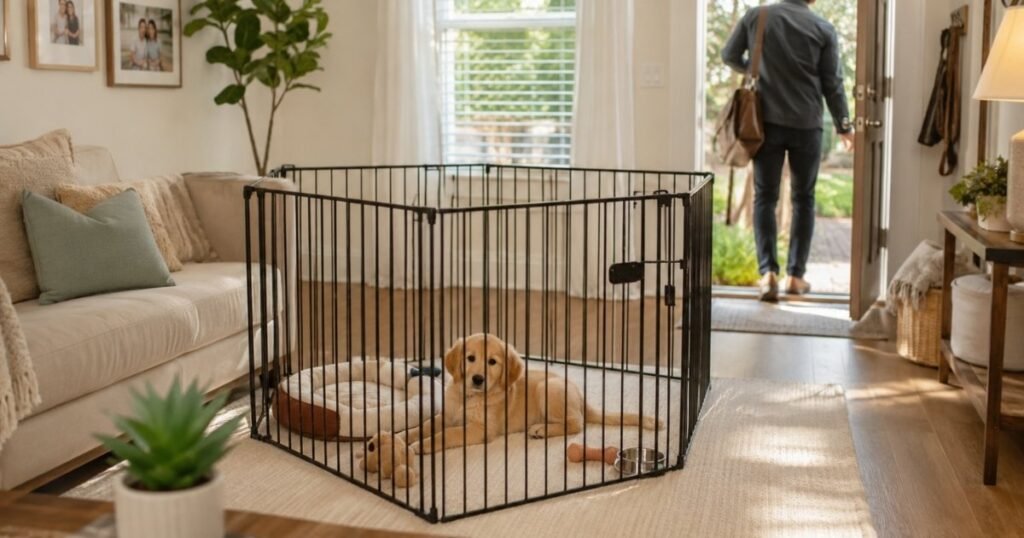
Leaving your new puppy home alone for the first time can feel harder than expected. One question almost every new owner asks is: how long can you leave a puppy alone?Whether you’re heading to work, running errands, or attending class, it’s normal to worry about leaving your puppy behind.
A puppy’s safe alone time depends on its bladder control, confidence, previous alone-time training, and the space it’s stays in. Sleeping through the night also doesn’t mean a puppy is ready to stay home alone for the same number of hours during the day.
In this guide, you’ll find realistic age-by-age time limits, practical training steps, safe setup tips, and a working owner’s schedule to help your puppy become comfortable being home alone—at a pace that’s both safe and realistic.
Quick Answer: Puppy Alone-Time Limits by Age
Here’s the short version before we get into the details. Treat these numbers as a starting point, not a guarantee — some puppies need less time, and pushing straight to the maximum too soon is one of the most common mistakes new owners make.
| Puppy Age | Approximate Daytime Potty Interval | Recommended Planned Absence | Best Confinement Setup | Midday Support Needed |
|---|---|---|---|---|
| 8–10 weeks | 1–2 hours | Up to about 1 hour | Crate + playpen combo | Yes, frequently |
| 10–12 weeks | 1–2 hours | About 1–2 hours | Playpen with potty area | Yes, likely |
| 3 months | 2–3 hours | About 2–3 hours | Playpen or puppy-proofed pen | Often yes |
| 4–5 months | 3–4 hours | About 3–4 hours | Crate, playpen, or safe room | Sometimes |
| 6 months+ | Gradually 4–6 hours | Up to 4–6 hours, if trained | Puppy-proofed room or larger space | Occasionally |
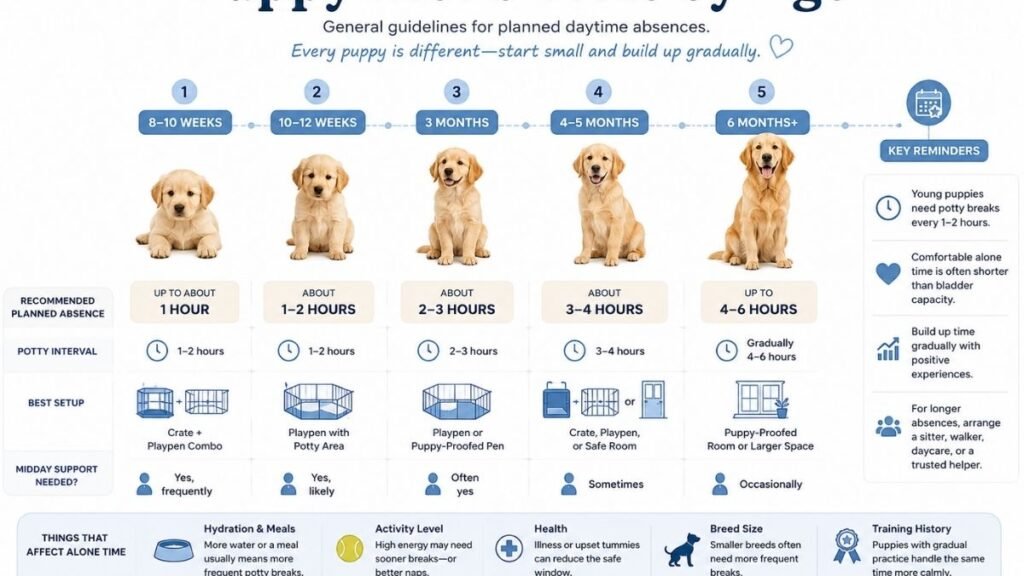
Key points worth remembering:
- Puppies under 10 weeks generally need a potty opportunity and a human check-in every 1–2 hours while awake.
- A 3-month-old puppy may typically manage around 2–3 hours alone.
- A 4-month-old puppy may typically manage around 3–4 hours.
- A puppy around 6 months old may gradually handle 4–6 hours, but only if it’s already trained and comfortable being alone.
- Young puppies should not routinely be left alone for a full 8-hour workday without extra support.
- The “age in months plus one hour” formula is a rough bladder estimate, not a complete answer.
- Comfortable alone time is often shorter than physical bladder capacity — those are two different things.
- Whenever an absence is going to exceed your puppy’s current limit, line up a sitter, walker, daycare visit, or a neighbor, friend, or family member to help.
How Long Can You Leave a Puppy Alone? Age-by-Age Guidelines
Direct answer: as a general guide, an 8–10-week-old puppy can typically manage about an hour alone, a 3-month-old around 2–3 hours, a 4–5-month-old around 3–4 hours, and a puppy around 6 months can gradually work up to 4–6 hours — but these are starting points, not fixed rules.
Age charts are useful because they give you somewhere to start, but they can be misleading if you treat them as guarantees. A newly adopted 4-month-old puppy that just left a breeder or shelter often tolerates less alone time than a 4-month-old that’s been in the same home since 8 weeks and has already had weeks of gradual practice. History matters just as much as age.
A handful of everyday factors shift these limits in either direction:
- Hydration and meals. A puppy that just drank a full bowl of water or ate a meal will likely need a potty break sooner than the chart suggests.
- Activity level. A puppy that just had a big play session may need to go out sooner — or may actually settle faster into a nap, depending on the puppy.
- Health. Anything from a mild stomach upset to a urinary tract issue can shrink the safe window considerably.
- Breed size. Smaller breeds generally have smaller bladders relative to their size and may need more frequent breaks than a same-age large-breed puppy.
- Training history. A puppy that’s practiced gradual alone time tends to handle the same duration more calmly than one that hasn’t.
8–10 Weeks: About 1 Hour
At this age, bladder control is extremely limited, and separation from littermates is still very recent. Puppies this young need frequent human contact and potty opportunities throughout the day — expecting a single nap cycle to double as a “safe” long absence usually backfires.
10–12 Weeks: About 1–2 Hours
Many puppies start tolerating short, planned departures around this age, but they’ll still likely need several check-ins spread across a full day.
3 Months: About 2–3 Hours
How much alone time a 3-month-old can handle depends heavily on how much practice it’s already had. Longer absences at this stage usually call for a playpen setup with a designated potty area rather than a small crate.
4–5 Months: About 3–4 Hours
Bladder control and the ability to self-settle typically improve noticeably during this stage. That said, it’s still worth watching for accidents or signs of distress rather than assuming the improvement is permanent.
6 Months and Older: Gradually Toward 4–6 Hours
Some puppies can manage longer stretches by six months, but not all of them — adolescence sometimes brings temporary potty or behavior regressions that catch owners off guard. It’s a mistake to assume every 6-month-old is automatically ready for a six-hour stretch; readiness should be demonstrated, not assumed from age alone.
Why Night-Time and Daytime Limits Are Different
This is one of the most common points of confusion for new owners, and it’s worth addressing directly: a puppy sleeping through the night does not mean it’s ready for the same number of hours alone during the day.
- Activity and urine production both slow down significantly during sleep.
- During the day, eating, drinking, playing, and general excitement all increase how often a puppy needs to go.
- Sleeping soundly overnight says nothing about whether a puppy feels emotionally secure being alone while awake.
Puppy to sleep a full eight hours overnight in its crate without any trouble, yet struggle badly with a much shorter daytime absence. That’s not a contradiction — it reflects two genuinely different physical and emotional states.
Related reading: How Much Do Puppies Sleep? The Complete Guide by Age
Is Your Puppy Ready to Stay Home Alone?
The first few times I left my puppy alone, I was tempted to make each session a little longer whenever things seemed to go well. I learned pretty quickly that one successful afternoon didn’t mean my puppy was ready for a big jump in freedom. Before extending your puppy’s alone time or giving it more space, look for these signs first—they’re a much better guide than simply relying on age.
Signs Your Puppy Can Stay Alone Longer
- Settles calmly and willingly in its designated safe space
- Stays relatively calm when you move to another room
- Has already completed shorter departures without accidents
- Eats or engages with enrichment after you leave
- Settles down after a brief period of whining rather than escalating
- Shows predictable, consistent potty habits
- Doesn’t scratch, climb, chew at barriers, or attempt to escape
- Recovers calmly once you return, without excessive relief or panic
Signs Your Puppy Needs More Practice
- Persistent barking or howling that doesn’t taper off
- Refusing to eat, even a high-value treat
- Repeated accidents despite a recent potty break
- Pacing, panting, or drooling
- Attempts to escape the crate, pen, or room
- Destructive chewing focused specifically on doors or barriers
When to Increase Time or Space
A useful rule here: only increase duration after several successful sessions in a row, and change one variable at a time — either the length of the absence or the amount of available space, not both together. If a session goes badly, it’s worth stepping back to an easier stage rather than pushing forward and hoping it improves on its own.
One pattern that surprises a lot of new owners: an older puppy that’s never practiced being alone can actually need shorter sessions at first than a much younger puppy that’s had weeks of gradual, successful practice. Age alone doesn’t guarantee readiness — repetition does.
Is Your Puppy Ready for More Alone Time? Checklist
- [ ] Potty needs have been met before the session
- [ ] Puppy is comfortable in its designated safe area
- [ ] Puppy stays calm during brief separations
- [ ] No escape behavior has been observed
- [ ] Puppy uses enrichment items safely
- [ ] The previous, shorter duration was completed successfully
- [ ] Camera footage (if available) shows resting or quiet activity
How to Help Your Puppy Feel Comfortable Being Alone
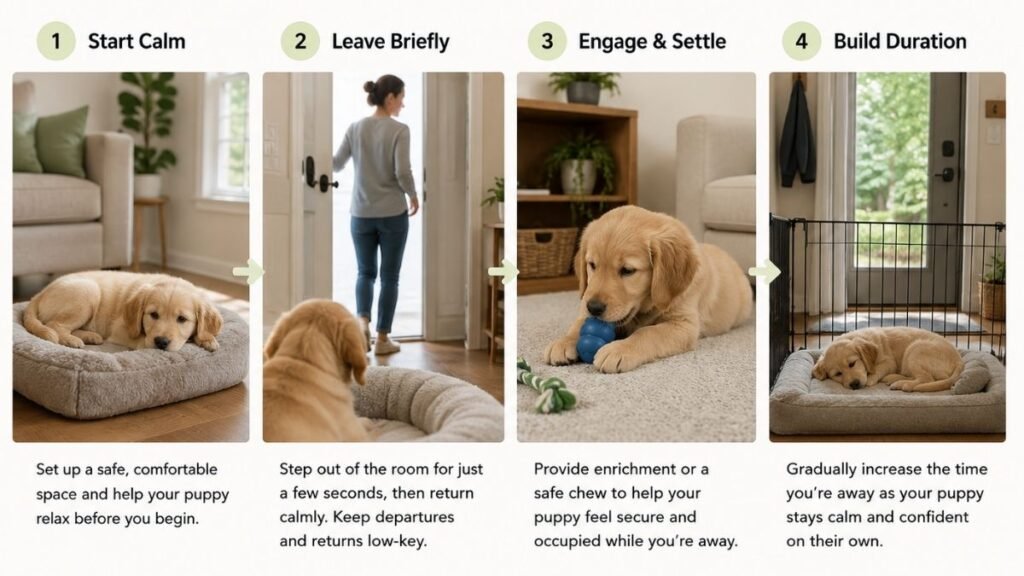
I learned pretty quickly that puppies don’t become comfortable being alone overnight. What worked was starting with just a few seconds apart and building up gradually, one successful session at a time.
Stage 1: Independence While You Are Home
Encourage your puppy to rest on its own bed or in a pen nearby, and move around the room yourself without constant petting or chatting. Reward calm, independent behavior rather than attention-seeking or following you everywhere.
Stage 2: Brief Out-of-Sight Practice
Step behind a door for just a few seconds, then come back while your puppy is still calm — not after it starts crying. Repeat this at different times of day so it doesn’t become tied to one specific routine.
Stage 3: Desensitize Departure Cues
Puppies quickly learn to associate keys, shoes, or coats with you leaving, which can trigger anxiety before you’ve even reached the door. Pick up your keys without leaving. Put on your shoes or coat, then sit back down. Open and close the front door without actually going anywhere. The goal is to stop these everyday cues from automatically triggering panic.
Stage 4: Step Outside Briefly
Start with just a few seconds outside the door, then gradually work up to one minute, two minutes, five minutes, and fifteen minutes. A camera can be genuinely useful here, letting you see how your puppy behaves the moment the door closes.
Stage 5: Extend to Age-Appropriate Absences
Increase the duration in small increments, and mix in some shorter sessions along with longer ones rather than only ever pushing the maximum. Avoid extending the time right after a difficult session — give your puppy a chance to succeed at the current level again first.
| Training Goal | Owner Action | Success Signal | When to Repeat | When to Shorten |
|---|---|---|---|---|
| 5–10 seconds | Step out of sight briefly | Puppy stays calm or barely notices | If puppy seems unsettled | If puppy panics immediately |
| 30 seconds | Close door, wait, return | Puppy is quiet or settling | Daily, varied times | If whining escalates |
| 1–2 minutes | Leave room, stay nearby | Puppy explores or rests | A few times before advancing | If barking doesn’t pause |
| 5 minutes | Step outside briefly | Puppy engages with enrichment | Multiple successful reps | If accidents occur |
| 15 minutes | Short outdoor errand | Puppy rests or plays quietly | Several sessions per week | If distress increases |
| 30 minutes | Quick errand | Calm on return, no accidents | Continue building gradually | If puppy seems anxious after |
| 60 minutes | Short outing | Normal reunion behavior | Repeat before extending further | If regression appears |
| Longer age-appropriate periods | Planned absence | Matches age-based limit above | Maintain consistency | Return to shorter stage if needed |
Before Each Alone-Training Session Checklist
- [ ] Puppy has had a potty break
- [ ] Puppy is not overtired or overstimulated
- [ ] Safe enrichment item is ready
- [ ] Confinement space has been checked
- [ ] Session length is realistic for this stage
- [ ] You can return before things escalate
Practicing departure cues — picking up keys, putting on shoes, opening the door — without actually leaving tends to reduce a puppy’s reaction to those same cues on real departure days. It’s a simple trick, but it works because it breaks the automatic link between “keys jingling” and “panic.”
Crate, Playpen, or Puppy-Proofed Room: Which Is Best?
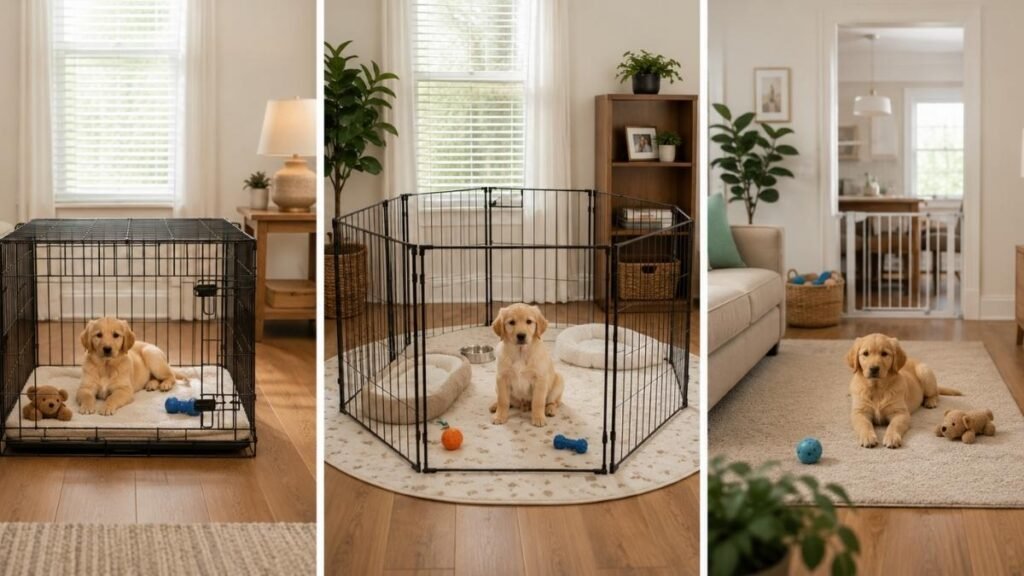
use a crate for short, planned absences and naps; use a playpen for longer daytime stretches that need room to move and access to water; move to a puppy-proofed room once your puppy has reliable potty habits and has stopped chewing unsafe items.
| Best For | Recommended Puppy Stage | Suitable Absence Type | Space Available | Potty Setup | Main Benefit | Main Limitation | |
|---|---|---|---|---|---|---|---|
| Crate | Short absences, planned naps | Puppies already comfortable with crate training | Under 2–3 hours | Minimal | Not included | Secure, promotes settling | Too confining for long daytime stretches |
| Playpen | Longer daytime absences | Most puppies from 8 weeks onward | 2–6 hours | Moderate to spacious | Can include a designated area | Room to move, stretch, drink water | Requires more setup and cleaning |
| Puppy-proofed room | Older, more reliable puppies | Puppies with consistent potty habits and safe chewing behavior | Full workday, gradually | Large | Usually not needed | Closer to full house freedom | Requires thorough proofing first |
When to Use a Crate
A crate works well for short absences, planned naps, and puppies that are already comfortable with crate training. It’s not designed for extended daytime confinement — a crate that’s fine for an afternoon nap isn’t automatically appropriate for a full workday.
When to Use a Playpen
A playpen makes sense once absences run longer than a comfortable crate stretch. It gives a puppy room to stretch, play, and reach water, and it can include a separate area for potty needs if the absence is long enough to require one.
When to Use a Puppy-Proofed Room
This option generally suits older puppies with reliable potty habits that have also stopped chewing on unsafe objects. It works well as a gradual step toward greater freedom around the house.
How to Arrange a Safe Puppy Zone
A well-arranged space keeps the sleeping area separate from the potty area, uses washable flooring, includes a stable (non-tip) water bowl, has secure barriers, and stays at a comfortable temperature with good ventilation.
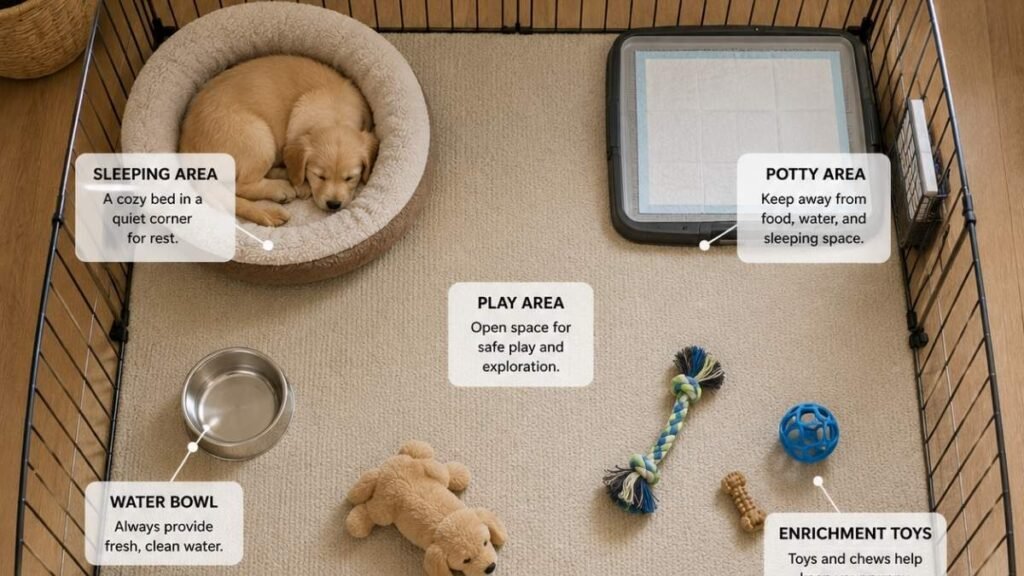
Puppy-Safe Area Inspection Checklist
- [ ] Electrical cords removed or covered
- [ ] Cleaning products secured out of reach
- [ ] Trash is inaccessible
- [ ] Blind and curtain cords removed or tied up
- [ ] Small swallowable objects cleared from the area
- [ ] Plants checked for toxicity
- [ ] Furniture is stable and can’t tip over
- [ ] Water bowl is secured against spills
- [ ] Toys have been tested under supervision first
- [ ] Collar and tags removed if there’s any snagging risk
- [ ] Temperature and direct sunlight exposure checked
- [ ] Camera angle covers the entire space
It’s fairly common for a fully crate-trained puppy to still need a larger playpen setup once daytime absences get longer — crate training and “ready for a bigger space” are two separate milestones, and reaching one doesn’t automatically mean the other is covered too.
What to Do Before Leaving Your Puppy Alone
Found that what happened before I left mattered just as much as how long I was gone. A simple routine—potty break, light activity, and a calm departure—helped my puppy settle much more easily.
30 Minutes Before Leaving
- Take your puppy out for a potty opportunity
- Go for a calm walk or engage in gentle play
- Include a short sniffing activity, which tends to be mentally tiring in a good way
- Run a brief, simple training session
10 Minutes Before Leaving
- Let any excitement from activity settle down
- Move your puppy into its designated safe area
- Double-check water and the general environment
- Prepare the enrichment item you plan to leave
At the Door
- Keep your body language neutral and low-key
- Skip repeated reassurance or a long, emotional goodbye
- Hand over the enrichment item
- Leave calmly, without lingering
The 30-Minute Pre-Departure Checklist
- [ ] Potty break completed
- [ ] Calm physical activity completed
- [ ] Sniffing or training activity included
- [ ] Puppy has settled down
- [ ] Water has been checked
- [ ] Enrichment item tested and ready
- [ ] Safe zone inspected
- [ ] Camera activated
- [ ] Departure kept low-key
A pattern many owners notice once they try this: ending the pre-departure routine with calm sniffing or basic training, rather than a burst of chasing or rough play, often leaves a puppy more ready to settle down and rest than one that’s still keyed up from an exciting game right before the door closes.
What Can You Safely Leave With a Puppy?
Only leave items your puppy has already used safely under supervision — durable food-stuffable toys and tested chews are generally safer bets than rope toys, rawhide, or soft plush items.
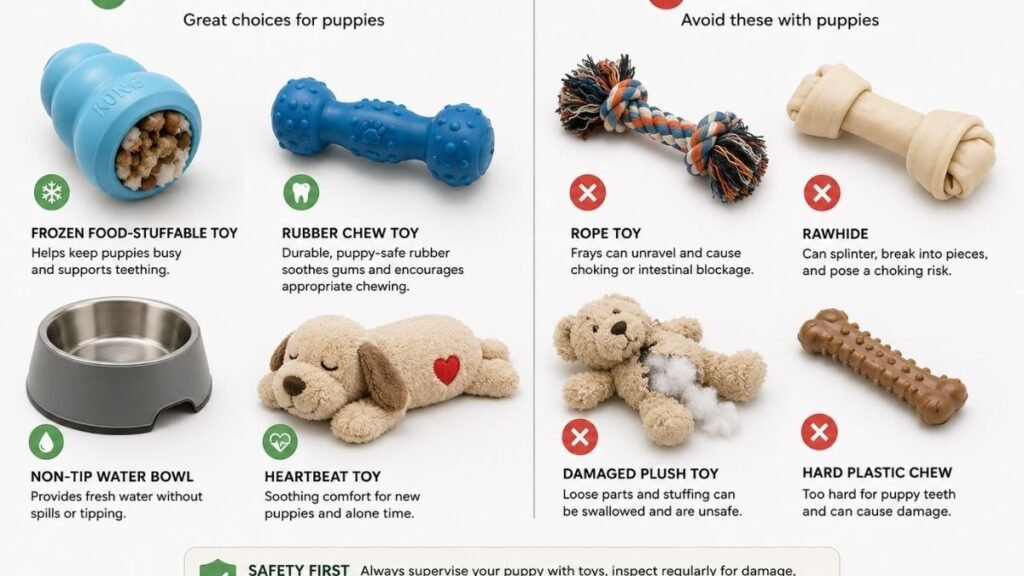
Safer Options for Unsupervised Enrichment
- Durable, size-appropriate food-stuffable toys
- Chew items that have already been approved through supervised use
- A stable, non-tip water bowl
- A comfort item that’s been tested and proven safe beforehand
Items That Require Supervised Testing First
- Lick mats
- Snuffle mats
- Puzzle toys
- Soft bedding
- Heartbeat toys
Items to Avoid When Nobody Is Home
- Easily shredded plush toys
- Rope toys that can unravel
- Rawhide
- Toys with loose squeakers
- Small chews that could be swallowed whole
- Damaged or cracked plastic toys
- Unsecured food containers
| Item Type | Potential Benefit | Main Risk | Suitable for Unsupervised Use? | Supervised Test Required | Best Use Case |
|---|---|---|---|---|---|
| Durable food-stuffable toy | Long-lasting engagement | Low, if size-appropriate | Yes, once tested | Yes, once | Regular unsupervised use |
| Frozen food toy | Extended engagement time | Melting mess if left too long | Yes, in most cases | Yes, once | Longer absences |
| Lick mat | Calming, slow feeding | Choking if piece breaks off | Only after testing | Yes, always first | Short absences with monitoring |
| Rope toy | Chewing satisfaction | Can unravel and be swallowed | No | N/A | Supervised play only |
| Rawhide | Long chew time | Choking, digestive blockage | No | N/A | Not recommended unsupervised |
| Plush toy | Comfort | Stuffing or squeaker ingestion | No, unless supervised | Yes | Supervised comfort item |
A toy marketed as “indestructible” is not automatically safe for every puppy — chewing style varies enormously, and what one puppy can’t damage, another can tear through in minutes. Rotating a small number of tested options, and keeping an eye on the calories these food toys add to your puppy’s daily intake, both help avoid surprises.
Related reading: Puppy Separation Anxiety: What’s Normal and How to Fix It
A Sample Schedule for Full-Time Working Puppy Owners
Yes, a full-time work schedule can work with a puppy, but the day needs to be broken into age-appropriate blocks with realistic midday support — not one long, unbroken absence.
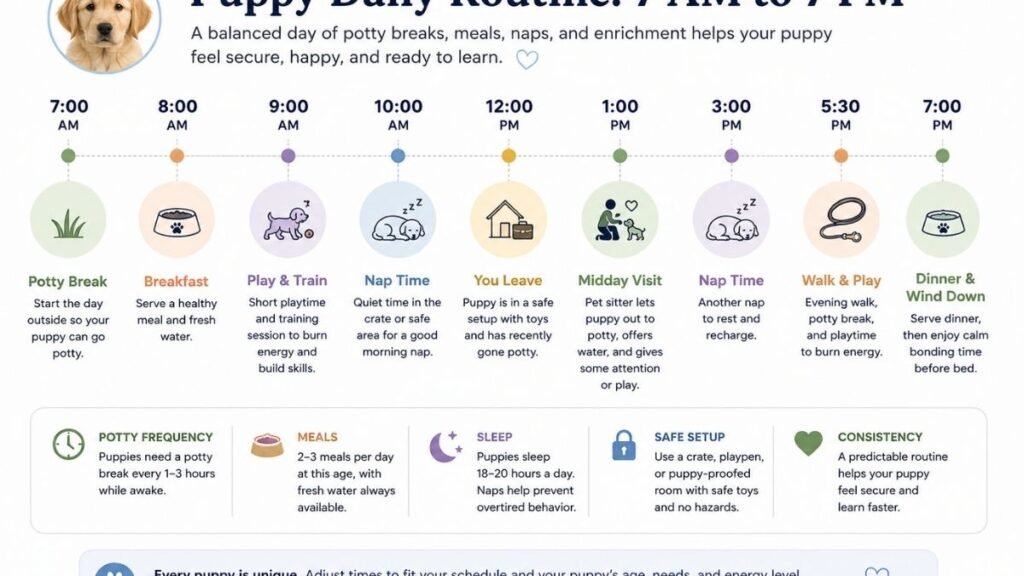
| Time | Puppy Activity | Potty Opportunity | Feeding | Alone-Time Block | Caregiver Support | Training Purpose |
|---|---|---|---|---|---|---|
| 7:00 AM | Wake up, potty, breakfast | Yes | Yes | — | — | Morning routine |
| 7:30 AM | Calm play, short walk | Yes | — | — | — | Physical and mental activity |
| 8:00 AM | Settle into safe space | Yes | — | Begins | — | Independence practice |
| 8:00–10:00 AM | Alone time | — | — | 1–2 hrs | Owner leaves for work | Age-appropriate block |
| 10:00–10:30 AM | Midday visit (young puppies) | Yes | Maybe | — | Sitter, walker, or family | Break up the day |
| 12:00–1:00 PM | Lunch-break visit or sitter | Yes | Yes | — | Owner or helper | Midday reset |
| 1:00–4:00 PM | Alone time | — | — | Up to age limit | — | Continued independence |
| 4:00–5:00 PM | Afternoon visit (if needed) | Yes | Maybe | — | Sitter, walker, or family | Support for younger puppies |
| 5:00–7:00 PM | Owner returns, exercise, training | Yes | Yes | — | Owner | Social contact, exercise |
| 7:00 PM onward | Evening wind-down | Yes | Dinner | — | Owner | Bonding, calm routine |
Sample Schedule for an 8–12-Week-Old Puppy
This age group typically needs multiple daytime check-ins, short alone-time blocks, a midday feeding if it’s still on three meals a day, and a playpen or crate-and-pen combination rather than one long stretch in a single small space.
Sample Schedule for a 3–5-Month-Old Puppy
At this stage, morning and afternoon blocks can usually run a bit longer, but at least one planned midday visit is still worth keeping in the routine, along with continued potty and enrichment support.
Sample Schedule for a Puppy Around 6 Months
Many puppies this age can gradually transition toward longer periods alone, with just one midday break where it’s genuinely needed. It’s still worth watching for adolescent regressions — some puppies temporarily backslide on potty habits or independence around this stage, which is normal and usually passes with continued consistency.
A realistic example: an 8-hour workday might call for two separate midday visits for a very young puppy, while an older, well-trained puppy of the same household might only need one. The schedule should flex around the individual puppy, not the other way around.
A full-time work schedule and puppy ownership are compatible — but only when the day is broken into age-appropriate care and alone-time blocks rather than one long absence.
Related reading: How to Crate Train a Puppy at Night
What If You Must Leave a Puppy for 6–8 Hours?
An 8-week-old puppy cannot safely adapt to a full 8-hour workday alone — when your schedule genuinely requires it, add human support rather than expecting the puppy to simply cope.
A larger playpen can reduce some risks compared to a small crate, but it doesn’t replace the need for a potty break, food, or social contact partway through the day. When an absence is longer than your puppy’s current limit, a few realistic options can bridge the gap.
Drop-In Pet Sitter
Best suited for very young puppies, a drop-in sitter can provide a potty break, feeding, and some brief interaction. Clear written care instructions make a noticeable difference in how smoothly these visits go.
Dog Walker
This works well once vaccination status and the walking environment are appropriate, and it suits puppies that are ready for structured outdoor activity. Walk duration should still match your puppy’s age and stamina.
Puppy Daycare
Daycare can offer supervision and social interaction, but it isn’t the right fit for every puppy or every single day — it’s worth evaluating health status, temperament, and the facility itself before committing to a regular schedule.
Friends, Family, or Neighbors
This tends to be a lower-cost option, but it only works well if the person is reliable and willing to follow the same potty and training routine you use — inconsistent handling can undo some of your training progress.
Shared or Flexible Work Arrangements
Split schedules, hybrid work days, and lunch-break check-ins can all help, especially as a temporary adjustment during the youngest, most demanding stage.
| Option | Best For | Potty Support | Feeding Support | Social Interaction | Key Safety Question | Relative Cost | Main Limitation |
|---|---|---|---|---|---|---|---|
| Drop-in pet sitter | Very young puppies | Yes | Yes | Brief | Are instructions clear and followed? | Moderate | Limited social time |
| Dog walker | Vaccinated, active puppies | Yes | No | Yes, during walk | Is the environment safe and vaccination current? | Moderate | Not a full-day solution alone |
| Puppy daycare | Social, healthy puppies | Yes | Sometimes | High | Is the facility reputable and puppy-appropriate? | Higher | Not suitable for every puppy or day |
| Friend/family/neighbor | Budget-conscious owners | Depends on person | Depends on person | Yes | Will they follow the same routine? | Low | Depends heavily on reliability |
| Flexible work arrangement | Owners with schedule flexibility | Yes (owner-led) | Yes | Yes | Is it sustainable long-term? | None | Not available to everyone |
Arranging outside help is responsible planning, not proof that you’re failing as an owner. Matching the right kind of support to your puppy’s age, temperament, budget, and location is exactly what age-appropriate care looks like in real life — and it’s worth having a backup plan ready in case a sitter cancels or your commute runs long unexpectedly.
How to Use a Pet Camera to Check on Your Puppy
Direct answer: position the camera to cover the full space, then review the first 10–20 minutes after you leave to see how quickly your puppy settles, whether it engages with enrichment, and whether any behavior needs adjusting before your next session.
What to Monitor
- How long it takes your puppy to settle
- How long any vocalization lasts
- Whether there are real rest periods
- Whether your puppy interacts with its enrichment item
- Any potty accidents
- Any attempts to escape
How to Use Two-Way Audio Carefully
Some puppies find hearing their owner’s voice reassuring, while others become more confused or even more agitated by a voice with no visible person attached to it. It’s worth testing this deliberately during short practice sessions rather than assuming it will help.
How to Adjust the Next Session
Increase the next session’s length only after several calm sessions in a row. If results are mixed, it’s usually better to hold the same duration for a bit longer. If distress escalates or accidents occur, shorten the next session rather than pushing through.
Pet Camera Review Checklist
- [ ] Did the puppy eat or use its enrichment item?
- [ ] How long did any vocalization last?
- [ ] Did the puppy settle at some point?
- [ ] Was there pacing or panting?
- [ ] Were there any escape attempts?
- [ ] Did the puppy sleep?
- [ ] Was there an accident?
- [ ] How did the puppy behave once you returned?
Review the recorded footage rather than reacting to every real-time notification. Motion alerts can make an ordinary stretch or shift in position look far more dramatic in the moment than it actually turns out to be once you watch the fuller clip.
Normal Protest, FOMO, or Separation Anxiety?
Brief whining that fades as your puppy settles is usually normal protest; barking triggered by visible activity that stops once things go quiet is often FOMO or demand barking; escalating panic, food refusal, and repeated escape attempts point toward separation-related distress that needs a different approach.
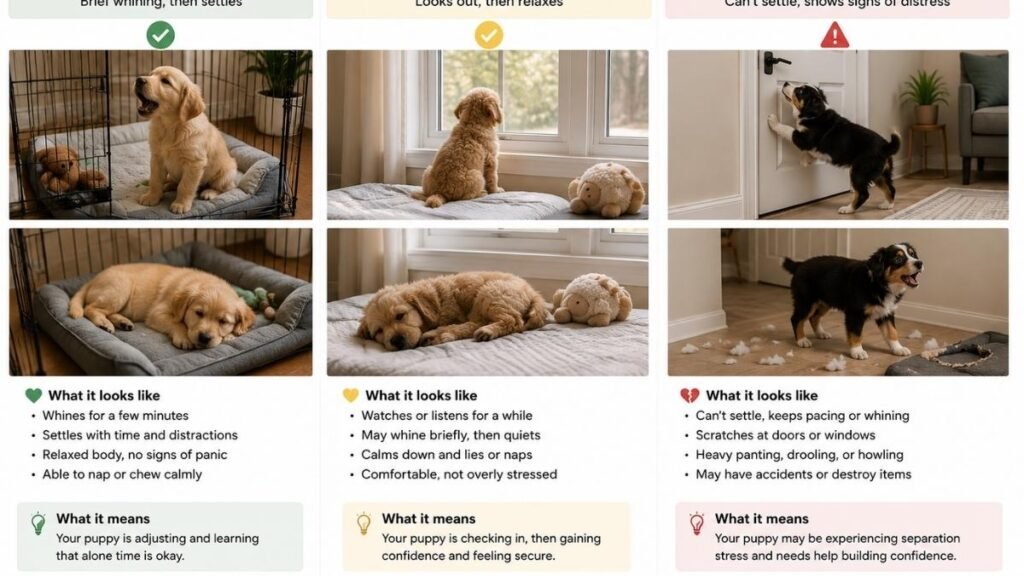
Normal Brief Protest
- Short whining that doesn’t escalate
- Puppy still takes food or engages with a toy
- Settles within a reasonable amount of time
- Body language returns to normal fairly quickly
FOMO or Demand Barking
- Vocalization tends to be triggered by visible activity nearby
- Puppy can settle once the environment becomes quiet again
- No real panic-related body language
- Tends to improve steadily with gradual independence practice
Separation-Related Distress
- Vocalization escalates rather than fading over time
- Refusal to eat, even a favorite treat
- Repeated attempts to escape
- Heavy panting, drooling, or visible panic
- Ongoing inability to rest or settle at all
| Vocalization Pattern | Ability to Eat | Body Language | Settling Behavior | Escape Behavior | Recommended Response | |
|---|---|---|---|---|---|---|
| Normal protest | Brief, fades | Eats normally | Relaxed after a moment | Settles within minutes | None | Continue current routine |
| FOMO / demand barking | Tied to nearby activity | Eats normally | No panic signs | Settles once quiet | None | Continue gradual practice |
| Separation distress | Escalates over time | Refuses food | Panting, drooling, trembling | Doesn’t settle | Repeated attempts | Shorten sessions, consider professional support |
It’s worth being clear that destructive chewing around doors or windows isn’t your puppy getting back at you — it’s almost always a distress response, and punishing it after you return doesn’t address the underlying cause; if anything, it tends to add confusion on top of existing anxiety. What matters more than whether a puppy makes any noise at all is the duration, intensity, and whether it can recover and settle on its own.
When to Seek Professional Help
Consider reaching out to a veterinarian or a qualified behavior professional if there’s any risk of self-injury, if distress is severe or doesn’t fade with time, if gradual training isn’t leading to any progress, if behavior changes suddenly, or if accidents continue happening despite a recent potty break — the last of which can sometimes point to an underlying medical issue rather than a training one.
Related reading: Puppy Separation Anxiety: What’s Normal and How to Fix It
Frequently Asked Questions
How long can a puppy realistically be left alone by age? As a general guide, an 8–10-week-old puppy can usually manage about an hour, a 3-month-old around 2–3 hours, a 4–5-month-old around 3–4 hours, and a puppy around 6 months can gradually work up to 4–6 hours if it’s already trained and comfortable. These numbers are a starting point — actual readiness depends just as much on training history and temperament as on age itself.
How do I leave an 8-week-old puppy home alone for a full workday? Honestly, you generally shouldn’t try to do this without support — an 8-week-old puppy’s bladder and emotional readiness simply aren’t built for a full 8-hour stretch alone. The realistic approach is arranging a midday visit from a sitter, family member, or neighbor to break the day into shorter, age-appropriate blocks rather than one long absence.
Is a crate, playpen, or puppy-proofed room best for leaving a puppy alone? It depends on the length of the absence and your puppy’s stage of training. A crate suits short absences and naps, a playpen works well for longer daytime stretches that need room to move and access to water, and a puppy-proofed room is best reserved for older puppies with reliable potty habits and safe chewing behavior.
How long can a 6-month-old puppy stay home alone without an accident? Many puppies around this age can manage roughly 4–6 hours, but this varies quite a bit by individual puppy and training history, and adolescence can sometimes bring temporary regressions. It’s worth building up to that range gradually rather than assuming every 6-month-old is automatically ready for it.
How can I tell if my puppy has separation anxiety or is just demand barking? Demand barking and FOMO-related vocalization tend to be triggered by visible activity and settle down once things go quiet, with normal eating and body language throughout. Separation-related distress tends to escalate over time, come with food refusal, heavy panting or drooling, and repeated escape attempts — if you’re seeing that pattern, it’s worth slowing down the training plan and considering professional support.
What are the best toys and distractions to keep a puppy busy when left alone? Durable, food-stuffable toys and previously tested chews tend to be the safest options for unsupervised use, while rope toys, rawhide, and soft plush toys carry more risk if left unattended. The safest rule is only leaving items your puppy has already used without any problems while you were watching.
Should I hire a dog walker or use puppy daycare if I work full-time? Both can genuinely help, and the right choice depends on your puppy’s age, vaccination status, and temperament — a dog walker suits puppies ready for structured outdoor activity, while daycare offers more social interaction but isn’t the right fit for every puppy or every day. Many working owners end up using a mix of both, along with occasional help from family or friends.
Why can my puppy sleep through the night in a crate for 8 hours but can’t be left alone for 8 hours during the day? Sleep dramatically slows down both activity and urine production, so an overnight stretch doesn’t place the same physical or emotional demands on a puppy as eight active daytime hours filled with eating, drinking, and excitement. Sleeping soundly overnight is a sign of good night-time settling — it isn’t evidence that your puppy is emotionally ready for the same length of time alone while awake.
🐾 Editor’s Note: Why We Created This Guide
Leaving a puppy home alone is one of the biggest worries for first-time dog owners. We’ve seen the same questions come up again and again: How long is too long? Should I use a crate or a playpen? What if I work full-time?
That’s why we put this guide together. Instead of relying on one simple rule, we focused on practical advice you can actually use—from age-based alone-time limits and gradual training to safe home setups and realistic schedules for busy owners.
Our goal isn’t to help you leave your puppy alone for longer. It’s to help you build your puppy’s confidence safely, one small step at a time, so both of you feel more relaxed every time you head out the door.
🐶 Keep Learning About Your Puppy
Learning to leave a puppy home alone is just one part of raising a happy, confident dog. These beginner-friendly guides can help you better understand your puppy’s behavior, build healthy routines, and make the first few months much easier.
- Puppy Separation Anxiety: What’s Normal, What’s Not, and How to Fix It — Learn how to tell the difference between normal puppy protests and true separation anxiety, plus practical steps to help your puppy feel more secure.
- How Much Do Puppies Sleep? The Complete Guide by Age — Find out how much sleep puppies need at every stage, why sleep matters for healthy development, and how to build a balanced daily routine.
- Puppy Crying at Night: Why It Happens and What to Do — Discover the most common reasons puppies cry at night and simple, proven ways to help them settle and sleep more peacefully.
❤️ A Final Note
A well-behaved puppy isn’t raised overnight—it’s built through patience, consistency, and small daily wins.
At PurrliPaw, we’re here to help first-time dog owners feel more confident, avoid common training mistakes, and make puppy care a little less overwhelming.
Our goal is simple: helping you raise a happy, confident puppy while making every stage of the journey easier to enjoy.