
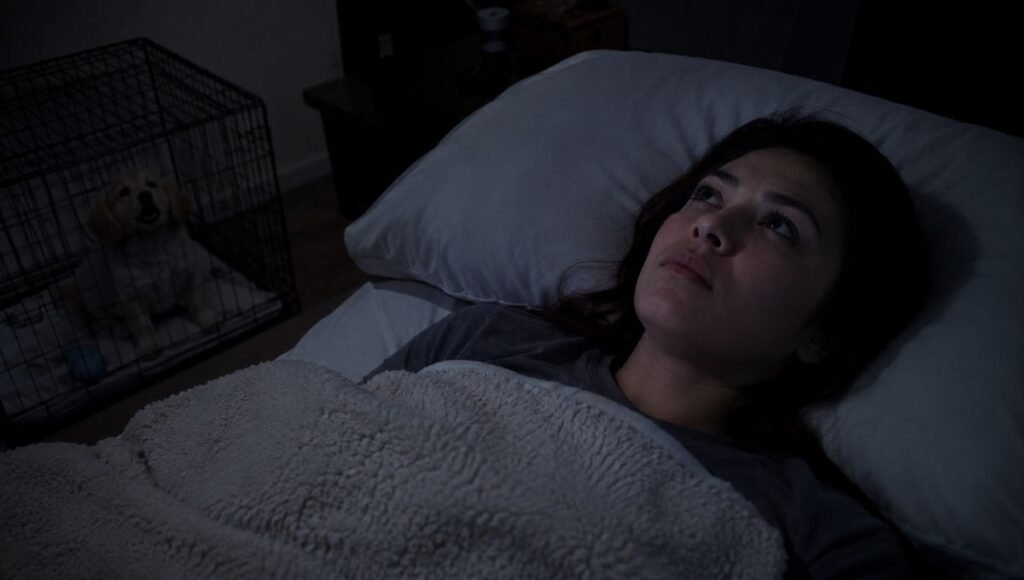
It’s 2am. You’re lying in bed, staring at the ceiling, listening to your puppy cry. Not a gentle whimper — a full, heartbreaking, this-is-the-worst-night-of-my-life kind of cry. And you’re doing the math in your head: if you go to them, you’ll reinforce the crying. If you don’t go to them, you’re a terrible person. The neighbors are definitely awake. You’ve already Googled “puppy crying at night” three times and gotten three different answers.
You’re not alone. This exact scenario plays out in households across the world every single night that a puppy comes home for the first time. The crying is normal. The guilt is normal. The 2am spiral is normal.
What’s less normal is having a clear, honest guide that actually tells you what to do — not just “puppies cry, it gets better” but specifically what to do tonight, why it’s happening, how long it’s realistically going to last, and when you should actually be concerned. That’s what this is.
Key Takeaways
- Puppy crying at night is biologically normal — your puppy has just lost the only social environment they’ve ever known. The distress is real and appropriate, not manipulation.
- Most puppies show meaningful improvement within 3 to 7 nights when the crate is positioned correctly and the overnight routine is consistent.
- The answer to “should I let my puppy cry it out” is not black and white — there’s a critical difference between brief settling distress and sustained panic, and responding to each correctly is what produces the best outcome.
- Where the crate lives matters more than almost anything else. A crate in your bedroom reduces nighttime crying dramatically compared to a crate in another room.
- Puppies under 16 weeks cannot hold their bladder overnight — if your puppy wakes and cries, there’s a real chance they need a bathroom trip, not just comfort.
Why Your Puppy Is Crying at Night: The Honest Explanation
Before you can decide what to do about the crying, it helps to understand what’s actually happening — because it’s not what most people assume.
Your puppy isn’t crying to manipulate you. They’re not “testing boundaries” in some strategic sense. They’re not spoiled or badly behaved. They’re a baby animal who has just been separated from their mother, every littermate they’ve ever known, and the only environment that has ever felt safe — all in the same day. The crying is grief. It’s confusion. It’s a completely appropriate response to an enormous, disorienting transition.
Understanding this doesn’t mean you immediately run to them every time they make a sound. But it does mean you can stop spending mental energy being frustrated at the crying and instead direct that energy toward actually helping your puppy through this phase as quickly as possible.
The biology of why nighttime is hardest
Dogs are social animals who in the wild would never sleep alone. Not as adults, and certainly not as puppies. The nighttime environment removes every sensory signal that tells your puppy they’re safe — no visual contact with you, no sound of your voice, reduced smell of your presence. The darkness and quiet that feels peaceful to you feels isolating to them.
Add in that puppies this age still have immature stress regulation systems — they don’t have the neurological capacity to “calm themselves down” the way an adult dog can — and you have the perfect conditions for an extended crying episode.
This is also why the location of the crate matters so disproportionately. A crate in the same room as you provides ambient sound, scent, and the occasional reassurance of your voice without requiring you to physically pick them up. It leverages the same biology that’s causing the crying to work in your favor.
Where You Put the Crate Changes Everything
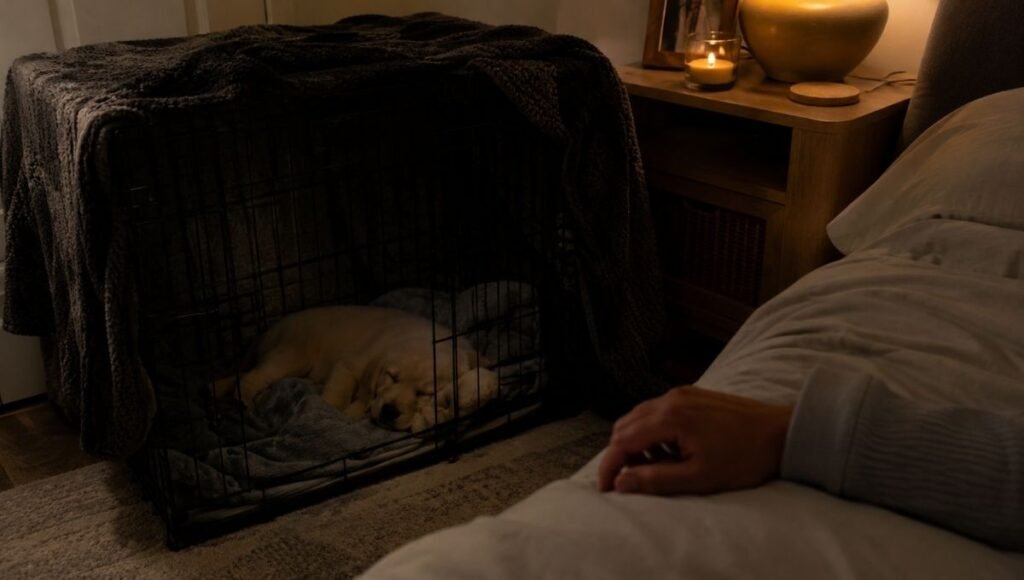
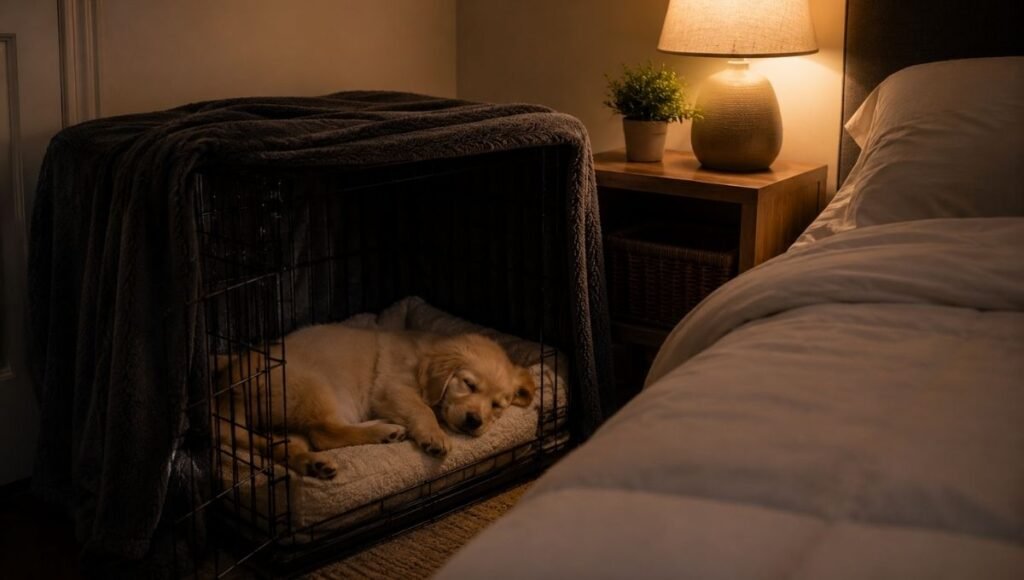
If there’s one thing in this entire guide that you implement tonight, make it this: move the crate into your bedroom.
Not permanently. Not because you’re committing to the dog sleeping in your room forever. Just for the first week or two — until your puppy has settled into the routine and the crying has naturally decreased.
The difference this makes is not subtle. A puppy who can hear your breathing, smell your scent, and occasionally hear your voice when they whimper is a puppy who has biological evidence that they are not abandoned. The proximity doesn’t prevent the training from working — it accelerates it, because your puppy’s nervous system can regulate faster when they have a trusted social presence nearby.
If you genuinely can’t have the crate in your bedroom, the next best option is a playpen or crate positioned just outside the bedroom door, or with a baby monitor so you can speak to them through it.
What not to do: put the crate in a laundry room, basement, or guest room and close the door. This maximizes isolation at exactly the moment your puppy needs the least of it. The dogs who cry longest and most intensely at night are almost universally the ones who are farthest from their owners.
Cover three sides of the crate
A wire crate that feels like a cage in an open room is very different from a wire crate with a blanket draped over three sides, creating a den-like enclosure. Most puppies settle faster in a covered crate — the darkness reduces visual stimulation, and the enclosed space feels more like the nest environment their instincts associate with safety.
Leave the front uncovered so they don’t feel trapped, and ensure adequate ventilation. But the covering is worth trying if you haven’t already.
The Real Answer to “Should I Let My Puppy Cry It Out?”

This is the question that generates the most disagreement online, and honestly, both extremes — “never let them cry” and “always let them cry it out completely” — miss the nuance.
Here’s the distinction that actually matters:
Brief settling distress is a puppy who cries for a few minutes, then quiets, then maybe cries again, gradually stretching the quiet periods. This is your puppy learning that being in the crate is okay. It is not comfortable to listen to, but it’s not harmful, and responding to every sound here teaches your puppy that crying is the mechanism that produces you — which is the opposite of what you want.
Sustained panic is a puppy who is escalating rather than settling — crying that gets louder and more intense rather than punctuated by quiet, a puppy who is hurling themselves at the crate door, who is clearly unable to catch their breath, whose body language when you do check on them is one of genuine terror. This is not “learning to settle.” This is a puppy in distress that requires intervention and a slower, more gradual crate introduction.
Most first-night crying is somewhere in between, which makes it genuinely hard to interpret. Here is the practical framework:
Wait 10 to 15 minutes from the first cry before going in. If the crying is settling in intensity or becoming intermittent, your puppy is beginning to regulate. Keep waiting. If the crying is escalating in the first 10 minutes with no sign of slowing, go check on them — briefly, calmly, with minimal interaction, and then leave again.
When you do go in: don’t take them out of the crate unless you’re doing a potty trip. Don’t turn on the lights. Don’t talk in an animated way or offer prolonged cuddles. The check-in is meant to tell your puppy “I’m here, you’re safe” — not “your crying got me here, let’s make this exciting.”
The potty variable complicates everything
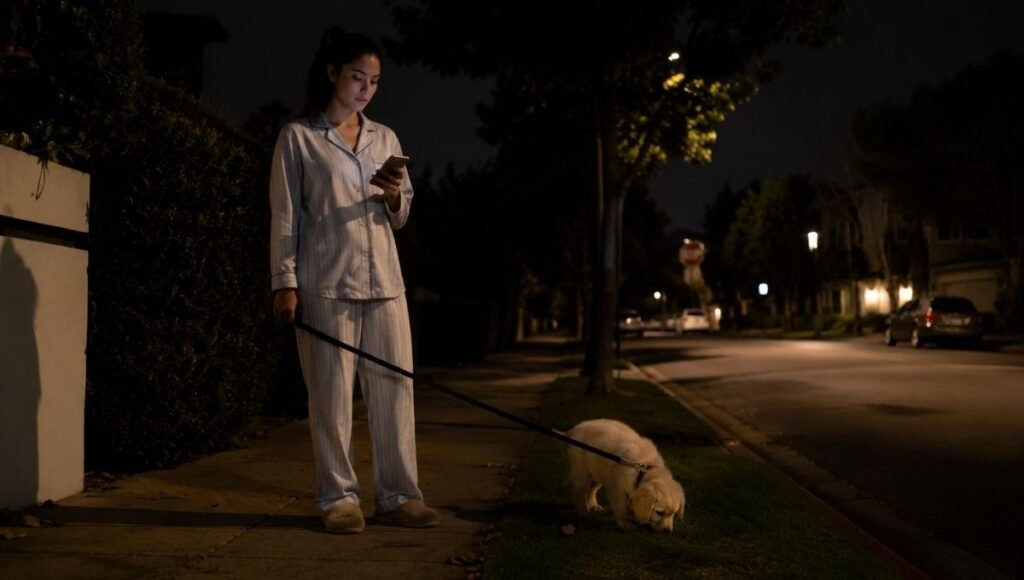
Here’s the issue that makes the “let them cry it out” advice genuinely more complicated for puppies than it is for toddlers: your puppy might be crying because they need to go to the bathroom.
A puppy under 12 weeks can hold their bladder for approximately 2 hours. A 12 to 16 week old, 3 to 4 hours. If your puppy wakes up crying at 2am and last went outside at 10pm, there’s a real biological reason they’re uncomfortable that has nothing to do with needing emotional comfort.
Set an alarm and take them out proactively, before the crying starts. For very young puppies (8 to 10 weeks), one alarm at approximately 1am and another at 4am is reasonable. As they grow and bladder control develops, you’ll stretch these intervals. The goal is to get ahead of the need so the crying doesn’t start — because if you wait for the crying and then take them out, you’ve accidentally taught them that crying at night produces a trip outside.
The First Night Is the Hardest: What to Expect Night by Night
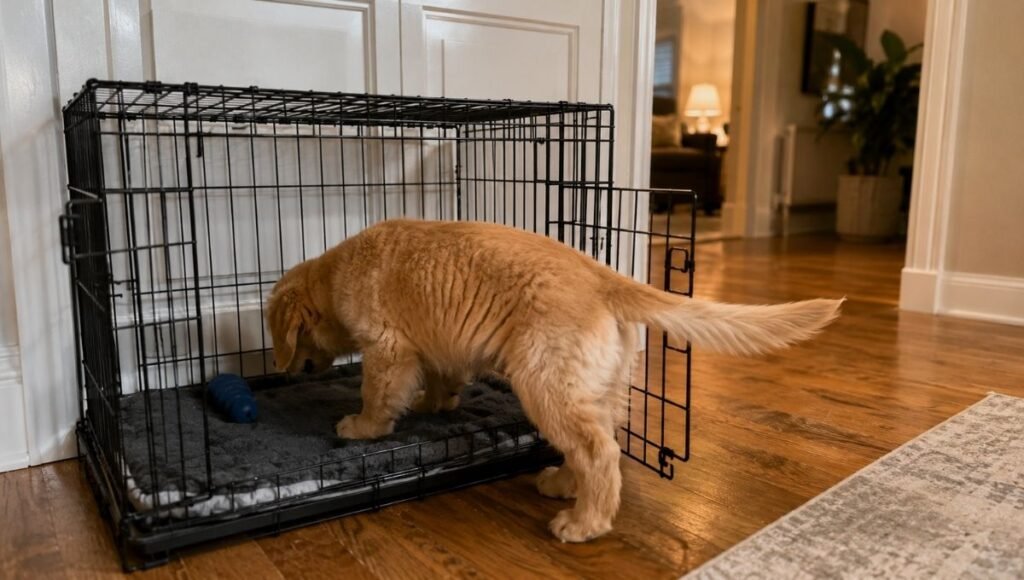
If you’re on night one of a puppy crying situation, here’s the realistic trajectory with consistent management:
Night 1: Often the worst. Your puppy has just arrived. Everything is new and nothing smells or sounds right. Expect significant crying with limited settling. This is not a preview of the future — it’s the peak.
Nights 2 to 3: Crying often continues but usually with more settling periods. Your puppy is beginning to understand the pattern — crate happens, you don’t disappear forever, the morning comes.
Nights 4 to 5: Most puppies show noticeable improvement. Crying episodes are shorter and less intense. Some puppies start sleeping through several hour stretches.
Nights 6 to 10: The majority of puppies have settled into a workable overnight routine by this point. Some still need a potty break or two, but the dramatic crying has typically resolved.
Week 3 and beyond: Most puppies who have had consistent, patient crate management are going into the crate willingly at night and settling within a few minutes.
If you’re past night 10 and things are getting worse rather than better, something in the system needs adjusting. See the troubleshooting section below.
What to Do Tonight: A Step-by-Step Plan
If you’re reading this at 11pm before your puppy’s first night, or at 2am in the middle of the crying, here’s what to actually do.
Before bed: Take your puppy outside for a final potty trip as late as realistically possible — 10 or 10:30pm if you can. The longer they last in the crate before needing the bathroom, the better the night goes.
Feed their last meal no later than 6pm. A puppy with food digesting through the night is a puppy who needs to eliminate through the night.
Give them physical activity and mental engagement in the hour or two before bed — play, a training session, sniffing activities. A tired puppy is not guaranteed to sleep through the night, but an understimulated one definitely won’t.
Put a frozen Kong in the crate with them when you close the door. The act of chewing and the satisfaction of food releases calming neurotransmitters. It’s not a guaranteed solution, but it gives them something to focus on as you leave.
Put something in the crate that smells like you — an old T-shirt, a worn pillowcase. Scent is enormously comforting to dogs, and at 2am when they can’t see you, your scent tells them you’re still present.
When the crying starts:
Wait 10 to 15 minutes before doing anything. Watch the clock if you need to — it will feel longer than it is.
If they’re showing signs of settling (quieting for a few seconds, then crying again, rather than escalating), keep waiting. Speak quietly from where you are: “It’s okay, good girl” — your voice carries, and it’s often enough to reassure without requiring a physical presence.
If they’re escalating after 15 minutes, go to the crate. Sit beside it, put a finger through the bars for them to sniff, speak softly. Do not open the crate unless you’re taking them for a potty trip. Stay for 2 to 3 minutes, then leave again.
The 2am potty trip:
When you do a nighttime potty trip, keep it as boring as possible. No lights if you can manage, no talking, no play. Walk outside, wait for them to go, bring them straight back in, put them in the crate, walk away. The less engaging this trip is, the less worth crying for it becomes.
The Witching Hour: When Your Puppy Loses It in the Evening
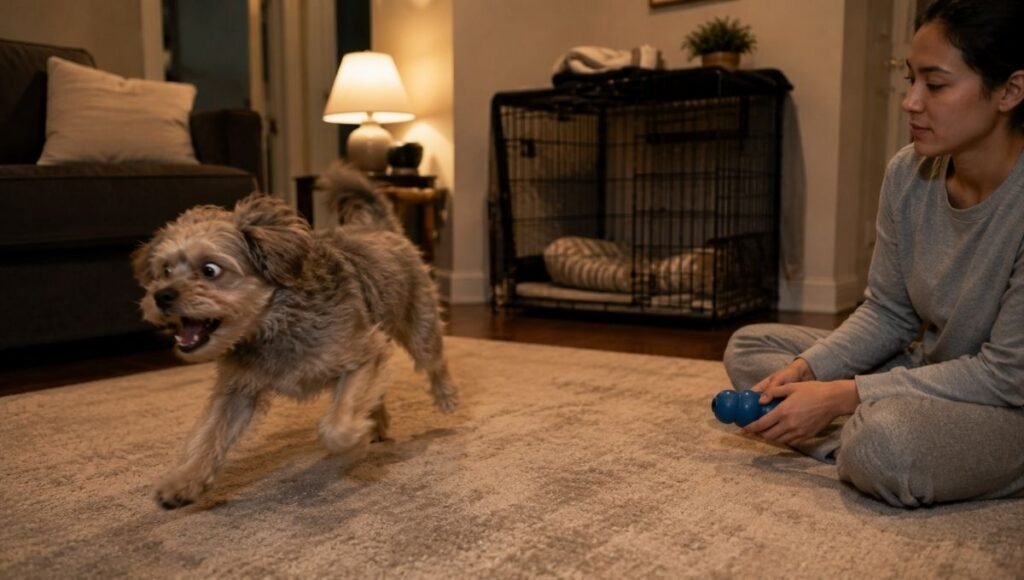
A separate but related phenomenon that catches many new owners off guard: the evening meltdown that happens before bedtime even begins. Around 5 to 8pm, many puppies hit a behavioral cliff — they become frantic, bitey, seemingly deranged, and often begin a full crying or barking episode that feels completely disconnected from anything that happened earlier in the day.
This is called the witching hour, and it’s caused by overtiredness, not excess energy.
Puppies cannot self-regulate sleep. When they push past their capacity for sustained wakefulness, their nervous system releases cortisol and adrenaline — stress hormones that produce the frantic, hyperstimulated behavior that looks like the opposite of tiredness but is actually its endpoint.
The solution is the same as it would be for an overtired toddler: structured enforced rest, not more stimulation. When you see the signs — escalating biting, frantic movement, inability to settle, crying that seems to have no cause — put the puppy in their crate with a Kong or a chew, cover the front, and leave. They will protest. They will also fall asleep within 15 minutes in most cases.
If the evening meltdown is happening consistently between 6 and 8pm, build an enforced nap into the schedule before it occurs. A puppy who has rested at 5:30pm goes to bed calm. A puppy who has been awake since 3pm goes to bed in a spiral.
Puppy Crying at Night: When Something Is Actually Wrong
Most crying is normal and temporary. Some crying signals something that needs attention.
Go check on your puppy immediately if:
- Crying is accompanied by yelping, a single sharp cry, or sounds of pain rather than distress
- You can hear them retching or vomiting
- Crying is accompanied by visible shaking, stumbling, or loss of coordination when you check on them
- There is blood in the crate
- A puppy who has been sleeping through the night for several days suddenly begins crying intensely — this regression can signal illness or pain
Call your veterinarian if:
- Nighttime crying is accompanied by refusal to eat, lethargy, or vomiting during the day
- Your puppy seems to be in pain when you handle them
- Any signs of illness alongside the behavioral change
Most nighttime crying is adaptation, not pathology. But the above are flags that warrant more than patience.
Troubleshooting: When the Crying Isn’t Improving
If you’re consistently past night 10 and the crying is not improving or is getting worse, run through this checklist:
Is the crate in your bedroom? If not, try this first. It makes a larger difference than most owners expect.
Is the crate the right size? A crate that’s too large allows the puppy to soil one end and sleep in the other — eliminating the denning instinct that makes crate training work. The crate should be just large enough to stand, turn around, and lie down comfortably.
Is your puppy getting enough daytime sleep? An overtired puppy sleeps worse, not better. If your puppy is having more than one evening meltdown per week, they likely need more enforced daytime naps.
Is the pre-bed routine consistent? Puppies learn patterns fast. A consistent pre-bed sequence — final potty, Kong in crate, same words, lights off — teaches them what to expect and reduces anxiety about what comes next.
Is someone in the household inconsistent? One person who picks the puppy up when they cry undoes the work of everyone else. The protocol only works when everyone applies it the same way.
Are you taking them out when they cry? If potty trips are happening in response to crying rather than on a proactive schedule, you may have accidentally reinforced the behavior of crying to get outside. Return to a scheduled approach and stick to it for a week.
If You Only Have 10 Minutes Tonight
You’re exhausted. It’s late. Here’s the absolute minimum:
Move the crate into your bedroom. Put something that smells like you inside it. Take the puppy out for a final potty trip, then put them in the crate with a frozen Kong. When they cry, wait 15 minutes before doing anything. Go to sleep.
That’s it. Everything else is refinement on top of these basics.
FAQ: What New Puppy Owners Actually Search For
How long does puppy crying at night last? Most puppies show meaningful improvement within 3 to 7 nights with consistent management. Full resolution — where your puppy goes into the crate at night with minimal or no protest — typically happens within 2 to 3 weeks. The first 3 nights are usually the hardest, and night 1 is almost always the worst.
Should I let my puppy cry it out at night? It depends on what you mean by “cry it out.” Brief settling distress — crying that comes in waves and gradually decreases — can usually be waited out. Sustained, escalating panic should be responded to with a calm check-in. The key is distinguishing between the two, and never letting your puppy cry for more than 15 to 20 minutes without at least a brief calm check-in.
My puppy cried all night — is that normal? On night one, yes, it’s possible. A puppy who cries for most of the first night and then settles significantly by night 3 to 5 is following a typical pattern. A puppy who cries all night for more than 4 or 5 consecutive nights without improvement needs a crate placement change, a routine adjustment, or a veterinary check if illness might be contributing.
Will going to my puppy when they cry make it worse? Not if you do it correctly. Brief, calm, non-exciting check-ins don’t reinforce crying — animated, prolonged interactions do. Going to your puppy, sitting quietly for 2 minutes, and leaving is different from picking them up, carrying them around, and then trying to put them back. The manner of the response matters more than whether you respond at all.
My puppy is waking up at 3am crying — do they need to go outside? Almost certainly yes, if they’re under 12 to 14 weeks. Young puppies cannot hold their bladder overnight without at least one trip. Take them out proactively before the crying starts rather than waiting for it — set an alarm if needed. As they grow and bladder control develops, the middle-of-the-night trip will naturally phase out.
My puppy cried for 20 minutes and then stopped — did I do the right thing? Yes. A puppy who cries for 20 minutes and then settles has just done the work of learning that the crate is survivable. That is exactly what you want to happen. Resist the urge to go in after they’ve settled — your entrance would wake them up and teach them that quiet eventually produces you.
The Bottom Line
The puppy crying at night phase is temporary. It doesn’t feel temporary at 2am, but it is — measurably, predictably, reliably temporary for the vast majority of puppies with consistent management.
The two things that matter most: crate in the bedroom, and a calm consistent response that doesn’t accidentally reward the crying. Everything else — the blanket over the crate, the frozen Kong, the T-shirt that smells like you, the proactive potty schedule — is the scaffolding that supports those two fundamentals.
Night one is the hardest. By night seven, most people can’t believe how different things are. The puppy who seemed inconsolable on night one is often the same puppy who walks into their crate on night ten with the quiet confidence of someone who knows exactly what happens next.
You’re in the hard part. It ends.
What to Read Next
Nighttime crying connects directly to these other first-year essentials:
- Puppy Separation Anxiety: What’s Normal, What’s Not, and How to Fix It — When nighttime distress goes beyond normal adjustment and becomes a genuine anxiety issue
- What Puppy Kennel Do You Actually Need? — Choosing the right crate size and type, and the correct introduction process that makes nighttime easier from day one
- How to Potty Train a Puppy: The Step-by-Step Guide — How to build the overnight potty schedule that gets ahead of nighttime crying
- How Much Do Puppies Sleep? The Complete Guide by Age — Why sleep management during the day directly affects nighttime crying at night
- New Puppy Checklist: Everything You Need Before Day One — What to have set up before your puppy’s first night home
References
- American Kennel Club / Gibeault, S., MSc, CPDT. (2026). Puppy Crying: Why Do Puppies Cry and How to Help. akc.org
- Rover.com / Lane, R., Fear Free Certified Trainer. (2025). Should You Let Your Puppy Cry It Out in the Crate? rover.com
- ASPCA. (2024). Crate Training Your Dog. aspca.org
- Herron, M.E., Shofer, F.S., & Reisner, I.R. (2009). Survey of the use and outcome of confrontational and non-confrontational training methods in client-owned dogs showing undesired behaviors. Applied Animal Behaviour Science, 117(1–2), 47–54.
- Overall, K.L. (2013). Manual of Clinical Behavioral Medicine for Dogs and Cats. Elsevier Mosby.