

Nobody tells you this part before you bring a puppy home: the behavior is going to confuse you constantly, and the confusion is going to make you question everything.
Is the biting normal or is something wrong? Is this much energy typical for the breed or is there a problem? Why does a puppy who was perfect at 10 weeks suddenly seem to have lost their mind at 5 months? Is the crying at night separation anxiety or just adjustment? What does it mean when they do that thing with their tail?
Most new owners spend the first few months in a cycle of behavior they don’t understand, Google searches that give contradictory answers, and a persistent worry that they’re either overreacting or missing something important.
This guide is the one place that pulls it all together — what puppy behavior is normal at each age, what your puppy is actually communicating through their body language, which behaviors you can relax about and which ones actually need attention, and how to respond to the ones that are disrupting your life. It’s not a training manual. It’s a behavior decoder — the thing you needed before you needed the training.
Key Takeaways
- Most behaviors that alarm first-time owners — biting, zoomies, crying, sudden regression, hyperactivity — are developmentally normal and phase-specific. Understanding which phase your puppy is in changes your entire response.
- Puppy body language is a second language that takes deliberate practice to read. The same tail wag means different things in different contexts. A yawn is often a stress signal, not tiredness.
- The critical socialization window closes at 16 weeks — it’s the single most time-sensitive behavioral investment you can make, and missing it has consequences that persist for life.
- Adolescence (5 to 18 months depending on breed size) is the phase that breaks most owners’ confidence. It’s temporary, predictable, and navigable — but only if you understand what’s driving it.
- Most puppy behavior problems are not character flaws. They’re unmet needs, developmental phases, or patterns that have been accidentally reinforced. The solution is almost always environmental management plus consistent positive training, not correction.
How Puppy Behavior Changes by Age: The Stage-by-Stage Guide
Puppy behavior is not random. It follows a predictable developmental sequence, and behaviors that seem alarming at one age are perfectly normal — even necessary — at that stage. Knowing where your puppy is in this sequence helps you respond appropriately instead of reacting to behavior as if it’s a character flaw.
8 to 12 Weeks — The New Home Phase

This is the age most puppies come home, and it coincides almost exactly with the first fear period — the developmental window when puppies are most sensitive to frightening experiences. A puppy who has a genuinely scary experience during this window (rough handling, a painful vet visit, an aggressive dog encounter) is more likely to develop a lasting fear response to that specific trigger.
What’s normal: Mouthing and nipping everything, frequent napping, bursts of energy followed by sudden crashes, some anxiety when left alone, startling at new sounds or objects.
What owners worry about but is normal: The puppy who was calm at the breeder is suddenly frantic. The puppy who seemed confident on day one is now anxious about things that didn’t bother them before. This is the first fear period, not a character change.
What actually needs attention: Extreme, sustained fear that doesn’t decrease at all with calm exposure and time; biting that is escalating in intensity toward genuinely painful despite consistent redirection.
What to prioritize: Socialization comes before training at this age. The window for positive exposure to the world is open and narrowing — every week matters. Use it.
12 to 16 Weeks — The Socialization Window Closing
The critical socialization window — the neurological period when new experiences are encoded as “normal” rather than “potentially dangerous” — closes somewhere between 12 and 16 weeks. This doesn’t mean socialization stops mattering, but it means the ease and durability of new associations changes significantly.
What’s normal: Increased confidence in the home environment, more persistent biting and chewing as teething begins, starting to test limits more deliberately, possible temporary regression in behaviors that seemed settled (like potty training).
What owners worry about but is normal: The puppy who “forgot” they were supposed to not bite ankles. The puppy who started having accidents again after being mostly reliable. These regressions are developmental, not failures.
What actually needs attention: A puppy who is terrified of things they’re encountering regularly — people coming to the door, car rides, loud sounds that are a constant part of their environment. Fear that isn’t decreasing with gentle, positive exposure needs professional guidance before the window closes completely.
What to prioritize: Get outside. As much as possible. New environments, new people, new surfaces, new sounds. Carry them where they can’t walk safely (due to vaccination status). But get them in the world.
4 to 6 Months — The Teething and Testing Phase
This period combines two challenging factors: teething, which creates genuine oral discomfort that drives compulsive chewing and intensified biting, and the beginning of adolescent independence, which shows up as more deliberate boundary-testing.
What’s normal: Dramatically increased chewing, biting that seems more intentional and harder than before, finding baby teeth around the house, some increase in stubbornness during training sessions, zoomies in the late afternoon or early evening.
What owners worry about but is normal: The puppy who was making great training progress suddenly seems to be “forgetting” commands. This is not forgetting — it’s a combination of teething discomfort lowering frustration tolerance and early adolescent independence beginning to emerge. Both are temporary.
What actually needs attention: Biting that is causing injury to people despite consistent, correct redirection for 4 to 6 weeks. Destruction that goes beyond normal teething chewing (significant property damage, eating non-food items).
What to prioritize: Frozen toys for gum relief. Management of the environment during peak chewing hours. Continued training with shorter sessions and more patience.
5 to 18 Months — Adolescence: The Phase Nobody Warned You About

This is the developmental stage that surprises owners most severely because it doesn’t fit the narrative of “puppies get easier as they get older.” In many ways, adolescence makes things temporarily harder.
The neurological reality: the prefrontal cortex — the brain region responsible for impulse control, sustained attention, and deliberate decision-making — is one of the last areas to mature. In dogs, this process is still incomplete through adolescence. The result is a dog who knows what you’re asking (the neural pathway was built during early training) but struggles to reliably choose compliance over distraction.
What’s normal: A puppy who sat reliably at 12 weeks now seems to have “forgotten” how to sit when there are distractions. A dog who was good on leash is now pulling again. Selective hearing during exciting situations. Increased reactivity toward other dogs or strangers.
What owners worry about but is normal: “My puppy has completely regressed” — a phrase heard from most owners somewhere between 6 and 10 months. This is not regression. It’s a developmental phase with a biological explanation and a finite end.
What actually needs attention: Reactivity that is escalating rather than staying the same; lunging, barking, or growling at people or dogs that is becoming more intense over weeks; any behaviors that feel unsafe.
What to prioritize: Management over correction during this phase. Keep the leash on. Keep the environment controlled enough that the puppy doesn’t practice behaviors you don’t want. Continue training daily even when it feels like it isn’t working. It is working — the investment shows up on the other side of adolescence.
The length of adolescence depends on breed size:
- Small breeds: approximately 5 to 12 months
- Medium breeds: approximately 6 to 14 months
- Large breeds: approximately 8 to 18 months
- Giant breeds: approximately 12 to 24 months
Reading Puppy Body Language: The Second Language Every Owner Needs

Your puppy is communicating with you constantly — through posture, facial expression, tail position, ear position, and movement. Most owners learn to read the obvious signals (tail wagging = happy, cowering = scared) and miss the subtler ones that carry more information.
Learning to read body language gives you two things: the ability to recognize when your puppy is comfortable or stressed in a given situation, and the early warning signals that tell you a situation is about to escalate before it does.
Signals of Relaxation and Comfort
A relaxed puppy has soft, fluid body movement rather than stiff, deliberate movement. Their weight is balanced evenly or slightly forward. Their tail is in a neutral position relative to their body (the baseline varies by breed — a German Shepherd’s neutral tail is lower than a Labrador’s). Their facial muscles are loose, their eyes are soft and blinking normally, their mouth may be slightly open.
When your puppy flops down in the middle of the floor and lets out a long exhale, they are communicating “I am settled and safe.” When they approach with a loose, wriggly body and soft eyes, they are communicating “I want to interact and feel good about it.”
Stress and Discomfort Signals
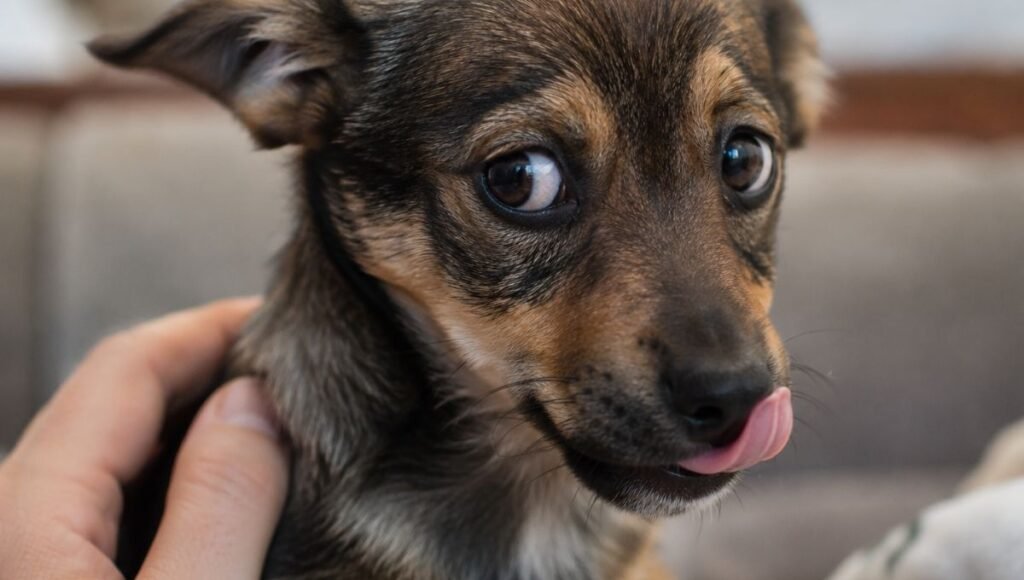
These are the signals that most owners miss — and missing them is what leads to situations escalating past the point where early intervention was easy.
Yawning when not tired is one of the most commonly misread signals. In dog body language, a yawn is often a displacement behavior — a way of releasing tension or signaling discomfort with a situation. A puppy who yawns repeatedly during a training session, at the vet, or when meeting a stranger is telling you something about their comfort level.
Lip licking or nose licking without food present is another displacement signal. Watch for this when your puppy is in an unfamiliar situation, being handled by someone unfamiliar, or is asked to do something they find difficult.
Whale eye — when you can see the whites of your puppy’s eyes — often indicates stress or discomfort. Combined with a stiff body and a turned-away head, it’s a significant warning signal.
Excessive panting when not hot or post-exercise often indicates stress. A puppy who is panting heavily at the vet, in the car, or during a greeting with an unfamiliar person is showing physiological stress.
Tail position is more nuanced than most owners realize. A low, slow wag is not the same as a high, fast wag. A low, tucked tail signals fear or submission. A high, stiff tail can signal arousal or aggression. A loose, mid-height wag with fluid body movement indicates friendly relaxed engagement.
Freezing — sudden stillness in a previously moving dog — is a critical signal. A puppy who goes still during handling, when approached by another dog, or when a child comes toward them is saying “I am at the limit of my comfort and may escalate.” This signal, ignored, often precedes a snap or growl.
Play Signals
The play bow — front end down, back end up, often accompanied by an enthusiastic expression and tail wag — is one of the clearest communication signals in a dog’s repertoire. It means “what follows is play, not threat.” Recognizing it helps you distinguish rough play from genuine conflict.
During puppy play, normal behaviors include: chasing, being chased, wrestling, brief freezing to reset, some barking and vocalizing, and periodic disengagement where both dogs take a break before re-engaging. Abnormal play that warrants intervention: one dog who cannot disengage despite the other trying, escalating arousal that isn’t punctuated by breaks, or one dog who is consistently being targeted while trying to get away.
Normal Puppy Behaviors That Worry New Owners (And Shouldn’t)
Zoomies — Frenetic Random Activity Periods (FRAPs)

Your puppy suddenly takes off running in circles at full speed, possibly bouncing off furniture, skidding around corners, and looking faintly deranged. This is zoomies — formally called Frenetic Random Activity Periods — and it’s completely normal.
Zoomies happen when a dog needs to release pent-up energy or excitement in a burst. Common triggers: after waking from a nap, after a bath, after being in the crate for a while, in the early evening. They’re typically short (30 seconds to a few minutes), intense, and followed by a noticeably calmer puppy.
What to do: clear the space of anything breakable if you can, let it run its course, and enjoy the spectacle. Trying to stop zoomies is usually futile and unnecessary. Redirect to the garden or a safe space if possible.
When to take notice: if what looks like zoomies is accompanied by loss of coordination, falling, apparent confusion, or unusual vocalization — this could indicate a neurological issue rather than excitement and warrants a vet call.
Eating Grass, Dirt, and Things That Are Not Food
Puppies investigate the world with their mouths. Eating grass is extremely common in dogs of all ages — it’s not a sign of illness or nutritional deficiency in most cases, though it can trigger vomiting in some dogs. Eating dirt is also common and usually harmless unless compulsive.
What warrants attention: compulsive consumption of non-food items (pica) that persists beyond puppyhood, consumption of items that could cause blockages (fabric, toys, socks), or grass-eating accompanied by drooling and repeated swallowing that suggests nausea rather than casual grazing.
Chasing Their Tail
Completely normal in young puppies who are still discovering that their tail is attached to them. Usually phases out as they mature.
When to take notice: persistent tail-chasing in adolescent or adult dogs can sometimes indicate obsessive-compulsive behavior, particularly if it becomes difficult to interrupt or escalates in frequency. This warrants a behavioral consultation.
Rolling in Things That Smell Terrible
This is one of those behaviors that is entirely normal, deeply evolutionary, and profoundly inconvenient. Dogs roll in strong-smelling things because of instincts around scent masking that go back long before domestication. It serves no useful purpose in your suburban garden but it’s not a behavioral problem.
What to do: bathe them. There’s no training solution that reliably stops this — management (keeping them on leash in areas where it might happen) is more effective than trying to train against a drive this strong.
Puppy Behavior Problems: What’s Actually Going On
Separation Distress and Separation Anxiety
A puppy who cries, whines, or barks when left alone is displaying some degree of separation distress. The question is whether this is normal adjustment behavior or true separation anxiety — and the distinction determines the correct response.
Normal adjustment: a puppy who cries for 10 to 20 minutes when first placed in their crate and then settles. This is a puppy learning that being alone is temporary and survivable.
True separation anxiety: a puppy who escalates rather than settles, who cannot relax even for brief periods during your absence, who shows physical distress (panting, drooling, destructive behavior focused specifically on exit points) that doesn’t improve with time or training consistency. This requires a more systematic approach.
The recording test is the most useful tool: record your puppy during your absence and watch what actually happens. Most owners discover their puppy is more distressed than they realized, or less distressed than they feared. The data changes the response.
→ For the complete guide to separation anxiety including the recording test method, the graduated departure protocol, and when to seek professional help: Puppy Separation Anxiety: What’s Normal, What’s Not, and How to Fix It
Excessive Crying at Night
Puppies cry at night because they are babies who have just lost everything familiar — their mother, their littermates, the environment they’ve known their entire lives. Some crying in the first week is not a behavioral problem. It’s a grief response.
The question is how to support them through it without accidentally reinforcing a pattern that makes the crying last longer and become harder to resolve.
→ For the complete guide to nighttime crying including the night-by-night trajectory, the crate placement factor, and when to go in versus when to wait: Puppy Crying at Night: Why It Happens, How Long It Lasts, and What to Do Tonight
Sleep That Seems Excessive
New owners often worry that their puppy sleeps too much. In almost all cases, they don’t. Puppies at 8 to 12 weeks need 18 to 20 hours of sleep per day — not as one long block, but distributed across multiple naps and overnight. Sleep is when brain development, muscle growth, immune function, and memory consolidation all happen. A puppy who sleeps a lot is a puppy whose biology is working correctly.
The much less recognized problem is the overtired puppy — a puppy who has been kept awake past their capacity and is now frantic, bitey, and unable to settle. This looks like excess energy when it’s actually its opposite. The treatment is a nap, not more stimulation.
→ For the complete sleep guide by age including the enforced nap protocol and the evening witching hour explained: How Much Do Puppies Sleep? The Complete Guide by Age
Biting and Mouthing
Biting is the behavior that generates the most owner distress in the first 16 weeks, and the most misunderstanding. Puppy biting is:
- Normal and developmentally expected
- How puppies explore, play, and communicate
- Intensified during teething by genuine oral discomfort
- Not an indication of aggression or a “bad dog”
The correct response is consistent redirection, not punishment. The moment teeth contact skin: all interaction stops. Brief pause. Redirect to a chew toy. Resume when the toy is accepted. Over hundreds of repetitions, this teaches the puppy that teeth-on-skin ends all fun, while a toy continues it.
What makes biting training fail: inconsistency (one person allowing it while others don’t), sessions that go on too long (overtired puppies bite more), rough play with hands (teaching that hands are appropriate chew targets).
→ For the complete biting guide including the age-by-age breakdown, the family consistency plan, and teething-specific interventions: How to Stop Puppy Biting: The Positive Reinforcement Guide
Socialization Gaps
Puppies who missed significant socialization during the critical window often show behavioral effects that owners mistake for stubbornness, aggression, or defiance. A dog who barks at men with beards, reacts at bicycles, or becomes overwhelmed in busy environments is usually showing fear — not behavior problems in the traditional sense.
The treatment for socialization gaps is systematic desensitization and counter-conditioning — a gradual, positive process of creating new associations. It works, but it takes longer and requires more effort than early socialization would have. Professional guidance is often helpful for significant gaps.
→ For the complete socialization guide including the checklist, the pre-vaccination protocol, and how to handle socialization gaps: Puppy Socialization: The Complete Guide
Puppy Body Language: What Your Dog Is Trying to Tell You
Understanding body language is the foundation of responding to behavior correctly. When you can read what your puppy is experiencing, you stop asking “why is my puppy doing this” and start asking “what does my puppy need right now.”
Happy and Engaged
- Loose, wiggly body movement
- Tail in mid-position with easy, fluid wag
- Soft eyes, relaxed facial muscles
- Mouth slightly open, possible “smile”
- Weight balanced or slightly forward with curiosity
Stressed or Overwhelmed
- Yawning when not tired
- Lip licking without food
- Whale eye (whites of eyes visible)
- Tucked tail
- Low, slow movement
- Shaking off when not wet
- Seeking distance or hiding
Playful
- Play bow (front end down, back end up)
- Bouncy, loose movement
- High-pitched vocalizations
- Exaggerated, theatrical movements
Fearful or Threatened
- Freezing or stillness
- Stiff body
- Ears pinned flat
- Tail tucked or low and stiff
- Growling (important signal — do not punish)
- Showing teeth
Overstimulated or Aroused
- Fast, stiff movements
- High, stiff tail
- Inability to disengage
- Escalating intensity in play or behavior
- Difficulty responding to known cues
The most important signal to recognize: growling is communication, not defiance. A puppy who growls is telling you — clearly and honestly — that they are uncomfortable with what is happening. Punishing the growl removes the warning signal without addressing the underlying discomfort. Dogs who have been punished for growling are significantly more likely to bite without warning because they’ve learned that warning doesn’t work.
When Puppy Behavior Is Actually a Problem (And Needs More Than Patience)
Most puppy behavior resolves with time, consistent training, and appropriate management. Some situations warrant more — either professional training support or veterinary consultation.
Seek professional training help when:
- Biting has caused injury to people despite 4 to 6 weeks of consistent correct management
- Reactivity (barking, lunging, growling at people or dogs) is escalating rather than staying the same or improving
- Separation distress is severe enough to affect quality of life for the dog or the household despite consistent management
- Any behavior feels genuinely unsafe
Seek veterinary consultation when:
- Behavioral changes are sudden and dramatic in a previously settled puppy — pain, illness, and thyroid conditions can all produce behavioral changes
- Compulsive behaviors (tail chasing, fly snapping, repetitive circling) that are difficult to interrupt and increasing in frequency
- Extreme fearfulness that doesn’t improve at all with gentle positive exposure over several weeks
- Appetite changes, lethargy, or other physical signs alongside behavioral changes
A certified professional dog trainer (CPDT-KA credential) is the appropriate first resource for behavioral issues. For severe anxiety, aggression, or suspected behavioral conditions, a veterinary behaviorist (DACVB) provides the highest level of specialized support.
The Role of Sleep, Exercise, and Routine in Puppy Behavior
Before looking for training solutions to behavior problems, check the fundamentals. The majority of puppy behavior issues that owners struggle with are downstream of three unmet needs:
Insufficient sleep. An overtired puppy is a difficult puppy — more reactive, less trainable, more likely to bite hard, more likely to have the evening meltdown that makes the whole household miserable. Enforced nap times are not optional for young puppies. They cannot self-regulate sleep effectively. You have to manage it for them.
Insufficient mental stimulation. A puppy who is physically exercised but mentally understimulated is a puppy who invents their own entertainment — which usually involves chewing things, barking at things, or generally being difficult. Mental enrichment — training sessions, food puzzles, sniff walks, new environments to explore — is as important as physical exercise, often more so for intelligent breeds.
Inconsistent routine. Puppies regulate behaviorally around predictable patterns. A puppy who knows when meals happen, when walks happen, when crate time happens, and when play happens is a puppy with a nervous system that doesn’t have to stay on alert for what’s coming next. Consistency isn’t just helpful for training — it’s directly calming.
The Five Most Common Puppy Behavior Mistakes Owners Make
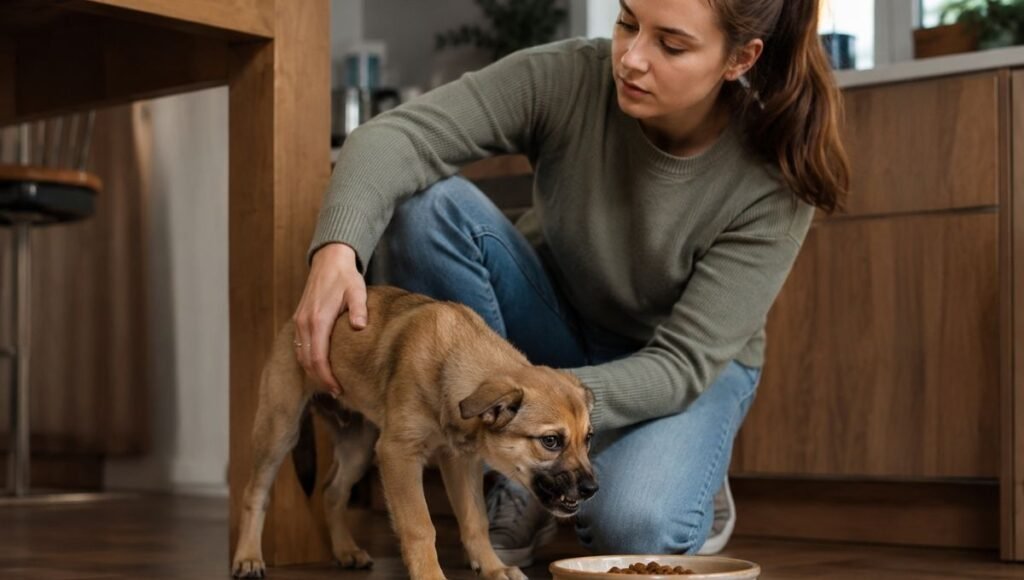
Expecting adult behavior from a puppy brain. A 12-week-old puppy does not have the neurological infrastructure for sustained attention, reliable impulse control, or consistent compliance. Expecting these things and responding with frustration when they’re absent sets up a negative dynamic that makes everything harder.
Responding to behavior after the fact. A puppy cannot connect your response to something that happened more than 2 to 3 seconds ago. Scolding after finding a chewed shoe, rubbing a nose in a potty accident, or any correction applied after the behavior has passed does nothing to change the behavior and can damage the relationship.
Inadvertently reinforcing the problem. Attention — even negative attention — is reinforcing for many puppies. A puppy who jumps and gets a big reaction (even “no! down!”) has been reinforced for jumping. A puppy who cries and gets picked up has been reinforced for crying. The response to unwanted behavior matters as much as the behavior itself.
Punishing warning signals. Growling, stiffening, and showing teeth are communication. Punishing them doesn’t resolve the underlying discomfort — it removes the early warning system and makes escalation more likely, not less.
Giving up during adolescence. The owners who stop daily training at 7 months because “it’s not working anymore” are the ones who end up with adult dogs whose behavioral foundations were never completed. Adolescence is exactly when consistency matters most. The investment made during this phase shows up on the other side.
FAQ: What New Puppy Owners Actually Search For
Is it normal for puppies to bite so much? Yes — biting is developmentally normal and expected in puppies from 8 to 20 weeks, intensified by teething between 12 and 20 weeks. It is not aggression and does not predict adult biting behavior. Consistent positive redirection resolves it in most cases within 2 to 6 weeks of systematic application.
Why does my puppy have so much energy at night? The evening energy spike is often the witching hour — a combination of overtiredness and accumulated sensory input from the day. Counterintuitively, the solution is usually more sleep (an enforced nap before dinner) rather than more exercise. A puppy who has rested in the late afternoon goes through the evening calmly. A puppy who has been awake since noon hits the evening in a spiral.
Why is my puppy suddenly scared of things they were fine with before? This is the second fear period, typically occurring between 6 and 14 months. Things that previously triggered no reaction may suddenly trigger fear or reactivity. This is a developmental phase with a biological explanation. The response: reduce pressure, increase distance from triggers, and use positive exposure at the puppy’s pace. It passes.
Is my puppy dominant or aggressive? Dominance theory — the idea that dogs misbehave because they’re trying to “be the boss” — has been comprehensively discredited by modern behavioral science. Puppies who bite, pull, jump, steal food, or refuse commands are not asserting dominance. They’re doing what works in the absence of clear guidance about what else to do. The solution is teaching, not control.
How do I stop my puppy from jumping on everyone? Remove the reward — attention, even negative attention. Turn away completely when they jump, wait for all four paws on the floor, then calmly acknowledge them. Consistently, across every person your puppy encounters. It takes longer than you want but works reliably when applied consistently.
My puppy is perfect at home but different with strangers or in new places — why? Behavior learned in one environment doesn’t automatically transfer to others. Training your puppy in your living room produces a puppy who can perform in your living room. Generalizing behavior across environments requires practicing in each environment, at gradually increasing difficulty levels. This is called proofing, and it’s a normal part of the training process.
When does puppy behavior get easier? Most owners notice a significant shift between 18 months and 3 years, depending on breed size. The hardest period for most households is 5 to 10 months — peak adolescence, peak energy, and lowest reliability. The light at the end of that tunnel is real. The puppies who get through adolescence with a solid foundation of consistent positive training become genuinely easy adult dogs.
The Bottom Line

Puppy behavior is not a mystery — it’s a developmental sequence with predictable phases, identifiable patterns, and clear biological explanations. Understanding what phase your puppy is in, what they’re communicating through their body language, and which behaviors are normal expressions of that phase versus which ones need active intervention is the foundation of responding effectively rather than reactively.
Most of what new owners worry about resolves on its own or with consistent management. Some of it needs professional support. Almost none of it is the character of the dog — it’s the stage they’re in and the environment they’re living in.
Read your puppy. Understand their phase. Manage the environment to set them up for success. Keep training consistent even when it feels like it isn’t working. And remember that the difficult behaviors of puppyhood are temporary, while the relationship you’re building is permanent.
Go Deeper: The Complete Puppy Behavior Library
This guide covers the overview. These articles go deeper into each behavior topic:
- Puppy Socialization: The Complete Guide — The critical window, the complete checklist, pre-vaccination socialization, and reading stress signals
- Puppy Separation Anxiety: What’s Normal, What’s Not, and How to Fix It — The recording test, the graduated departure protocol, and when separation distress becomes a disorder
- How Much Do Puppies Sleep? The Complete Guide by Age — Sleep needs by age, the enforced nap protocol, and the overtired puppy problem
- Puppy Crying at Night: Why It Happens, How Long It Lasts, and What to Do Tonight — The night-by-night trajectory, crate placement, and the potty-schedule connection
- How to Stop Puppy Biting: The Positive Reinforcement Guide — The complete biting system by age, teething-specific strategies, and the family consistency plan
- Puppy Development Stages: Week-by-Week Guide — The physical and neurological development timeline that explains every behavior phase
- How to Train a Puppy: The Complete First-Year Guide — The training system that runs alongside behavioral development throughout the first year
- New Puppy Checklist: Everything You Need Before Day One — How to set up the environment and routine that supports positive behavioral development from arrival
References
- American Veterinary Society of Animal Behavior. (2021). AVSAB Position Statement on Puppy Socialization. avsab.org
- American Veterinary Society of Animal Behavior. (2021). AVSAB Position Statement on the Use of Dominance Theory. avsab.org
- Herron, M.E., Shofer, F.S., & Reisner, I.R. (2009). Survey of the use and outcome of confrontational and non-confrontational training methods in client-owned dogs showing undesired behaviors. Applied Animal Behaviour Science, 117(1–2), 47–54.
- Howell, T.J., King, T., & Bennett, P.C. (2015). Puppy parties and beyond: the role of early age socialization practices on adult dog behavior. Veterinary Medicine: Research and Reports, 6, 143–153.
- Overall, K.L. (2013). Manual of Clinical Behavioral Medicine for Dogs and Cats. Elsevier Mosby.
- Serpell, J. (Ed.). (2017). The Domestic Dog: Its Evolution, Behavior and Interactions with People (2nd ed.). Cambridge University Press.
- Scott, J.P., & Fuller, J.L. (1965). Genetics and the Social Behavior of the Dog. University of Chicago Press.