
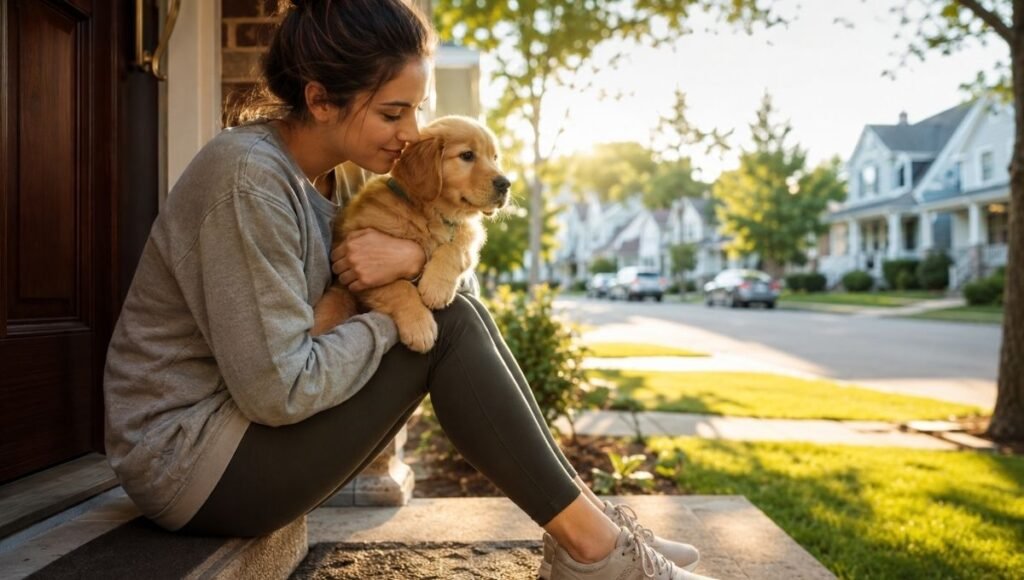
Your puppy is 10 weeks old and hasn’t left the house since you brought them home. You know parvo is out there — you’ve read enough to be genuinely scared of it. But you’re also reading that the socialization window closes at 16 weeks, and that missing it can cause behavioral problems that last a lifetime.
So you’re stuck. Your vet said one thing. The breeder said another. A Facebook group gave you three more contradictory answers. And meanwhile your puppy has never smelled grass, never seen another dog, never heard traffic or met a stranger, and you’re starting to wonder if you’re unintentionally setting them up for a fear-filled adulthood by keeping them safe indoors.
Here’s what nobody explains clearly enough: this is a real tension, not a question with one obvious right answer. Both risks are genuine. What matters is understanding them well enough to make smart decisions for your specific situation — not just waiting nervously until someone gives you permission to go outside.
This guide gives you the actual framework. What’s safe at what age, why the window matters, which environments are risky and which aren’t, and the practical socialization approaches that don’t require your puppy to set foot on ground that unknown dogs have walked on.
Key Takeaways
- The socialization window is 3 to 16 weeks. After 16 weeks, new experiences still matter but are encoded with significantly less ease. Missing this window has documented behavioral consequences.
- The vaccination series isn’t complete until 16 to 18 weeks. Full protection from parvo and distemper requires the complete series plus 1 to 2 weeks for immune response.
- These two facts are in direct conflict — and the answer is graduated outdoor access, not a binary “inside until fully vaccinated.”
- Low-risk outdoor exposure from 8 weeks onward is recommended by the AVSAB (American Veterinary Society of Animal Behavior). The behavioral risk of under-socialization outweighs the disease risk of carefully managed early exposure.
- Parvo risk is location-dependent. Your clean suburban backyard is not the same risk environment as a dog park where unknown dogs congregate.
The Real Question Behind “When Can My Puppy Go Outside”
Most owners are actually asking two overlapping questions when they search this.
The first is: “When is it safe from a disease perspective?” The second is: “Am I already failing my puppy by keeping them inside this long?”
Both are worth answering directly.
On the disease side: the primary concern is parvovirus, a highly contagious viral disease that can survive in soil and outdoor environments for 6 months to a year. Puppies with incomplete vaccination series have genuine susceptibility. This is not a theoretical risk — unvaccinated puppies who contract parvo have mortality rates of 68 to 91 percent without treatment.
On the behavioral side: the socialization window is a neurological reality, not a guideline. Between 3 and 16 weeks, a puppy’s brain is in a state of extraordinary plasticity — new experiences are encoded as “normal” with unusual ease. After 16 weeks, the fear response matures and new experiences require significantly more repetition to feel safe. Research on puppies raised during COVID-19 lockdowns — who had significantly restricted socialization during this window — showed measurably higher rates of fearfulness and aggression in adulthood compared to pre-lockdown puppies.
<cite index=”28-1″>Studies of puppies raised during COVID-19 restrictions highlighted a significant increase in personality traits related to fear and aggression in dogs who experienced lockdown restrictions during their socialization period, confirming that social restrictions during this window strongly impact behavioral development.</cite>
Missing the window cannot be fully compensated for later. It doesn’t mean the dog is ruined — it means building confidence takes more time, more patience, and often professional help.
So the answer to “when can my puppy go outside” is not a single date. It’s a progression.
The Vaccination Timeline: What’s Actually Happening
To understand the risk side, you need to understand what vaccinations are actually doing — because “not fully vaccinated” doesn’t mean “completely unprotected.”
Puppies are born with some immunity passed from their mother through colostrum (first milk). This maternal immunity is protective but fades — and here’s the tricky part — at different rates in different puppies. This is why vaccines are given in a series rather than a single shot: one dose catches the puppy after maternal immunity has faded but before they’ve been exposed to disease.
The standard core vaccine series (DHPP):
- 8 weeks: First DHPP (Distemper, Hepatitis, Parainfluenza, Parvovirus)
- 12 weeks: Second DHPP
- 16 weeks: Third DHPP + Rabies
- Full protection: 1 to 2 weeks after the final dose — approximately 18 weeks
This means there’s a real window between 8 and 18 weeks where your puppy has partial but not complete protection. After the first shot at 8 weeks, they have some protection from the first dose. After the second shot at 12 weeks, protection increases further. They’re not unprotected — they’re incompletely protected.
The disease risk is also not uniform across environments. A pristine fenced backyard that only your family and vaccinated dogs have access to is not the same risk as a popular dog park. The ground outside a vet clinic, a pet store, or anywhere large numbers of unknown dogs congregate carries genuinely different risk than a quiet residential sidewalk or a friend’s clean yard.
When Can Puppy Go Outside: A Stage-by-Stage Guide
Here’s the graduated approach that balances both risks appropriately.
8 to 12 Weeks — Start Now, Start Smart

Your puppy comes home at 8 weeks. This is the beginning of the most critical socialization window, and it’s also before any vaccines have built significant immunity. The answer is not to stay inside — it’s to choose environments carefully.
Safe from 8 weeks:
- Your own backyard, if no unknown dogs have recently had access to it
- The homes and yards of friends with vaccinated adult dogs in good health
- Indoor environments: stores that allow dogs, friends’ homes, family gatherings — anywhere you can verify the dog population is vaccinated
- Being carried in public — your arms are off the ground, and carrying your puppy through a busy environment exposes them to people, sounds, smells, and visual stimulation without ground-level disease risk
What to prioritize in this window: This is when your puppy’s brain is most open to encoding new experiences as normal. A puppy who is carried through a farmers market at 9 weeks hears traffic, sees strollers, smells food, encounters strangers — all of it is being filed away as “this is how the world works.” The exposure is happening even without paws on potentially contaminated ground.
Meeting vaccinated, healthy dogs in controlled environments is genuinely important here. The experience of interacting with other dogs — learning dog body language, bite inhibition, play signals — happens between dogs, not between a dog and a human. Find neighbors or friends with vaccinated adult dogs who are known to be gentle with puppies. These interactions are worth some carefully managed outdoor exposure.
The carrying technique: For public environments before 12 weeks, carry your puppy or use a puppy carrier/sling. They experience the environment; they just don’t touch potentially contaminated ground. This is not overprotective — it’s smart risk management.
12 to 16 Weeks — Expanding Carefully
After the second DHPP at 12 weeks, protection has increased meaningfully. The socialization window is narrowing. This is the phase for expanding outdoor access deliberately and systematically.
Safe from 12 weeks:
- Short walks on quiet residential sidewalks — the risk on a low-traffic neighborhood street is meaningfully lower than a busy dog park
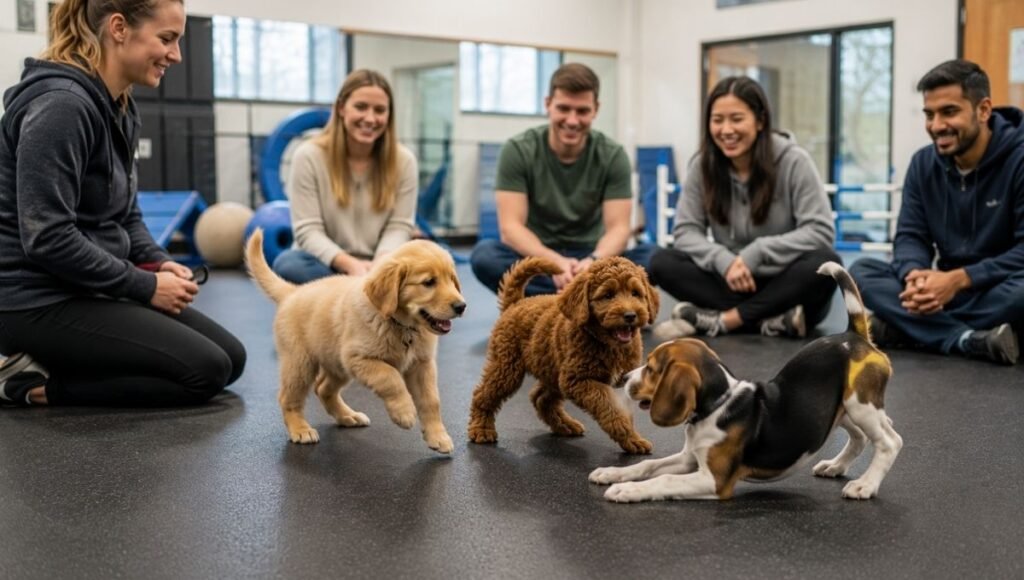
- Puppy classes at facilities that require proof of vaccination for all attending puppies (this is genuinely safe and enormously valuable for socialization)
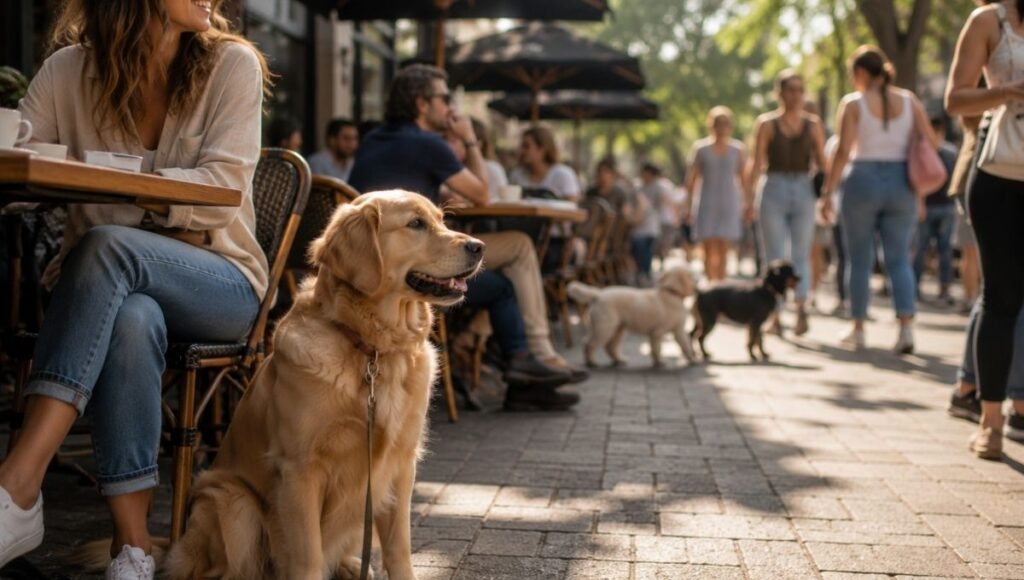
- Outdoor patios of cafes and restaurants where you can control the environment
- Continued backyard and friend’s yard access
- Car rides to new environments, even if you don’t get out (the sounds and sights from a car window are socialization)
What puppy classes actually provide: This is worth emphasizing. A reputable puppy class — one that checks vaccination records and maintains a clean environment — provides controlled interaction with other dogs AND people simultaneously, in a supervised setting. The American Veterinary Society of Animal Behavior explicitly endorses puppy classes starting at 7 to 8 weeks, as long as the puppy has had at least one set of vaccines 7 or more days before the class and is in good health.
The behavioral benefit of puppy class in this window is not replaceable by waiting. The skills learned in supervised play — reading dog body language, appropriate greetings, managing arousal — are exactly what the socialization window is designed to encode.
What to avoid: Dog parks. Pet store floors where unknown dogs walk. Hiking trails or parks where dogs congregate freely. Any environment where you can’t verify the vaccination status of dogs your puppy might encounter or ground they might contact.
16 to 18 Weeks — Full Outdoor Access
After the final DHPP and 1 to 2 weeks for immune response to build, your puppy has full core vaccine protection. The socialization window is closing.
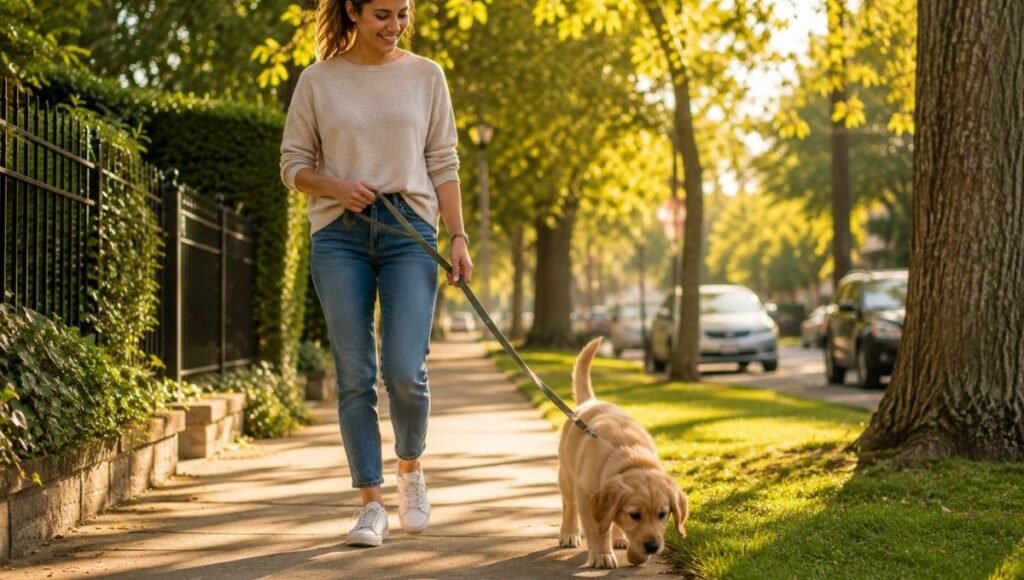
From approximately 16 to 18 weeks, normal outdoor life begins. Regular walks, dog parks, pet-friendly stores, trails — all of these are appropriate with the full vaccine series completed.
A note on the socialization window at this point: it’s closing, not closed. New experiences at this age still matter and can still be introduced positively. But the ease with which they become “normal” has decreased compared to 8 to 12 weeks. Any gaps in socialization — specific sounds, environments, or types of people your puppy hasn’t encountered — should be addressed systematically and positively now rather than assuming they’ll catch up naturally.
The Puppy Socialization Checklist: What Your Puppy Needs to Experience
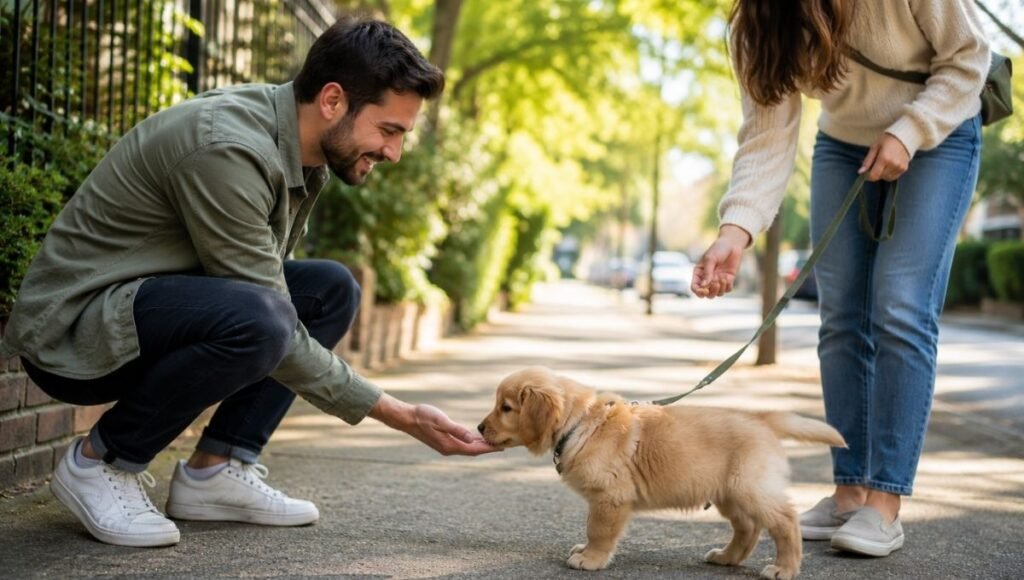
Socialization isn’t just about going outside. It’s about the specific range of experiences that produce a confident, adaptable adult dog. Here’s what to expose your puppy to during the window, organized by category.
People
- Men, women, children of various ages
- People with beards, hats, sunglasses, helmets, uniforms
- People with mobility aids — wheelchairs, canes, walkers
- People in high-visibility vests, delivery uniforms, rain gear
Environments and Surfaces
- Grass, gravel, pavement, wet pavement, grates, stairs
- Indoor spaces: elevators, stores, vet clinics (carried if pre-vaccination)
- Moving vehicles and public transit (if relevant to your life)
Sounds
- Traffic, construction, thunder recordings at low volume
- Doorbells, vacuum cleaners, power tools, fireworks (at a distance and low level)
- Children playing, crowds, music
Other Animals
- Vaccinated, friendly adult dogs — ideally multiple in different contexts
- Cats (supervised), if relevant to your household
- Birds, small animals at appropriate distance
Handling
- Every body part touched regularly: ears, paws, tail, mouth, between toes
- This builds tolerance for veterinary examination and grooming for the rest of their life
The “Good Experience” Rule
Every item on this list should be introduced with positive associations — treats, calm praise, your relaxed body language. The goal is not just exposure but positive exposure. A puppy who encounters a skateboard and has a treat appear simultaneously is building a different association than a puppy who is pulled toward a skateboard against their will.
Watch for stress signals: yawning, lip licking, turning away, whale eye (whites of eyes visible), trembling. If your puppy shows these, you’ve gone past their comfort threshold. Reduce intensity, increase distance, and work up more gradually.
Addressing the Parvo Risk Honestly
Some owners reading this will live in areas with known parvo outbreaks, or in urban environments with very high dog traffic and unknown vaccination rates. The graduated approach above assumes relatively low-risk outdoor environments. In genuinely high-risk situations, adjustments are warranted.
If you’re in a high-risk area:
- Extend the “carry only” period for public spaces
- Focus indoor socialization more intensively: visitors to your home, indoor puppy classes, car rides
- Limit backyard exposure if stray dogs or wildlife have access
- Discuss specific local risk with your veterinarian — they know the local parvo incidence
The bottom line on parvo: A vaccinated adult dog who was poorly socialized as a puppy may survive their entire life safely — and spend it afraid of strangers, reactive to other dogs, and difficult to manage. A puppy who contracts parvo despite careful management is in a genuine emergency. Both are serious. The graduated approach tries to honor both risks rather than pretending one doesn’t exist.
What to Do If You’re Behind on Socialization
If your puppy is already 14 or 15 weeks and hasn’t been outside much, don’t panic — but do act now.
Every day remaining in the socialization window is valuable. The 14-week puppy who has intensive, positive exposure for the next 2 weeks is in a better position than the 14-week puppy who waits for full vaccination before starting. Start the graduated exposure plan immediately. Use carrying, backyard access, and indoor environments aggressively. Book a puppy class for the earliest available slot.
After 16 weeks, continue socialization — just with the understanding that each new experience may require more repetitions and more patience to establish comfort. This is manageable. It’s not what we’d design if we were choosing, but it’s workable with consistent effort.
FAQ: What New Puppy Owners Actually Search For
Can I take my puppy outside before vaccinations? Yes, with managed risk. Your own backyard, friends’ yards with vaccinated dogs, and being carried in public are all appropriate from 8 weeks. Avoid high-traffic dog areas, dog parks, and any environment where unknown unvaccinated dogs congregate until the vaccination series is complete.
When can puppies go on walks? Short walks on quiet residential sidewalks are generally considered safe after the second DHPP at approximately 12 weeks. Avoid high-traffic dog areas and dog parks until the full vaccine series is complete at 16 to 18 weeks.
When can my puppy meet other dogs? Immediately, if those dogs are vaccinated and in good health. Known vaccinated adult dogs are safe from 8 weeks onward and provide essential socialization that humans cannot replicate. Unknown dogs in public areas should wait until the full vaccine series is complete.
Is my backyard safe for my unvaccinated puppy? Generally yes, if no unknown dogs have had access to it recently. Parvo can persist in soil for months, but risk is significantly lower in a private yard than in public dog areas. Discuss with your vet if there’s been recent dog activity in your yard from unknown animals.
When can puppy go to the dog park? Wait until after the full vaccine series plus 1 to 2 weeks for immune response — approximately 18 weeks. Dog parks are high-risk environments because vaccination status of all dogs present is unknown.
What is the puppy socialization window? The period from 3 to 16 weeks of age when a puppy’s brain is in a state of heightened plasticity — new experiences are encoded as normal more easily than at any other point in life. Missing this window doesn’t make socialization impossible, but it makes it significantly harder and less complete.
Can I carry my puppy outside to socialize before vaccinations? Yes, and this is specifically recommended. Carrying your puppy in public gives them exposure to people, sounds, environments, and visual stimulation without ground-level disease risk. This is one of the most effective early socialization techniques for pre-vaccination puppies.
The 10-Minute Socialization Plan for Busy Owners
You have 10 minutes tonight. Here’s what to do:
Sit outside on your front step with your puppy in your lap. Let them watch the street. Every time a car passes, give a small treat. Every time a person walks by, give a treat. Every time a sound happens — a door, a bird, a distant siren — let your puppy orient to it, watch them for calm curiosity vs. stress, treat for calm responses.
Ten minutes of this, three times a day, covers an enormous amount of environmental socialization ground without requiring any high-risk exposure. Add a short carry around the block. Add a visit from a neighbor. Add a session handling paws and ears while treating.
The window is open. Use it in whatever increments you have.
The Bottom Line
The tension between disease risk and socialization is real, and anyone who tells you it’s simple is oversimplifying. Both parvo and behavioral problems from under-socialization are genuine concerns with documented consequences.
What’s also true: the graduated approach works. Backyard access from day one. Carrying in public from day one. Known vaccinated dogs from day one. Careful short walks after 12 weeks. Full outdoor access after 16 to 18 weeks. Parallel indoor socialization every day.
The puppies who grow into genuinely confident, adaptable adult dogs are almost universally the ones who had intensive, positive socialization during the window — managed carefully for disease risk, but not sacrificed to it.
Start now. Use what you have. The window is open.
What to Read Next
- Puppy Vaccination Schedule: Every Shot Your Puppy Needs in Year One — The complete first-year vaccine timeline, what each shot protects against, and what to watch for after each visit
- Puppy Socialization: The Complete Guide — The full socialization checklist, how to read stress signals, and the pre-vaccination protocol in detail
- Puppy Development Stages: Week-by-Week Guide — How the socialization window fits into your puppy’s complete developmental timeline
- How to Leash Train a Puppy: Step-by-Step Guide — Building the leash skills you’ll need when full outdoor walks begin
- New Puppy Checklist: Everything You Need Before Day One — Complete preparation guide including the vet appointment to book in week one
References
- American Veterinary Society of Animal Behavior. (2021). AVSAB Position Statement on Puppy Socialization. avsab.org
- McEvoy, V.C., et al. (2022). Canine Socialisation: A Narrative Systematic Review. Animals, 12, 2895. ncbi.nlm.nih.gov
- Gazzano, A., et al. (2023). Puppies Raised during the COVID-19 Lockdown Showed Fearful and Aggressive Behaviors in Adulthood. Animals, 13(6), 1024. ncbi.nlm.nih.gov/pmc/articles/PMC10059587/
- Vaterlaws-Whiteside, H., & Hartmann, A. (2017). Improving puppy behavior using a new standardized socialization program. Applied Animal Behaviour Science, 197, 55–61.
- American Animal Hospital Association. (2022). AAHA Canine Vaccination Guidelines. aaha.org