
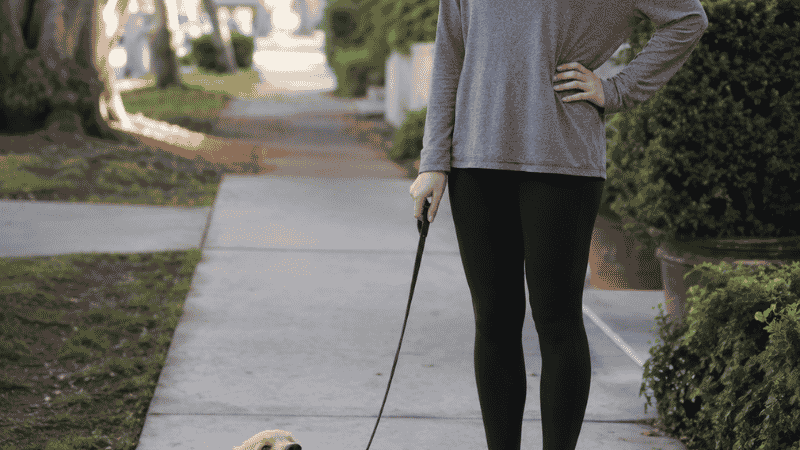
Picture this: you finally clip on the leash, open the front door, and your puppy takes three steps, sits down, and stares at you like you’ve personally offended them. You give the leash a gentle tug. Nothing. You try a treat. They sniff it, look away, and sit back down.
Or the opposite: they bolt forward with the enthusiasm of a dog who has discovered that the entire world is one giant smell buffet, and your arm is just an inconvenient attachment to the leash that apparently goes wherever they want to go.
Either scenario — the immovable statue puppy or the perpetual pulling machine — is completely normal. And either way, it doesn’t have to stay that way.
Leash training is genuinely one of the most rewarding skills you’ll teach your puppy, for a simple reason: every single walk for the rest of their life gets better when you do it right. We’re talking about potentially thousands of walks. Getting this foundation right in the first few months is an investment that pays off every single morning for the next decade.
Here’s the complete guide. No jargon, no equipment you need to buy today, and real answers for when things don’t go the way the basic instructions suggest.
Key Takeaways
- Start indoors, without a leash. The first step of leash training has nothing to do with the leash. Build the habit of walking beside you before you introduce any equipment.
- Puppies can start leash training as early as 8 weeks old. Earlier is better — the skills built now become the instincts that last a lifetime.
- Pulling happens because it works. If your puppy has ever pulled and gotten somewhere interesting, pulling has been reinforced. The fix is making forward movement dependent on a loose leash, every single time.
- Freezing and refusing to move is not stubbornness — it’s usually fear or sensory overwhelm. The solution is slower exposure, not more pressure.
- Most puppies make meaningful progress within 2 to 3 weeks of consistent daily practice. Consistency matters more than session length.
Why Leash Training Feels So Hard (It’s Not Your Fault)
Here’s something most guides don’t say clearly enough: dogs don’t naturally know how to walk on a leash. It’s not instinctive, it’s not intuitive, and from your puppy’s perspective, being attached to a person by a string while trying to explore the most interesting place they’ve ever been is genuinely confusing.
Walking politely beside you is an unnatural behavior that requires your puppy to override several very natural impulses — the pull toward interesting smells, the excitement of an open space, the desire to investigate everything. Teaching them to do this takes time, but more importantly, it takes the right sequence.
Most people start leash training by clipping on a leash and heading outside — which is effectively asking their puppy to perform the final exam before they’ve done any of the coursework. The outdoor environment is simply too stimulating for a young puppy to learn a brand-new skill. The smells, sounds, other dogs, people, traffic — all of it is competing against you for your puppy’s attention, and the environment wins every time.
The solution is to back up. Way up. Start somewhere your puppy has a fighting chance of paying attention to you, and build from there.
Step 1: Build the “Walking Beside You” Habit — No Leash Needed
Before your puppy ever sees a leash clipped to their collar, they should understand one basic concept: being next to you produces wonderful things.
This is called building a “reinforcement history” for the position beside you. It takes about 5 minutes per session and you can start it the same day your puppy comes home.
How to do it:
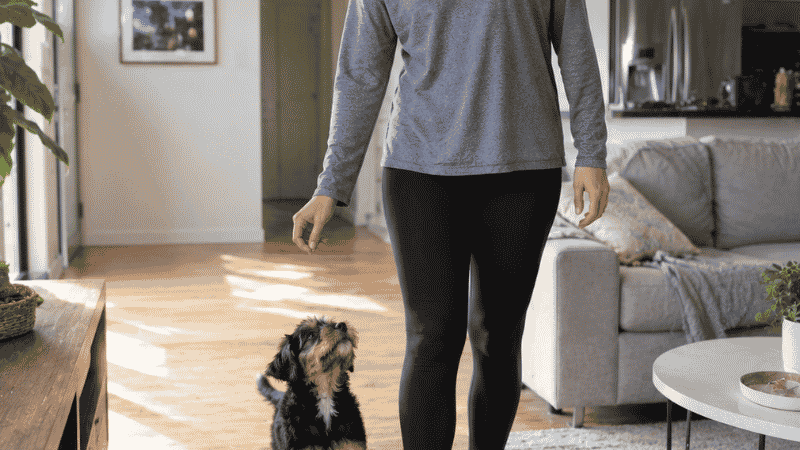
Stand in a quiet area inside your home with a handful of small, high-value treats. Wait for your puppy to naturally wander near your leg. The moment they’re beside you, say “yes” in a happy voice and drop a treat right next to your foot — not in your hand extended toward them, but on the ground at your feet.
This matters: where the treat lands teaches your puppy where the magic happens. If you deliver the treat from your hand held out to the side, you’re teaching them to walk ahead of you with their head turned back. If the treat lands at your feet, you’re teaching them that beside you is where good things appear.
Take a few steps. When your puppy follows and ends up next to you again, treat at your feet. Turn in a different direction. Treat when they’re beside you. Make a few laps around the room.
Do this for 3 to 5 minutes, twice or three times a day. Within a week, most puppies will actively choose to stay near you during these sessions — not because they’re told to, but because they’ve learned that your presence is consistently worth their attention.
That foundation changes everything that comes after.
Step 2: Introduce the Harness and Leash — Before You Go Anywhere
The harness and leash introduction should be its own project, completely separate from the first walk. A puppy who is stressed by wearing gear is a puppy who can’t learn anything on that walk.
Harness introduction:
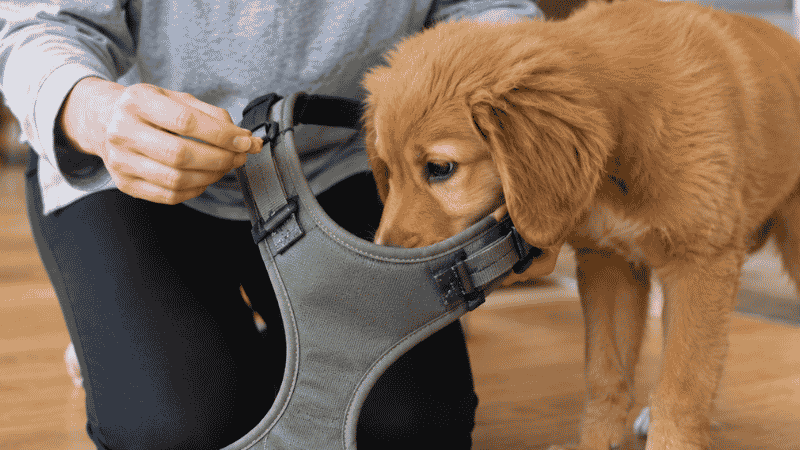
Place the harness on the floor. Let your puppy sniff it, paw it, and investigate it for a day or two with no pressure to wear it. Once they’re comfortable approaching it: hold a treat through the neck opening so the puppy puts their head through to get the treat. Practice just this for several sessions.
Gradually move to clipping the harness on for 30 seconds while feeding treats, then removing it. Build to 5 minutes, then 10. Once your puppy is comfortable wearing the harness without showing any concern — no pawing at it, no trying to remove it, no stiff or frozen body language — you’re ready to add the leash.
Leash introduction:
Clip on the leash and let it drag on the floor indoors. Let your puppy walk around with it trailing behind them for a few minutes while you offer treats and cheerful interaction. This gets them used to the weight and sensation of the leash without any pressure from the other end.
Then pick up the leash and walk around the room together, using the “beside you” habit you’ve already built. You’re not correcting anything or pulling — just walking with the leash attached, reinforcing proximity to you.
This whole process might take 3 to 5 days. It’s worth every minute of it.
Step 3: First Outdoor Sessions — Keep Them Very Short
First outdoor leash walk: not a walk. It’s a standing session near your front door.
Step outside, stand still, and let your puppy take in the environment. Smelling, looking around, processing the world — all of this is fine. Don’t try to walk anywhere. Don’t try to get them to focus on you. Give them 2 to 3 minutes to just exist in the outdoor space, feeding occasional treats when they check in with you voluntarily.
That check-in — when your puppy looks up at you of their own accord — is gold. Every time it happens, treat it like the best thing your puppy has ever done. Because from a training perspective, it is. A puppy who naturally looks at their owner in a stimulating environment is a puppy who is going to learn loose leash walking significantly faster than one who doesn’t.
After a few of these orientation sessions — which might mean standing outside for 3 minutes and going back in — you’re ready to try some actual walking.
The 10-step method for first outdoor walking:
Take 10 steps. Treat if your puppy is walking beside you with a loose leash. Stop. Let them sniff. Take 10 more steps. That’s it. Your first session outside might literally be 50 yards.
This isn’t because you’re being dramatic — it’s because short, successful sessions are enormously more effective than long sessions where the puppy spends most of the time at the end of a taut leash while you both grow increasingly frustrated.
Step 4: Dealing With Pulling — The Method That Actually Works
Pulling persists because it works. Every time your puppy has pulled and reached the thing they were pulling toward — the tree, the smell, the other dog — the pulling got reinforced. The only way to stop pulling is to make it stop working, consistently and immediately.
The stop-and-wait method:
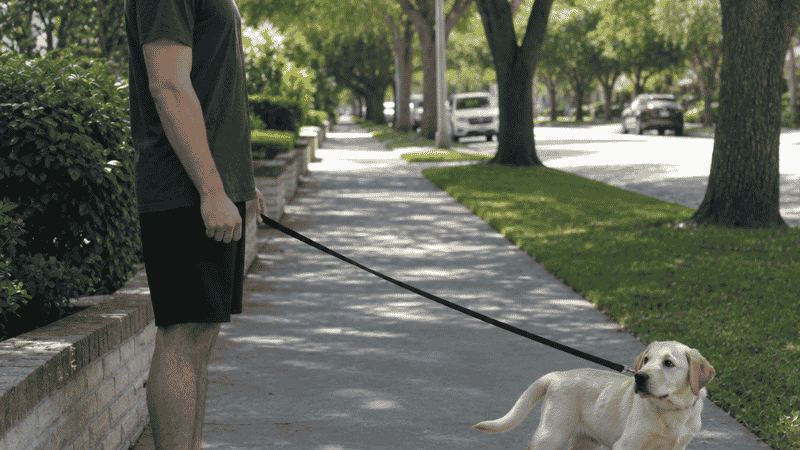
The instant the leash becomes taut, you stop walking. Completely. You don’t say anything, you don’t yank back, you don’t continue forward. You just stop.
You wait. Your puppy will typically do a few things: continue pulling (which doesn’t work), then look around, then eventually look at you or move back toward you to create slack in the leash. The moment there is any slack — any at all — you immediately start walking again and drop a treat.
The message is not subtle: leash tight = nothing happens. Leash loose = we go forward, sometimes treats appear.
It feels tediously slow. In the beginning, you might walk half a block in 20 minutes because you’re stopping every 10 seconds. This is completely normal and it works — most dogs figure out the pattern within 2 to 4 weeks of consistent application.
What doesn’t work:
- Continuing to walk while saying “no” or “easy”
- Jerking the leash
- Turning around and walking the other way every time (this can work as a variation but alone doesn’t teach the dog anything clear)
- Letting pulling sometimes work and sometimes not — inconsistency is the most common reason leash training stalls
The direction change variation:
When your puppy pulls, turn 180 degrees and walk the other way — cheerfully, without saying anything. Your puppy has to follow you because they’re attached. When they catch up and the leash is loose, praise and treat. This adds a slight inconvenience to pulling (they don’t get to go where they wanted) without any physical correction.
Many trainers use this alongside the stop-and-wait. The combination teaches the puppy two things: pulling doesn’t move you forward, and it might actually move you in the opposite direction.
Step 5: Teaching Your Puppy to Check In With You
There’s a skill beyond not-pulling that makes walks genuinely enjoyable: voluntary attention. A puppy who regularly glances up at you while walking is a puppy who is engaged with you, easy to redirect, and significantly less likely to lunge at distractions.
You can actively build this habit.
During walks, whenever your puppy looks up at you voluntarily — without being asked — immediately mark it (“yes!”) and reward. Do not ask for eye contact. Do not lure it. Just catch and reward the natural behavior of your puppy glancing at you.
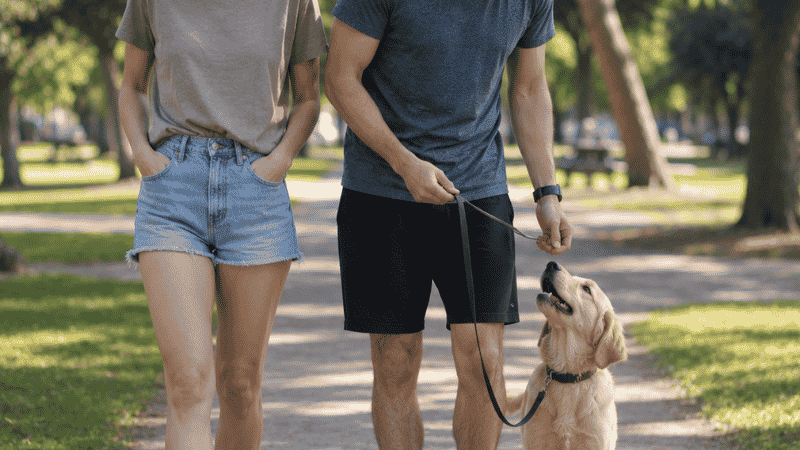
Within 2 to 3 weeks of consistently rewarding these voluntary check-ins, most puppies begin offering them more frequently. They learn that looking at you pays off, so they do it more. The cumulative effect on loose leash walking is remarkable — a puppy who checks in regularly is a puppy who is managing their own attention rather than being managed.
The Frozen Puppy Problem: When They Just Won’t Move
This is the other side of the pulling coin, and it catches many new owners off guard. Their puppy gets outside, hits some invisible threshold, and simply stops. Sits down. Won’t move. No treats in the world are convincing enough.
This is almost always fear or sensory overwhelm, not stubbornness. To a puppy with limited outdoor experience, the world outside is extraordinarily intense — sounds, smells, sights, movement, other animals. For a puppy who hasn’t had much outdoor exposure, it can be genuinely overwhelming.
What to do:
Don’t pull. Pulling against a frightened, frozen puppy escalates the stress response and worsens the association with the outdoor environment.
Instead: wait quietly beside your puppy. No pressure, no coaxing, no dragging. Let them process. When they take even one tentative step forward on their own, immediately reward enthusiastically. That one step is the win.
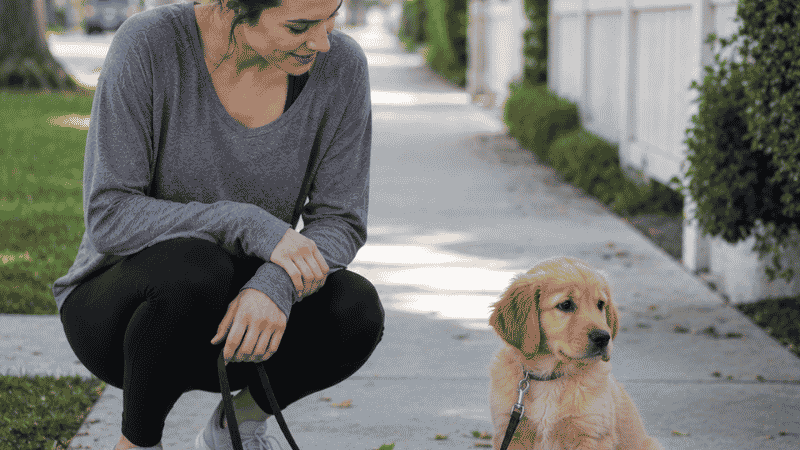
For puppies who consistently freeze, the issue is usually insufficient graduated exposure. They need more time in mildly stimulating environments before being expected to walk confidently in busy ones. Start in your backyard or a very quiet street. Build confidence there before moving to more stimulating environments.
It also helps enormously to not go outside for the purpose of “a walk.” Instead: go outside for the purpose of standing in one spot and letting your puppy observe the world while treats appear. No destination required. Once your puppy is comfortable and curious rather than frozen and anxious, actual walking becomes possible.
If You Only Have 10 Minutes
Life gets busy. Here’s what to prioritize if you can only fit in a 10-minute session:
At home: Practice the “beside you” foundation. 5 minutes of reinforcing your puppy for naturally walking next to you in the house, with direction changes and occasional speed variations. This builds the most important muscle — the habit of being next to you.
Outside: One 5-minute standing session in a mildly interesting spot. Let your puppy sniff, process, and check in with you voluntarily. Reward every check-in. Go back inside.
That’s it. 10 minutes of this, done consistently every day, will produce more progress than one 45-minute struggle walk twice a week.
When Leash Training Isn’t Working: A Diagnostic
If you’ve been doing consistent daily practice for 3 to 4 weeks and seeing no improvement, something in the system needs adjusting.
Check the treat value. What works as a reward at home may not be motivating enough outdoors. In stimulating environments, you typically need higher-value treats — small pieces of boiled chicken, cheese, or hot dog rather than kibble or standard training treats.
Check the environment difficulty. You may have moved outdoors too fast. Return to indoor practice for another week, then try the quietest possible outdoor environment you can find.
Check consistency. Is everyone in the household following the same protocol? A puppy who gets to pull when walked by one person and is stopped by another is receiving mixed messages.
Check the harness fit. An uncomfortable harness can make a puppy reluctant to move or anxious during walks. It should sit snugly but not restrict shoulder movement — you should be able to slip two fingers under every strap.
Check session length. Shorter sessions more frequently beat longer sessions less frequently for puppies every time. If sessions are running longer than 10 to 15 minutes, cut them in half.
When to Get Professional Help
Most puppies learn loose leash walking with consistent home practice. Some situations benefit from professional support:
- Persistent, severe reactivity on leash — lunging, barking, or snapping at other dogs, people, or objects — that doesn’t respond to redirection after 4 to 6 weeks of consistent work
- A puppy who consistently freezes completely outside and shows signs of significant fear (trembling, tail tucked, refusing all treats) despite gradual exposure
- Pain-related reluctance to walk — if your puppy is reluctant specifically on hard surfaces or shows lameness, a veterinary check is warranted before continuing leash training
A certified professional dog trainer (CPDT-KA) with experience in positive reinforcement methods is the appropriate first resource.
FAQ: What New Puppy Owners Actually Search For
At what age should I start leash training my puppy? As early as 8 weeks old. The indoor foundation work — building the habit of walking beside you and introducing the harness — can and should begin the day your puppy comes home. Early doesn’t mean pushing too fast; it means starting the positive associations from day one.
My puppy keeps biting the leash — what do I do? Leash biting is common, especially in teething puppies. Keep a high-value chew or toy in your free hand and swap it for the leash the moment they go for it. Ensure the leash is made of a less appealing material — braided nylon is less interesting to chew than rope-style leads. Consistent redirection to an appropriate chew item typically resolves this within a few weeks.
How long should puppy leash training sessions be? 3 to 10 minutes, two to three times per day. Young puppies have limited attention spans and fatigue mentally faster than owners realize. Short, successful sessions build the skill faster than long sessions where focus deteriorates.
My puppy walks perfectly at home but pulls constantly outside — why? Because outside is a completely different environment with entirely different levels of stimulation. Learning doesn’t automatically transfer from low-distraction to high-distraction environments — it has to be practiced and built up in progressively more interesting places. Treat the outdoor environment as a new training scenario and apply the same gradual approach you used indoors.
Should I use a collar or harness for leash training? A harness is strongly recommended for training — particularly a Y-shaped or H-shaped harness with a front clip option for dogs who pull significantly. Harnesses distribute leash pressure across the chest and shoulders rather than concentrating it on the neck, protecting the trachea and thyroid during the inevitable pulling phase of early training.
How do I stop my puppy from pulling toward other dogs? This is a distance management and distraction training problem. Increase the distance from the trigger (the other dog) until your puppy can remain focused on you. Work at that distance consistently, closing the gap only as your puppy demonstrates they can maintain focus. Rushing this process almost always results in reactive behavior being reinforced.
How long does leash training take? For the loose leash walking foundation: most puppies show meaningful improvement within 2 to 3 weeks of consistent daily practice. For reliable loose leash walking in all environments including high-distraction situations: typically 3 to 6 months of progressive work. The foundation is fast; the generalization takes longer.
The Bottom Line
Leash training isn’t a two-day project or a one-trick fix. It’s a sequence: build the habit of being beside you, introduce equipment positively, take your first steps outside successfully, and then teach pulling doesn’t work and checking in does.
The owners who find this hard aren’t failing — they’re usually just missing one piece of the sequence, or they’ve moved too fast into environments where their puppy can’t yet succeed. Back up, slow down, and start somewhere your puppy has a realistic chance of getting it right.
Every short session that ends with your puppy walking nicely beside you, even for just 20 yards, is a deposit into the account that produces the dog you want to walk with every morning for the next ten years.
That dog is achievable. You just have to build them one session at a time.
What to Read Next
Leash training connects to every other part of your puppy’s first year:
- Puppy Collar vs Harness Guide: What New Owners Actually Need — Which equipment to use and exactly how to fit it correctly
- When to Start Training a Puppy: Age-by-Age Guide — How leash training fits into the broader training timeline from 8 weeks onward
- How to Train a Puppy: The Complete First-Year Guide — The full training system, of which leash walking is one essential component
- Puppy Socialization: The Complete Guide — How socialization builds the outdoor confidence that makes leash training easier
- New Puppy Checklist: Everything You Need Before Day One — Harness, leash, and training treats to have ready before your puppy arrives
References
- American Kennel Club / Gibeault, S., MSc, CPDT. (2026). How to Leash Train a Puppy. akc.org
- American Veterinary Society of Animal Behavior. (2021). AVSAB Position Statement on the Use of Dominance Theory in Behavior Modification of Animals. avsab.org
- Collins, K., MS, CPDT-KA / ASPCA. (2024). Leash Training Your Dog. aspca.org
- Herron, M.E., Shofer, F.S., & Reisner, I.R. (2009). Survey of the use and outcome of confrontational and non-confrontational training methods in client-owned dogs showing undesired behaviors. Applied Animal Behaviour Science, 117(1–2), 47–54.
- Certification Council for Professional Dog Trainers. (2024). Standards for Professional Dog Training. ccpdt.org