
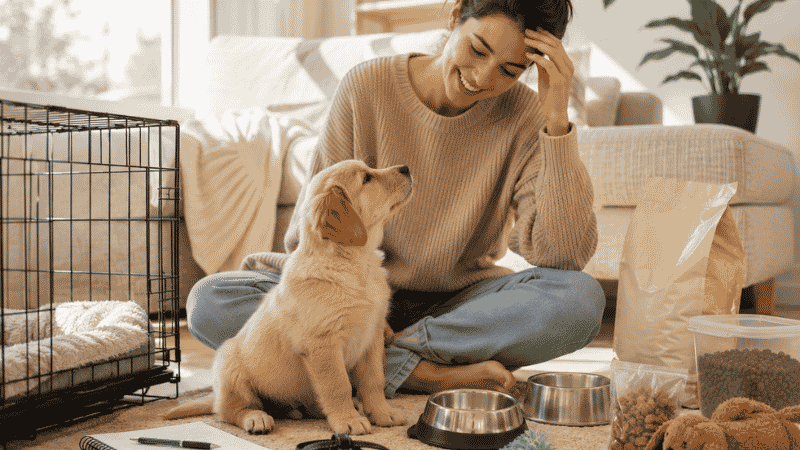
You said yes to the puppy. Now comes the part nobody fully prepared you for.
Not the joy — you were ready for that. The part nobody prepared you for is the sheer number of decisions waiting on the other side of “yes.” What food? What size kennel? What vaccinations and when? Is that whining normal? Should they sleep in the bedroom? What do I do about the biting?
The information is out there, but it’s scattered across dozens of different articles, and you don’t know what’s urgent, what can wait, or what order any of it goes in.
This guide puts it all in one place. Not just a shopping list — a complete timeline from the weeks before your puppy arrives through their first six months, with everything organized in the order it actually matters. Use it as your central reference, and follow the links throughout to go deeper on any topic that needs more detail.
Key Takeaways
- Start before they arrive. The supplies, the vet appointment, the puppy-proofing — all of this should be done before your puppy comes home, not scrambled together in the first week.
- The 3-3-3 rule. Most puppies take 3 days to decompress, 3 weeks to learn your routine, and 3 months to feel fully at home. Set your expectations accordingly — what you see in week one is not who this puppy will be at month three.
- The first vet visit happens within the first week. Not when convenient, not after they’ve “settled in.” Within 5 to 7 days of arriving home.
- Training starts day one. Not at six months. Not once they’ve “calmed down.” From the moment they come through your door.
- Budget realistically. The first year with a puppy costs most families between $1,500 and $3,500 in supplies, veterinary care, and food — often significantly more in the event of any health issues. Knowing this upfront allows you to plan rather than be surprised.
Phase 1: Before Your Puppy Arrives
Choosing the Right Puppy — The Decision Before All Others
Before the checklist comes the most important choice: which puppy, from where.
Breed matters more than most new owners realize. Not for prestige, but for practical compatibility. An energetic working dog in a small apartment with a busy owner who travels frequently is a mismatch that no amount of training fully resolves. A low-energy companion breed with an active family who wants a hiking partner is equally mismatched in the other direction.
The honest questions to ask before choosing:
- How much exercise can you genuinely provide daily — not ideally, but on your worst week?
- Do you have children, elderly family members, or other pets whose needs need to be considered?
- Are you comfortable with heavy shedding, extensive grooming requirements, or a breed known for specific health costs?
- Do you want a puppy from a breeder, a shelter, or a rescue? Each path has different considerations and timelines.
Responsible breeders health-test their breeding dogs, raise litters in home environments with early socialization, and ask you as many questions as you ask them. Reputable rescues assess the temperament of dogs in their care and provide honest information about history and potential challenges.
→ For a complete breakdown of the best breeds for first-time owners, including energy level, grooming needs, and temperament profiles, read: Best Puppy Breeds for First-Time Owners
The Must-Have Supplies Checklist
Get everything below before your puppy arrives. Running to the pet store at 11pm on night one is avoidable.
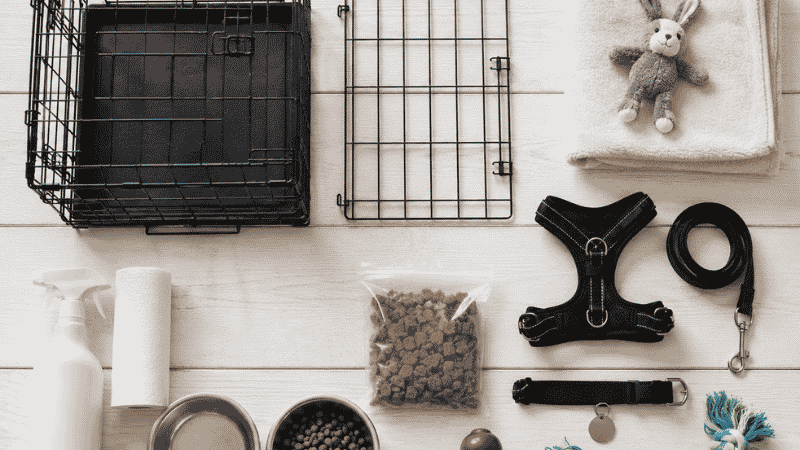
Feeding:
- [ ] Puppy food — specifically formulated for growth, with an AAFCO “growth” statement on the label. Large breed puppies need a large breed formula. Ask your breeder or rescue what food the puppy has been eating; start with that and transition gradually.
- [ ] Stainless steel or ceramic food and water bowls — not plastic, which can harbor bacteria and cause chin acne in some puppies.
- [ ] Slow-feeder bowl if your puppy eats quickly — prevents bloat and digestive upset.
- [ ] Treat storage container — you’ll use more treats in the first months than you expect.
Sleeping and Confinement:
- [ ] Kennel/crate — sized for your puppy’s adult dimensions with a divider panel to make it smaller now. Wire kennels with dividers are the most practical option for most owners.
- [ ] Kennel cover or large blanket — covering three sides creates a more den-like environment that helps puppies settle.
- [ ] Washable crate pad — thin, not bulky. Wait until you understand your puppy’s chewing habits before investing in expensive bedding.
- [ ] Baby gate or exercise pen — for managing your puppy’s access to rooms and for implementing training time-outs.
Walking and Identification:
- [ ] Flat collar with ID tag — engraved with your phone number before the puppy arrives. This goes on day one.
- [ ] Harness — Y-shaped or H-shaped, sized for your puppy’s current weight. The leash clips here for all outdoor activity, not to the collar.
- [ ] Leash — 4 to 6 feet for regular walking. A longer long-line (15 feet) for recall training.
- [ ] Poop bags — in quantity. More than you think you need.
Health and Cleaning:
- [ ] Enzymatic cleaner — non-negotiable for potty training. Standard cleaners don’t break down urine compounds; enzymatic cleaners do, eliminating the scent markers that pull puppies back to the same spot.
- [ ] Puppy-safe shampoo
- [ ] Nail clippers or file — starting handling paws early makes nail maintenance much easier for life.
- [ ] Soft toothbrush and puppy toothpaste — dental disease is the most common health issue in adult dogs. Starting early prevents it.
Training:
- [ ] High-value training treats — small, soft, and genuinely exciting. Boiled chicken, small pieces of cheese, or commercial soft treats. Have these ready from day one.
- [ ] Treat pouch worn on your hip — timing is everything in training. Fumbling in your pocket costs you critical seconds.
- [ ] Chew toys in various textures — rubber, rope, and nylon. These are your redirect tools for biting and chewing.
- [ ] Frozen Kong or similar — stuffed with peanut butter or wet food and frozen, this is the single most useful tool for building a positive kennel association.
Safety:
- [ ] Puppy-proof the space before they arrive: secure electrical cords, move toxic plants, store medications and cleaning products out of reach, check for gaps under fences and in yard perimeters.
- [ ] Microchip appointment — schedule this with your first vet visit. More permanent and reliable than ID tags alone.
→ For kennel size guides, type comparisons, and how to introduce the crate positively, read: What Puppy Kennel Do You Actually Need?
→ For the collar vs harness breakdown and why the leash should never clip to the collar for walks, read: Puppy Collar vs Harness Guide
The Vet Appointment — Book It Before the Puppy Arrives
Don’t wait until your puppy is home to find a veterinarian. Practices with good reputations fill quickly, and you need an appointment within the first week of bringing your puppy home. The right time to find and book a vet is before you pick up your puppy.
What to look for in a veterinarian:
- Fear-free or low-stress handling practices — how a puppy experiences their first few veterinary visits shapes their relationship with veterinary care for life
- Clear communication about costs and recommendations
- A location you can realistically get to in an emergency
When you book, let them know you’re bringing home a new puppy. Ask what to bring: vaccination records from your breeder or rescue, a fresh stool sample for parasite testing, and any information about the food they’ve been eating.
Phase 2: The First 24 Hours
Arriving Home — Calm Is the Goal
Your puppy has just left the only world they’ve ever known. Everything is different — the smells, the sounds, the people, the absence of littermates. The temptation to introduce them to everyone immediately, to let the kids hold them, to photograph every moment — all of it should wait.
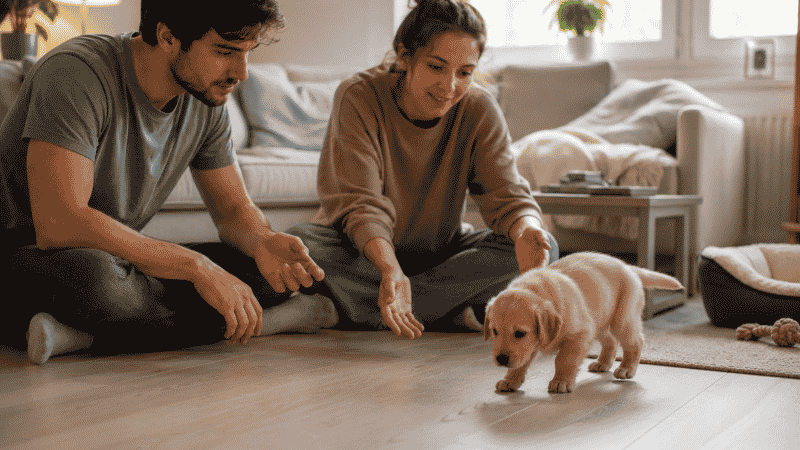
For the first few hours, the goal is calm. One or two family members maximum. A brief introduction to one room. Their kennel set up and accessible. Their first meal in the new environment.
The 3-3-3 rule is worth understanding and sharing with everyone in your household:
- 3 days to decompress from the stress of transition. Don’t evaluate your puppy’s personality based on this period. Some puppies are withdrawn and quiet. Others are frantic and overstimulated. Neither is their permanent state.
- 3 weeks to learn the routine of your household. To understand where things happen, what the schedule looks like, who the people are.
- 3 months to feel truly at home — to show you who they actually are.
What looks like a difficult puppy at day three is often a completely different dog at month two. Patience in the first week pays dividends for years.
The First Night
This is often the hardest night. Your puppy is alone — really alone — for the first time in their life. Crying is normal. Whining is normal. Some puppies cry intensely for the first few nights before settling; others adapt within 24 hours.
The single most effective intervention for first-night crying is placing the kennel in or near your bedroom. Your breathing, your scent, your occasional voice reassurance — all of it tells your puppy that they are not abandoned. This proximity dramatically reduces the intensity and duration of nighttime distress.
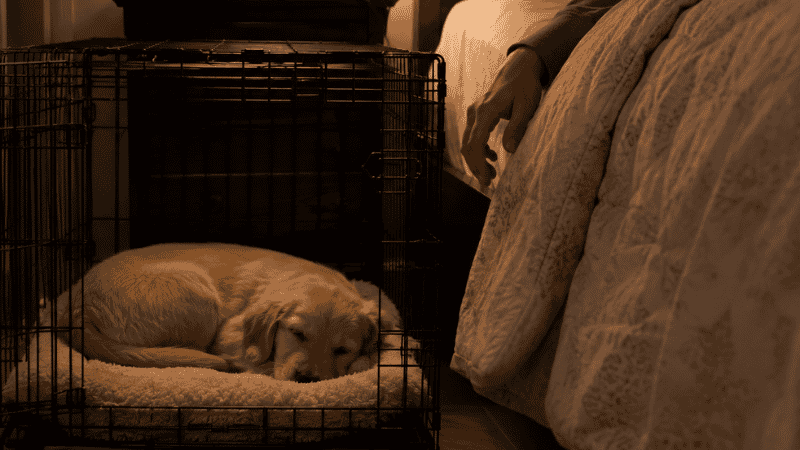
This does not lock you into a permanent arrangement. Once your puppy is settled — typically within 1 to 2 weeks — you can gradually move the kennel to wherever you want it to live permanently.
What not to do: bring your puppy into your bed to stop the crying. This works, immediately, which is exactly why it’s a problem. Your puppy learns that crying produces bed access, and the crying intensifies and extends accordingly.
Day One Training Begins
Not “maybe tomorrow, once they’ve settled.” Today. Not formal training sessions — your puppy is exhausted and overwhelmed — but the behavioral patterns you’re establishing right now are already teaching them something.
Every time someone reaches for their hands to let the puppy bite: teaching hands are acceptable chew targets. Every time the puppy whines and someone immediately comes: teaching that whining gets attention. Every time the puppy sits calmly and receives a small treat: teaching that calm, grounded behavior is what produces good things.
The foundation is being built whether you’re paying attention to it or not.
Phase 3: The First Week
The Vet Visit — Priority One
Within 5 to 7 days of arriving home. Not when convenient — within the first week.
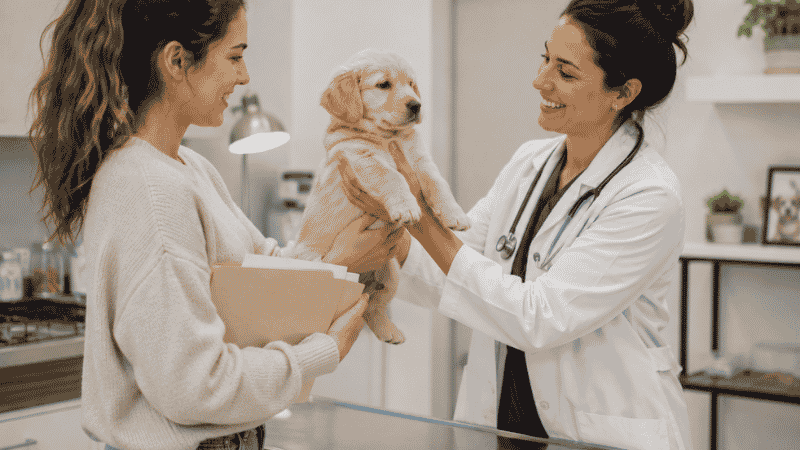
What happens at this visit:
- Complete physical examination: weight, heart, lungs, eyes, ears, mouth, abdomen, lymph nodes
- Parasite screening: fecal test for intestinal parasites, which most puppies carry from birth
- Vaccination review and schedule: what they’ve had, what they need, when
- Discussion of heartworm, flea, and tick prevention appropriate for your region
- Microchipping if not already done
- Conversation about food, behavior, and development
Bring: vaccination records from your breeder or rescue, the stool sample, a list of questions, and a familiar toy or blanket for comfort. Arrive a few minutes early to allow your puppy to acclimate to the clinic environment before going in.
→ For the complete first-year vaccination schedule, including core vs. non-core vaccines and costs, read: Puppy Vaccination Schedule: Every Shot Your Puppy Needs
Establishing the Daily Routine
Puppies thrive on predictability. The routine you establish in the first week becomes the expectation for weeks and months to come. Even if the specific times shift as your schedule evolves, the structure itself — meals at predictable intervals, potty trips on a consistent schedule, sleep and wake times that are roughly consistent — is what creates a puppy who knows what to expect and feels secure enough to learn.
A basic first-week daily routine for a puppy 8 to 12 weeks old:
| Time | Activity |
|---|---|
| Morning | Wake up → outside immediately for potty → breakfast → outside again 15 minutes later |
| Mid-morning | Supervised play → short training session (3–5 minutes) → nap in kennel |
| Midday | Wake → outside → lunch → outside again → supervised time |
| Afternoon | Training session → outdoor exploration → nap |
| Evening | Dinner → outside → supervised family time → short training session |
| Night | Final potty outside → kennel for the night |
Overnight: puppies under 12 weeks need one to two bathroom trips during the night. Set an alarm. Waiting for crying is less effective than proactive trips.
Potty Training — Start the System Immediately
The potty training system is not complicated, but it requires commitment from everyone in the household:
Every time your puppy wakes up: outside immediately. Every time your puppy eats: outside within 15 minutes. After every play session: outside. Every 1 to 2 hours during the day for puppies under 12 weeks.
When they eliminate outdoors: immediate, enthusiastic reward — treat and genuine praise the moment it happens, not once you’re back inside.
When accidents happen indoors: say nothing. Clean thoroughly with enzymatic cleaner. Adjust your schedule — an accident means the interval between outdoor trips was too long, not that the puppy is “bad.”
Most puppies are reliably house-trained between 4 and 6 months with consistent management. Small breeds often take until 7 to 9 months due to smaller bladder capacity.
→ For the complete potty training system including apartment guidance, the enzymatic cleaner protocol, and managing accidents correctly, read: How to Potty Train a Puppy
Kennel Training — Building the Safe Space
The kennel should be introduced as a positive experience, not used as confinement from day one. If your puppy is already reluctant, the introduction needs to be slower and more deliberate.
The foundation: feed all meals inside the kennel. Leave the door open during the day and toss treats inside periodically. Provide a frozen Kong or high-value chew inside the kennel for any periods when the door is closed. Cover three sides with a blanket to create a den-like atmosphere.
Never use the kennel as punishment. The association between kennel and punishment will undermine its function as a calm retreat and significantly complicate everything from potty training to managing separation.
Biting — The Week One Reality
Your puppy will bite. Multiple times a day. With considerable enthusiasm.
This is normal. Completely normal. Puppies use their mouths to explore, play, and relieve teething discomfort. It is not aggression, and it does not mean you have a difficult puppy.
The method that works: the moment teeth make contact with skin, all movement stops immediately. No eye contact, no reaction. Wait 3 to 5 seconds of calm, then offer a chew toy. When they take the toy, immediately resume positive interaction.
This needs to happen consistently: every person, every interaction, every single time. One person allowing biting “just because they’re small” teaches the puppy that biting sometimes works, which means it will continue.
→ For the complete biting guide including the age-by-age breakdown and the family consistency plan, read: How to Stop Puppy Biting: The Positive Reinforcement Guide
Phase 4: Weeks 2 to 4
Training in Earnest
By week two, your puppy has begun to understand the rhythm of your household. This is when structured training sessions — brief, positive, multiple times daily — become the most productive use of your time together.
The essential first commands, in order of priority:
- Name recognition: before anything else. Say their name in a happy tone; reward immediately when they orient toward you.
- Sit: the foundation of everything else. Lure with a treat held above and slightly behind the nose; the bottom drops naturally as the head lifts.
- Come: begin indoors, low distraction. Make coming to you the best thing that ever happens.
- Leave it: one of the most valuable safety commands your dog will ever know.
Three to five minute sessions, three to five times daily. Always end on a success.
→ For the complete training guide including what to teach at every age, the 5-minute rule explained, and the training diagnostic checklist, read: How to Train a Puppy: The Complete First-Year Guide
Socialization — The Window Is Already Closing
The critical socialization window runs from 8 to approximately 16 weeks. You are already partway into it when your puppy comes home at 8 weeks. Every week matters.
Socialization is not the same as playing with other dogs. It means systematic, positive exposure to the full range of people, environments, surfaces, sounds, and animals your puppy will encounter throughout their life.
The goal is not to make your puppy love everything. It is to make them neutral about everything — able to encounter a man with a beard, a child on a bicycle, a slippery floor, or a loud truck with curiosity or indifference rather than fear.
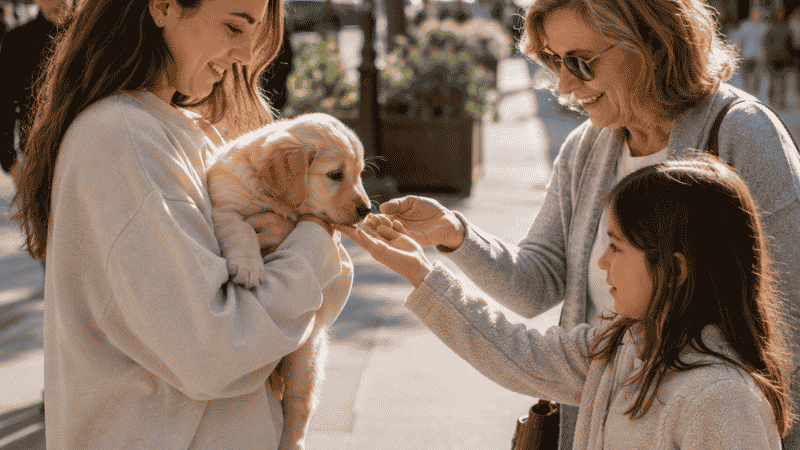
What to expose your puppy to before 16 weeks:
- People of all ages, appearances, and clothing types
- Children — supervised, calm interactions
- Different surfaces: hardwood, tile, grass, gravel, grates, wet pavement
- Sounds: traffic, crowds, household appliances, construction (at safe volume)
- Handling: ears, paws, mouth, tail — building tolerance for veterinary and grooming procedures
- Car travel
- Urban environments — observed from your arms if not yet fully vaccinated
On pre-vaccination socialization: the AVSAB (American Veterinary Society of Animal Behavior) is explicit that the risks of under-socialization during the critical window outweigh the risks of disease exposure when socialization is done thoughtfully. Carry your puppy in high-risk areas. Visit vaccinated dogs in clean homes. Attend puppy classes that require vaccination documentation.
→ For the complete socialization checklist and pre-vaccination safety protocol, read: Puppy Socialization: The Complete Guide
Food and Feeding
By the end of the first week, your puppy should be on the food you’ve chosen (if you’re transitioning from what the breeder fed, do this gradually over 7 to 10 days to avoid digestive upset).
What matters on a puppy food label:
- The AAFCO nutritional adequacy statement specifically for “growth” or “all life stages” — this is the one claim that is actually regulated and meaningful
- A named animal protein as the first ingredient
- DHA for brain development
- Appropriate calcium levels — large breed puppies must have a large breed formula; standard puppy foods have too much calcium for their skeletal development
Feeding frequency in the first six months: three meals daily for puppies under 6 months, reducing to two meals at approximately 6 months. Meal timing predicts potty timing — consistent feeding creates a more predictable elimination schedule, which accelerates potty training.
→ For the complete guide to puppy food labels, grain-free concerns, wet vs. dry, and when to switch to adult food, read: What to Feed a Puppy: The No-Confusion Food Guide
→ For the feeding schedule by age and how to feed a puppy when you work full-time, read: How Often to Feed a Puppy
Phase 5: Months 2 to 6
Completing the Vaccine Series
Vaccinations continue through approximately 16 to 18 weeks, with a one-year booster visit after that. The schedule matters precisely — each dose is timed to catch the puppy as maternal antibody protection fades.
Core vaccines for every puppy: DHPP (a combination protecting against Distemper, Hepatitis, Parvovirus, and Parainfluenza) and Rabies. Depending on your lifestyle and region, your veterinarian may also recommend Bordetella, Leptospirosis, Lyme, or Canine Influenza.
Keep a physical copy of your puppy’s vaccination record. You will need it for puppy classes, boarding, grooming, and dog parks.
One of the most important points to understand about disease risk: Parvovirus is one of the most dangerous diseases unvaccinated puppies face. It can survive in the environment for 6 months to a year. Symptoms — lethargy, reduced appetite, vomiting, bloody diarrhea — require immediate emergency veterinary care. Without treatment, mortality rates in puppies exceed 68%. With prompt, aggressive care, most treated puppies survive.
→ For the complete vaccination schedule including costs, what to watch for after each shot, and the parvo risk window explained, read: Puppy Vaccination Schedule: Every Shot Your Puppy Needs
The Adolescent Phase — Be Prepared
Between approximately 5 and 7 months, most puppies enter adolescence. Hormonal changes bring increased independence, reduced responsiveness to previously learned cues, and significantly lower impulse control.
A puppy who sat reliably at 4 months may seem to have forgotten the command exists at 6 months. This is temporary. It is also normal. And it is significantly more manageable for puppies who have solid training in place before adolescence begins — which is the most practical argument for starting training at 8 weeks rather than waiting.
What helps during adolescence:
- Maintain the training schedule even when it feels like it isn’t working
- Use management rather than repeated correction for impulse-control failures — keep the leash on, keep the kennel available, limit unsupervised access to the house
- Reinforce recall (come) heavily — this is the command most likely to break down in adolescence, and the one with the highest safety stakes
Most dogs emerge from adolescence between 12 and 18 months (later for large breeds).
Safe Cleaning and Household Toxins
Living with a puppy means rethinking the cleaning products in your home. Many common household cleaners contain compounds — ammonia, bleach in high concentrations, phenols, quaternary ammonium compounds — that are toxic to dogs, particularly puppies who spend time on the floor and have immature liver function.
High-risk products to replace or use with extreme caution:
- Multi-surface sprays containing quaternary ammonium compounds (“quats”)
- Floor cleaners containing pine oil or phenols
- Toilet bowl cleaners left accessible to dogs
- Essential oil diffusers (many are harmful to dogs)
Safer alternatives: diluted white vinegar for general surfaces, enzyme-based cleaners for pet accidents, unscented dish soap diluted in water for floors.
→ For the complete guide to safe cleaning products including specific brands, dangerous ingredients to avoid, and emergency toxin response, read: Pet Safe Cleaning Products: What’s Actually Safe
The First Year Budget: What to Actually Expect
New puppy costs surprise most first-time owners. Here is a realistic breakdown for the first year:
| Category | Estimated Cost |
|---|---|
| Initial supplies (kennel, collar, harness, bowls, toys, etc.) | $200–$500 |
| Food (first year) | $300–$800 depending on breed size |
| Veterinary care (exam fees + vaccine series + year-one booster) | $400–$800 |
| Parasite prevention (heartworm, flea/tick monthly) | $150–$300 |
| Training treats and training-related supplies | $100–$200 |
| Grooming (professional grooming if applicable) | $0–$600 |
| Puppy classes | $100–$300 |
| First-Year Total | $1,250–$3,200+ |
Emergency veterinary care is not included in this estimate. A single emergency visit for something like foreign body ingestion, parvovirus, or a broken bone can easily cost $2,000 to $6,000. Pet insurance purchased before any illness is detected provides meaningful protection against these costs. The younger the puppy when enrolled, the fewer pre-existing condition exclusions apply.

Common New Puppy Mistakes — And How to Avoid Them
Waiting to start training. Every week of the 8 to 16 week window that passes without consistent positive training is a week of missed neurological opportunity. Start the day they arrive.
Letting the puppy have free run of the house immediately. Too much space too soon prevents effective potty training and leads to unsupervised destruction. Start with one or two rooms and expand access as reliability increases.
Using punishment for accidents or biting. Punishment for potty accidents achieves nothing — puppies cannot connect the response to something that happened more than a few seconds ago. Punishment for biting increases arousal and often makes biting worse. Both require redirection and consistent positive reinforcement, not correction.
Inconsistent rules across household members. A puppy who learns that biting is allowed with one person, or that the sofa is sometimes acceptable, or that one specific cue word gets treats while a different word for the same command doesn’t — this puppy cannot learn the rule because there is no rule. Household consistency is not optional.
Skipping the first vet visit until convenient. The first week matters medically. Parasites, early disease signs, and developmental issues caught in week one are far easier to address than those discovered at month three.
Under-socializing during the critical window. The socialization window closes at approximately 16 weeks and does not reopen. Every week of missed socialization is a week that cannot be recovered — only partially compensated for later with significantly more effort.
A Note on Puppy Classes
One of the most valuable investments you can make in the first 16 weeks is enrolling in a well-run puppy class. Not primarily for the training — though the training is genuinely useful — but for the controlled, supervised dog-to-dog socialization that is otherwise difficult to replicate safely.
A good puppy class:
- Requires proof of at least the first DHPP vaccination
- Uses positive reinforcement exclusively
- Has structured supervised play sessions, not uncontrolled free-for-alls
- Is led by a trainer with recognized credentials (CPDT-KA, KPA-CTP)
- Keeps class sizes small enough for individual attention
The AVSAB endorses puppy classes beginning as early as 7 to 8 weeks, provided the first DHPP has been administered and the facility requires health documentation for all attendees.
FAQ: What New Puppy Owners Actually Ask
What do I absolutely need before bringing a puppy home? At minimum: kennel with divider, flat collar with ID tag, harness, food and water bowls, puppy food, enzymatic cleaner, high-value training treats, and a vet appointment booked within the first week. Everything else can follow.
When should a puppy have their first vet visit? Within 5 to 7 days of coming home. Not when convenient — within the first week. This visit establishes a health baseline, screens for parasites, reviews vaccinations, and begins the preventive care schedule.
Is it okay to let a puppy cry it out at night? For mild, settling-down crying in a kennel near your bed: yes, allowing them to self-settle teaches an important skill. For intense, sustained distress: placement of the kennel near you (not in bed with you) is the most effective intervention. Bringing the puppy into bed teaches them that crying produces bed access.
How do I stop my puppy from biting everything? The moment teeth contact skin: stop all movement and interaction for 3 to 5 seconds. Then redirect to a chew toy. Reward immediately when they take the toy. Repeat every single time, consistently, with every person in the household. Progress takes 2 to 4 weeks of consistent practice.
When can my puppy go to the dog park? After the full vaccination series is complete — typically 2 weeks after the final DHPP at 16 to 18 weeks. Before that, controlled environments (puppy classes, known vaccinated dogs) are appropriate. High-traffic dog parks with unknown dogs should wait until full immunity is established.
How long does potty training take? Most puppies are reliably house-trained between 4 and 6 months of age with consistent management. Small breeds often take until 7 to 9 months. The primary variable is owner consistency, not the puppy’s ability.
Should I get pet insurance? Consider it seriously, particularly before your first vet visit — once any health condition is identified, it becomes a pre-existing exclusion. The first year of puppyhood carries real financial risk from accidents, illness, and the unexpected. A wellness plan (covering routine care) and accident/illness coverage serve different purposes; many owners benefit from both.
The Bottom Line
Everything on this checklist exists to give your puppy the best possible start — and to give you the best possible chance of navigating the first year without the crises that come from being underprepared.
The puppies who become genuinely wonderful adult dogs are not the ones who arrived to perfect owners. They’re the ones who arrived to owners who paid attention, started early, stayed consistent, and showed up every day — for the vet appointments, for the training sessions, for the potty trips at 2am, for all of it.
You’ve already started. That matters.
Go Deeper: The Complete Puppy Essentials Library
This guide covers the overview. These articles go deeper into every topic:
- Best Puppy Breeds for First-Time Owners — Breed-by-breed guide to energy, grooming, and temperament for new owners
- What Puppy Kennel Do You Actually Need? — Size guide, type comparisons, and the 3-day introduction method
- Puppy Collar vs Harness Guide — Why the leash clips to the harness, not the collar, and how to fit both correctly
- Pet Safe Cleaning Products — What’s actually safe, what’s secretly toxic, and what to buy instead
- Puppy Vaccination Schedule: Every Shot Your Puppy Needs — Complete first-year vaccine timeline with costs and what to expect
- What to Feed a Puppy: The No-Confusion Food Guide — How to read a puppy food label and what actually matters
- How to Potty Train a Puppy — The complete system by age with apartment guidance
- How to Stop Puppy Biting — The positive reinforcement method that works, with a family consistency plan
- Puppy Socialization: The Complete Guide — The week-by-week socialization checklist and pre-vaccination protocol
- How to Train a Puppy: The Complete First-Year Guide — Everything from basic commands to the adolescent phase
References
- American Veterinary Society of Animal Behavior. (2021). AVSAB Position Statement on Puppy Socialization. avsab.org
- Banfield Pet Hospital. (2026). New Puppy Checklist: A Guide for First-Time Dog Owners. banfield.com
- American Animal Hospital Association. (2022). AAHA Canine Vaccination Guidelines. aaha.org
- Embrace Pet Insurance. (2026). New Puppy Checklist: Essential Puppy Supplies and Must Haves. embracepetinsurance.com
- American Kennel Club. (2026). New Puppy Checklist: Gear You’ll Need for Your New Dog. akc.org
- Overall, K.L. (2013). Manual of Clinical Behavioral Medicine for Dogs and Cats. Elsevier Mosby.