

You’d think feeding a puppy would be the easy part.
You’ve figured out the crate. You’re working on the potty training. The leash is a work in progress. But food? That’s just — you fill the bowl, right?
Then you stand in the pet food aisle for the first time and count seventeen different puppy food options, each claiming to be the best. You check the feeding chart on the back of the bag you eventually choose, realize it’s based on projected adult weight (which you had to Google), and then discover that how often you feed depends on how old they are, which apparently changes every few weeks.
And that’s before you find out that the amount you’re supposed to feed goes up and then down and then changes entirely when they switch to adult food, which happens at a different age depending on whether your puppy is a Chihuahua or a Great Dane.
None of this is as simple as it looked.
Here’s the good news: once you understand the logic behind puppy feeding, it stops being overwhelming and becomes a straightforward system. This guide covers everything — what to feed, how much, how often, when to switch — so you can stop guessing and start feeding with confidence.
Key Takeaways
- Puppy food is not optional. Adult dog food is formulated for maintenance, not growth. Feeding adult food to a growing puppy can cause nutritional deficiencies, skeletal problems in large breeds, and developmental delays.
- The feeding chart on your specific food bag is your primary reference. Generic charts are estimates. Your food’s chart accounts for actual calorie density.
- Feeding frequency changes as your puppy grows — from 4 meals per day at 8 weeks to 2 meals per day by 6 months.
- Large breed puppies must have a large breed formula. Standard puppy food has too much calcium for their developing joints, increasing the risk of orthopedic disease.
- The switch to adult food happens at different times by breed size — as early as 9 months for toy breeds, as late as 24 months for giant breeds.
- Treats count. The 90/10 rule: 90% of daily calories from food, maximum 10% from treats. Heavy training periods require meal portion reductions.
Why Puppy Nutrition Is Different From Adult Dog Nutrition
This is the foundation of everything that follows, and most new owners skip it entirely.
Puppies are not small adult dogs. Their bodies are doing something fundamentally different from an adult dog’s body — they’re building themselves from scratch. Every bone, joint, muscle, organ, and neural connection is being formed in the first 12 to 24 months of life, and the raw materials for all of it come from food.
Puppy foods are formulated to support this building process. They’re higher in protein for muscle development, higher in fat for brain development and energy, higher in calcium and phosphorus for bone growth, and contain DHA (an omega-3 fatty acid) specifically because it supports neurological and visual development in ways that matter during early life.
Adult dog food is formulated for maintenance — keeping an already-built system running efficiently. The protein levels are lower, the calorie density is lower, the mineral ratios are different. Feeding adult food to a puppy who is still actively growing means that puppy is building their body on a nutritional budget designed for a different purpose.
The consequences are not always immediate or dramatic — which is part of why this mistake persists. A puppy who eats adult food won’t immediately look sick. But the effects on bone development, muscle formation, immune function, and neurological development can show up months or years later, in ways that are harder to connect back to early nutrition decisions.
The opposite problem — keeping a puppy on puppy food too long — is also real. Puppy food’s calorie density becomes a liability once growth stops. A small breed dog who reaches adult size at 10 months but stays on puppy food until 18 months will steadily gain excess weight, usually without the owner noticing until it’s significant.
Getting the nutrition right starts with understanding that puppy feeding is not a static system — it’s a moving target that changes as your puppy grows.
What to Feed a Puppy: Choosing the Right Food
The pet food market is overwhelming by design. Every brand claims scientific formulation, premium ingredients, and optimal nutrition. Most of these claims are marketing language with no regulatory definition.
There is one label claim that is regulated and actually meaningful.
The AAFCO Statement: The Only Label Claim That Matters
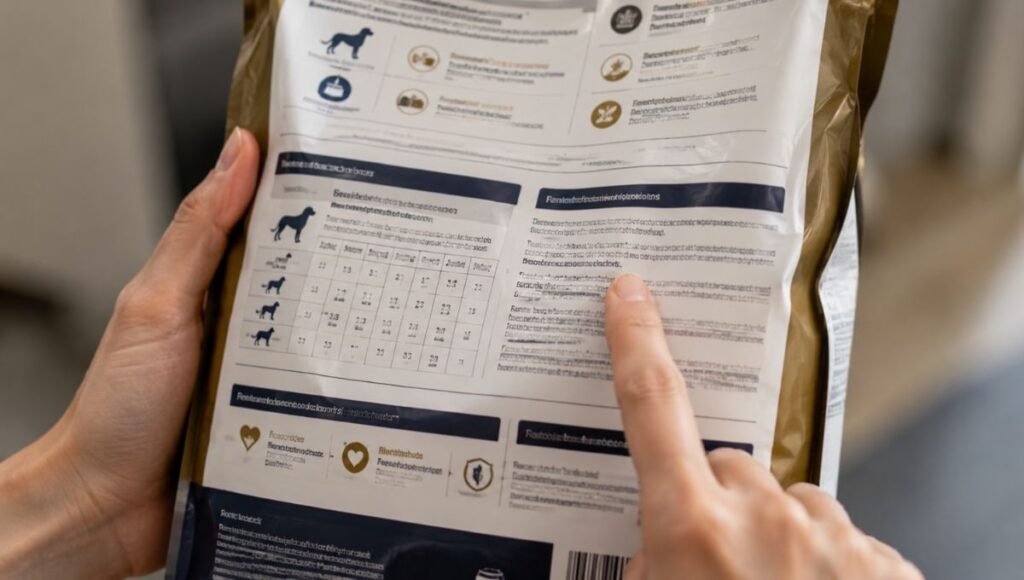
The Association of American Feed Control Officials sets the nutritional standards for pet food in the United States. Every reputable puppy food carries an AAFCO nutritional adequacy statement. It appears in small print on the back or side of the bag, and it tells you whether this food is appropriate for your puppy.
What to look for: the words “growth” or “all life stages” in the statement. A food that says “formulated to meet the nutritional levels established by AAFCO for growth” is appropriate for puppies. A food that says “adult maintenance” only is not.
The stronger version of this statement reads: “Animal feeding tests using AAFCO procedures substantiate that [product name] provides complete and balanced nutrition for growth.” This means the food was fed to actual dogs in controlled trials and confirmed to support healthy development — not just formulated on paper to meet nutrient profiles.
When you’re standing in that pet food aisle, flip every bag over and find this statement before you look at anything else.
Dry Kibble vs. Wet Food vs. Raw
Dry kibble is the most practical choice for most new owners. It’s cost-effective, stores easily, doesn’t spoil quickly once opened, and the texture provides mild dental benefit. Quality dry puppy kibble is complete and balanced on its own — no supplementation needed.
Wet food has higher moisture content and is more palatable, which helps with picky eaters or puppies with reduced appetite (during teething, for example). Its limitations: significantly more expensive per calorie, spoils within 2 to 4 days of opening, and provides no dental benefit. Most effective as a topper or supplement to dry kibble rather than a sole diet.
Raw feeding is advocated by some owners and carries real risks that make it inappropriate as a starting point for first-time owners. Commercial raw requires careful freezer management and produces bacterial contamination risks to both the puppy and humans in the household. Homemade raw diets are almost universally nutritionally incomplete without professional veterinary nutritionist guidance. If raw feeding is something you want to explore, consult a board-certified veterinary nutritionist before starting — not a blog post.
The Large Breed Exception
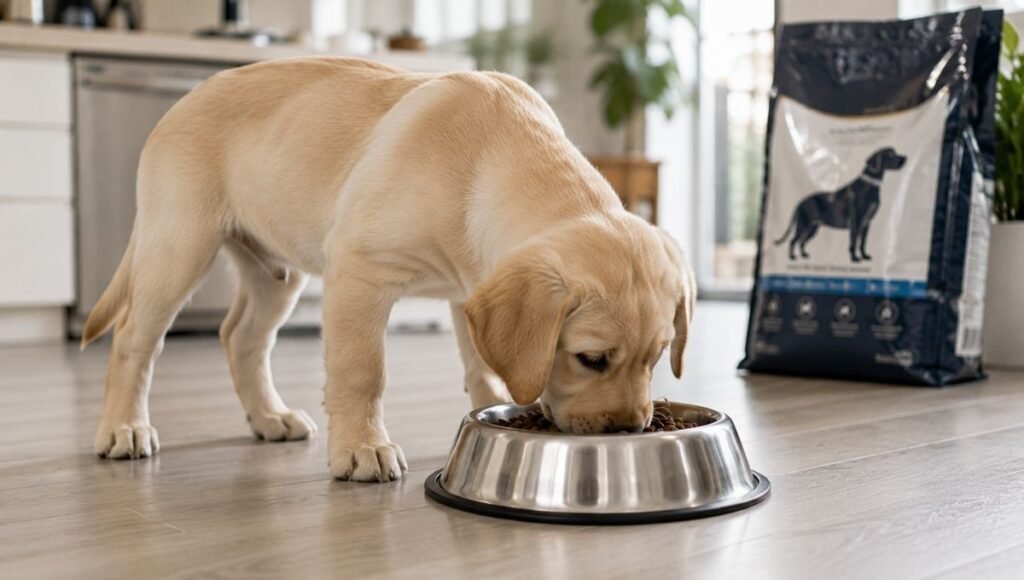
If your puppy will weigh more than 50 pounds as an adult, they need a large breed puppy formula — not a standard puppy food.
This is not a marketing distinction. Large breed puppies who eat standard puppy food receive calcium and phosphorus levels that are calibrated for smaller breeds. For rapidly growing large breed dogs, this excess can accelerate bone growth in ways that damage developing joints — contributing to hip dysplasia, elbow dysplasia, and osteochondrosis. These are painful, expensive conditions that are largely preventable with correct food selection.
Large breed puppy formulas have controlled mineral levels specifically designed to produce steady, healthy growth rather than rapid growth. If your puppy is a Labrador, Golden Retriever, German Shepherd, Boxer, or any breed expected to reach 50+ pounds, large breed formula is non-negotiable.
→ For the complete guide to puppy food labels, the grain-free debate, dry vs. wet, and the AAFCO statement explained in detail, read: What to Feed a Puppy: The No-Confusion Food Guide
How Often to Feed a Puppy: Meal Frequency by Age
Feeding frequency is the piece of puppy nutrition most owners get wrong, usually because they move to two meals per day too early.
The reason puppies need more frequent meals is biological: their stomachs are small relative to their energy needs, their blood sugar regulation is immature, and small breeds in particular are at real risk of hypoglycemia — dangerous low blood sugar — if they go too long between meals.
The schedule changes as their capacity develops.
8 to 12 Weeks — 4 Meals Per Day
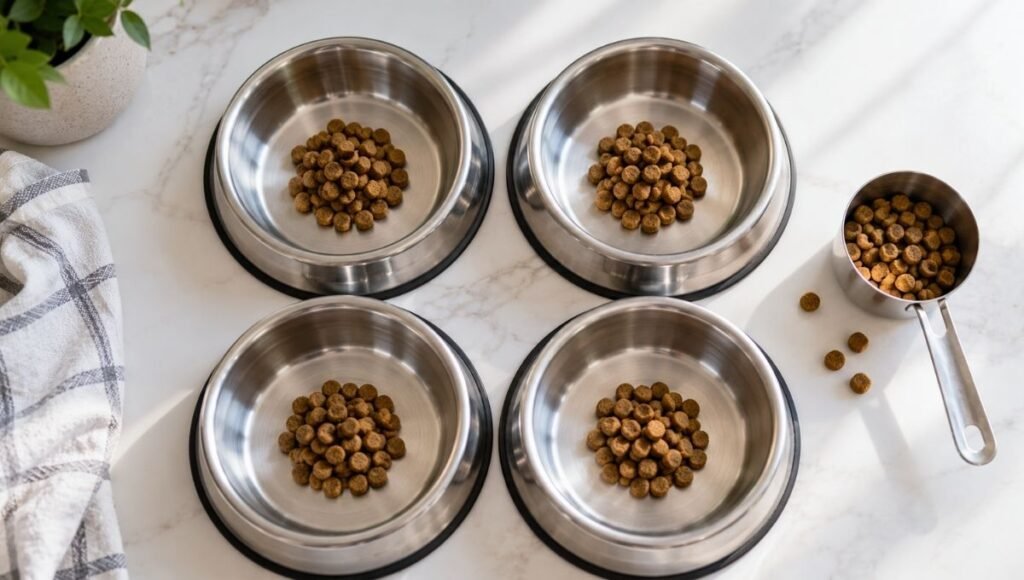
At 8 weeks, a puppy’s stomach holds a small amount of food at a time, and their metabolic rate is at its highest relative to body size. Four meals spread through the day — typically at 7am, 11am, 3pm, and 6pm — provides consistent fuel without overwhelming the digestive system.
The last meal should be no later than 6 to 7pm. A puppy with a full stomach going to bed will need to eliminate overnight, setting back potty training and disrupting sleep for everyone.
12 to 16 Weeks — 3 Meals Per Day
By 3 months, stomach capacity has increased and blood sugar regulation has improved enough for three meals per day. This also makes the feeding schedule more compatible with normal working hours — morning, midday, and evening — though the midday meal still requires a plan for owners who work outside the home.
6 Months Onward — 2 Meals Per Day
Most medium and large breed puppies transition to two meals per day around 6 months. Morning and evening, spaced approximately 10 to 12 hours apart.
Small and toy breeds often benefit from staying on three meals per day until 9 to 12 months due to their smaller stomachs and higher hypoglycemia risk.
The Potty Training Connection
Feeding schedule and potty training are the same system. Puppies typically need to eliminate within 15 to 20 minutes of eating. A consistent feeding schedule creates predictable elimination windows — which is the foundation of effective house training. Free feeding (leaving food available all day) eliminates this predictability entirely, making potty training significantly harder.
→ For the complete age-by-age feeding frequency guide including the working owner solution and the potty training connection, read: How Often to Feed a Puppy: The Complete Schedule by Age
How Much to Feed a Puppy: Portion Sizing
The most common feeding mistake is not measuring. “A scoop” or “about a cup” introduces significant inconsistency — enough to cause gradual weight gain or weight loss that owners don’t notice until it’s significant.
The Feeding Chart on Your Bag Is Your Primary Reference
Every reputable puppy food bag includes a feeding chart with daily amounts based on projected adult weight and current age. This chart is calibrated to the calorie density of that specific food — which makes it more accurate than any generic chart, including the ones in this guide.
Use projected adult weight, not current weight. A 12-week-old Labrador and a 12-week-old Maltese might weigh the same right now, but their nutritional needs over the coming months are completely different because of where they’re headed.
General Portion Estimates by Breed Size
These figures assume a standard puppy kibble with approximately 380 to 420 calories per cup. Cross-reference with your specific food’s packaging.
Toy and Small Breeds (Under 20 lbs adult)
- 8–12 weeks: ¼ to ½ cup daily
- 3–4 months: ½ to ¾ cup daily
- 5–6 months: ½ to ¾ cup daily
- 7–12 months: ⅓ to ½ cup daily
Medium Breeds (20–50 lbs adult)
- 8–12 weeks: ¾ to 1¼ cups daily
- 3–4 months: 1 to 1¾ cups daily
- 5–6 months: 1¼ to 2 cups daily
- 7–12 months: 1 to 1¾ cups daily
Large Breeds (50–90 lbs adult)
- 8–12 weeks: 1 to 2¼ cups daily
- 3–4 months: 1½ to 3 cups daily
- 5–6 months: 2 to 3½ cups daily
- 7–12 months: 2½ to 4 cups daily
Giant Breeds (90+ lbs adult)
- 8–12 weeks: 2 to 3½ cups daily
- 3–4 months: 3 to 4½ cups daily
- 5–6 months: 3½ to 5 cups daily
- 7–12 months: 4 to 6 cups daily
The Body Condition Check

Portion sizing isn’t set-and-forget. Your puppy’s actual body condition — not the number on the scale — is the most reliable ongoing indicator of whether they’re eating the right amount.
Run your hands along your puppy’s ribcage. You should be able to feel individual ribs with gentle pressure, but they shouldn’t be visible. Looking from above, there should be a visible waist — a narrowing behind the rib cage. From the side, the belly should tuck up slightly.
Check body condition monthly and adjust portions by 10% increments if needed. A puppy whose ribs are becoming hard to feel is likely getting slightly too much. A puppy whose ribs are clearly visible without pressing needs slightly more.
The 90/10 Treat Rule
Training a puppy means using treats — a lot of them. Those treats have calories. In a training-intensive week, a dedicated owner can easily give 30 or 40 treats per day.
The 90/10 rule: treats should make up no more than 10% of daily caloric intake. On high-training days, reduce the meal portion to compensate. Use small, pea-sized treats so your treat budget stretches further.
→ For the complete portion sizing guide including the breed-size chart, body condition scoring, and how to calculate treat calories, read: How Much to Feed a Puppy: Complete Chart by Age and Weight
When to Switch Puppy to Adult Food: The Timeline That Actually Makes Sense
The commonly repeated “switch at one year” advice is accurate for some dogs and wrong for many others. The correct trigger is reaching 80 to 90% of adult size — and since breed size determines when that happens, the timing varies dramatically.
By Breed Size
Small breeds (under 20 lbs adult weight): 9 to 12 months. Small breeds mature faster and the calorie-dense puppy food becomes a liability as soon as growth stops.
Medium breeds (20–50 lbs adult weight): 12 to 14 months. The one-year guideline is closest to correct for this group, though individual variation matters.
Large breeds (50–90 lbs adult weight): 12 to 18 months. This is where “switch at one year” goes wrong. Large breeds continue active skeletal development past 12 months. Switching too early deprives a still-growing skeleton of the nutritional support it needs.
Giant breeds (90+ lbs adult weight): 18 to 24 months. Giant breeds have the longest developmental timeline. Switching prematurely is the most consequential timing error in this category — the joint consequences are serious, expensive, and largely preventable.
How to Tell If Your Puppy Is Ready
Three checks:
The growth plateau test: Has your puppy’s weight been stable for 4 to 6 weeks? Weekly weigh-ins help identify when rapid growth has concluded.
The rib and waist assessment: Run hands along the ribcage. Visible waist from above. Belly tuck from the side. This assessment also tells you whether weight is appropriate before you transition.
Breed size reference: Compare current weight to the expected adult weight range for the breed. At 80 to 90% of adult weight with a stable weight trend, most puppies are ready.
The Transition Process
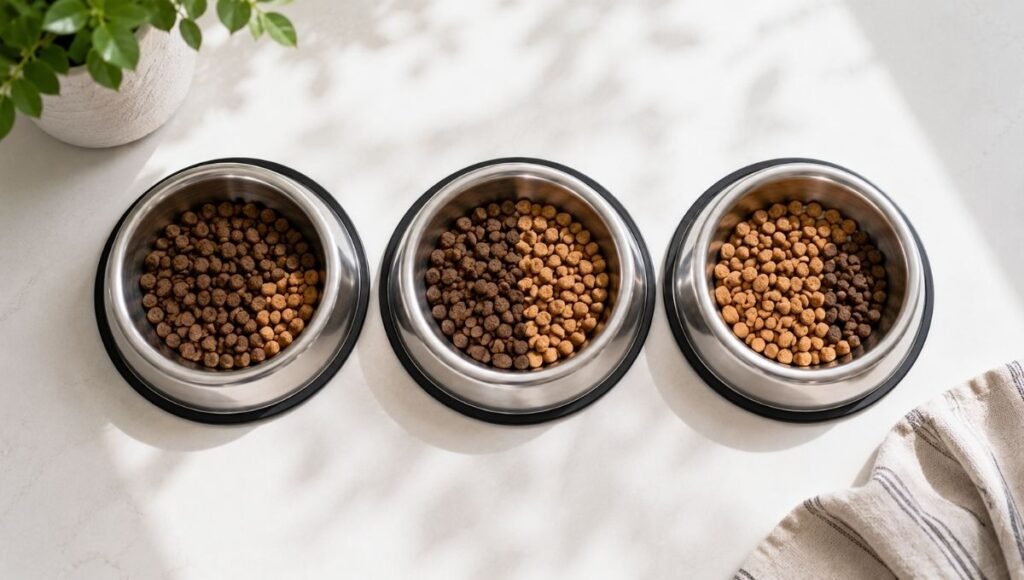
Always transition gradually over 7 to 10 days:
| Days | Old Puppy Food | New Adult Food |
|---|---|---|
| 1–3 | 75% | 25% |
| 4–6 | 50% | 50% |
| 7–9 | 25% | 75% |
| Day 10 | 0% | 100% |
Loose stools during transition are common. Pause the progression and stay at the current ratio for 2 to 3 extra days before continuing. This is normal adjustment, not a sign the food is wrong.
→ For the complete transition guide including the spay/neuter timing consideration and what to do if your puppy has digestive upset during the switch, read: When to Switch Puppy to Adult Food: Complete Guide by Breed Size
The Puppy Feeding Timeline: Month by Month
Here’s the complete first-year picture in one place.

Months 1 to 2 (8 to 12 Weeks) — The New Home Phase
Your puppy arrives already eating. The most important first step: find out exactly what food they’ve been eating from the breeder or rescue, and start with that. Any food change should happen gradually — even if you plan to switch to a different brand, do it over 7 to 10 days.
Four meals per day. Measured portions from the bag’s chart. Enzymatic cleaner ready for potty training accidents that happen because you don’t always make it outside in time after meals.
Focus: establish the routine, not optimize the diet.
Months 2 to 4 (12 to 16 Weeks) — The Teething Phase
Teething begins around 12 weeks and runs through 6 to 7 months. Sore gums can affect appetite — some puppies become picky or chew slowly during active teething. If your puppy is reluctant to eat their regular kibble, soaking it in warm water for a few minutes softens it enough to be more comfortable.
Transition to 3 meals per day when your puppy has consistently been finishing meals and blood sugar has become more stable (typically around 12 to 14 weeks).
Watch for the teething-biting connection: a puppy whose gums hurt bites harder and more frequently. This is physiological, not behavioral failure.
Months 4 to 6 — The Fastest Growth Phase
This is when the feeding chart amounts often go up most noticeably — particularly for large and giant breeds who are adding weight rapidly. Check the chart monthly and adjust.
The adolescent phase is approaching. Impulse control will temporarily decrease, training receptiveness may fluctuate. Keep feeding consistent even when behavioral consistency wavers.
Most medium and large breed puppies transition to 2 meals per day around 6 months.
Months 6 to 12 — Approaching Maturity
Small breeds may be approaching or reaching adult size. Large breeds are still actively developing. Giant breeds have the most significant remaining growth ahead.
This period is when the switch-to-adult-food question becomes relevant for small and medium breeds. Use the readiness checks rather than the calendar.
If your puppy has been spayed or neutered, metabolism decreases in the months following surgery. Monitor body condition carefully and reduce portions if weight gain occurs — this is common and expected.
Month 12 and Beyond — The Transition
Small breeds: already switched or switching now. Medium breeds: switching now or within the next 2 months. Large breeds: continue assessing. Most aren’t ready until 14 to 18 months. Giant breeds: continue puppy food until 18 to 24 months.
Common Puppy Feeding Mistakes
Using the wrong food type for the breed size. Standard puppy food fed to a large or giant breed is one of the most consequential nutritional mistakes new owners make. Large breed formula is not optional for these dogs.
Free feeding instead of scheduled meals. Leaving food out all day removes your ability to monitor intake, makes potty training significantly harder, and often leads to overeating. Scheduled, measured meals serve every aspect of puppy management better.
Switching foods suddenly. Every food transition — including the first food change after bringing your puppy home — should happen over 7 to 10 days. Sudden switches cause unnecessary digestive upset that owners often blame on the new food rather than the transition speed.
Not adjusting portions as the puppy grows. The right amount at 8 weeks is too little at 16 weeks. The right amount at 4 months may be too much at 9 months. Reassess monthly using the body condition check.
Ignoring treat calories. Heavy training periods can add significant calories through treats. The meal portion needs to decrease to compensate. The 90/10 rule isn’t just a guideline — it’s what prevents gradual weight gain during training-heavy months.
Switching to adult food too early for large breeds. Moving a Labrador or German Shepherd off puppy food at 12 months — while still in active skeletal development — removes nutritional support at a critical time. Wait until the body condition and weight trend indicate readiness.
Over-supplementing. If you’re feeding a complete and balanced puppy food, additional vitamins, calcium, or omega-3 supplements are not necessary and can actively cause harm. Excess calcium in large breed puppies specifically is dangerous. Supplements are for puppies eating incomplete diets or those with veterinarian-identified deficiencies.
Nutrition Red Flags: When to Talk to Your Vet
Most puppy nutrition questions don’t require a veterinary visit — they require the right information. Some situations do warrant professional guidance.
Talk to your vet if:
Your puppy is consistently losing weight despite eating the chart-recommended amount. This warrants a parasitology check (intestinal parasites are extremely common in puppies and can interfere with nutrient absorption) and a general health assessment.
Your puppy is gaining weight rapidly despite feeding chart amounts and no extra treats. This may indicate the calorie density of the food is higher than average, or that body condition has been drifting without regular checks.
Your puppy refuses food for more than 24 hours. Occasional picky meals are normal, especially during teething or in a new environment. Persistent food refusal is not.
You have a giant breed puppy and want specific guidance on nutrition timing. Giant breed development is complex enough that a 15-minute veterinary consultation specifically about feeding is a genuinely worthwhile investment.
Your puppy has chronic loose stools, vomiting, or skin reactions that correlate with eating. These may indicate a food sensitivity or intolerance that warrants dietary adjustment under veterinary guidance.
Puppy Feeding FAQ
What’s the best puppy food? There’s no single best puppy food — the right food depends on your puppy’s breed size, your budget, and the specific product’s nutritional profile. What matters most: the AAFCO statement for “growth” or “all life stages” on the label, a named animal protein as the first ingredient, and for large breeds, a large breed specific formula. Your veterinarian can recommend specific brands they trust for your breed.
Can I feed my puppy homemade food? Homemade diets for puppies are high risk without professional nutritionist guidance. The vast majority of homemade diets — even well-intentioned ones — are nutritionally incomplete or imbalanced. If homemade feeding matters to you, consult a board-certified veterinary nutritionist (DACVN) before starting.
My puppy skips meals sometimes — is that normal? Occasional meal skipping is normal, particularly during teething, after stressful events, or in the first few days in a new home. A puppy who skips one meal but eats the next is generally fine. A puppy who consistently refuses food for more than 24 hours warrants a veterinary call.
Should I feed my puppy at the same time every day? Yes. Consistent meal timing helps regulate the digestive system, creates predictable elimination windows that support potty training, and establishes the routine your puppy needs to feel secure. Mealtimes that vary by hours each day make everything harder — including training and house training.
Is grain-free puppy food better? No. Grain-free food is not nutritionally superior for most puppies, and the FDA has been investigating an association between certain grain-free diets (particularly those high in legumes like peas and lentils) and dilated cardiomyopathy (DCM) in dogs. Unless your veterinarian has diagnosed a specific grain allergy — not assumed based on itching or loose stools — a grain-inclusive food from a reputable manufacturer is the better choice.
When should I add supplements to my puppy’s food? Only when your veterinarian recommends it for a specific identified need. A puppy eating a complete and balanced food does not need additional vitamins, minerals, or supplements. Over-supplementation — particularly of calcium in large breed puppies — can cause harm. If you’re unsure, ask your vet rather than supplementing based on online recommendations.
How do I know if my puppy is a healthy weight? Use the body condition score method monthly: feel the ribs (should be palpable with gentle pressure, not visible), look for a waist from above, and check for a slight belly tuck from the side. This physical assessment is more reliable than the scale alone because it tells you about body composition, not just weight.
The Bottom Line

Puppy feeding isn’t complicated once you understand the system. It has four moving parts — what you feed, how much, how often, and when you transition — each of which is well-defined once you know what to look at.
The practical checklist:
✓ Choose a food with the AAFCO growth statement and, if applicable, a large breed formula ✓ Use the feeding chart on your specific food’s packaging as the primary reference ✓ Feed 4 times daily under 12 weeks, 3 times daily from 12 weeks to 6 months, 2 times daily from 6 months onward ✓ Measure every meal — don’t eyeball ✓ Check body condition monthly and adjust portions by 10% increments as needed ✓ Account for treat calories during training-heavy periods ✓ Time the adult food switch based on breed size and readiness, not the calendar
That’s the whole feeding system for the first year. Get these right, and you’ve given your puppy one of the most important foundations of their long-term health.
Go Deeper: The Complete Puppy Feeding Library
Each part of this guide is covered in detail in these dedicated articles:
- What to Feed a Puppy: The No-Confusion Food Guide — How to read a puppy food label, what AAFCO actually means, the grain-free debate, and dry vs. wet food
- How Often to Feed a Puppy: Complete Schedule by Age — Exact meal frequency from 8 weeks through adulthood, with working owner solutions and the potty training connection
- How Much to Feed a Puppy: Complete Chart by Age and Weight — Portion sizing by breed size, body condition scoring, and how to calculate treat calories
- When to Switch Puppy to Adult Food: Complete Guide by Breed Size — The exact timeline by breed, how to tell if your puppy is ready, and a 10-day transition plan
- Puppy Development Stages: Week-by-Week Guide — How nutritional needs connect to physical and behavioral development across the first two years
- New Puppy Checklist: Everything You Need Before Day One — Complete preparation guide including feeding supplies to have ready before your puppy arrives
- How to Potty Train a Puppy — How feeding schedule directly drives potty training success
References
- Association of American Feed Control Officials. (2026). AAFCO Dog Food Nutrient Profiles. aafco.org
- American College of Veterinary Nutrition. (2024). Selecting a Pet Food. acvn.org
- U.S. Food and Drug Administration. (2024). FDA Investigation into Potential Link between Certain Diets and Canine Dilated Cardiomyopathy. fda.gov
- Larson, J., & Newman, S.J. (2020). Developmental Orthopedic Disease in Large Breed Dogs. Veterinary Clinics of North America: Small Animal Practice, 50(5), 1171–1183.
- Hawthorne, A.J., Butterwick, R.F., & Markwell, P.J. (2004). The relationship between body condition and body composition in cats. Journal of Nutrition, 134, 2125S–2127S.
- Purina. (2026). How Much to Feed a Puppy: Puppy Feeding Guide. purina.com
- PetMD / Veterinary Review Team. (2026). Puppy Feeding Guide. petmd.com