
Bringing a new puppy home is exciting—until bedtime. You tuck your puppy into the crate, turn off the lights, and within minutes the whining starts. Suddenly you’re lying awake, wondering whether to comfort them or stay strong and wait it out.
If that sounds familiar, you’re not alone. Night-time crate training is one of the biggest challenges for first-time puppy owners. The good news? With the right routine and a little consistency, most puppies learn to settle, sleep through the night, and see their crate as a safe place—not something to fear.
This guide walks through the entire process in order — from the first night home to the point where your puppy sleeps through the night. You’ll learn how to set up the crate, what a solid bedtime routine looks like, how to tell the difference between real distress and attention-seeking crying, how long puppies can hold their bladder overnight, the most common mistakes to avoid, and which products are actually worth buying. By the end, you’ll have a plan you can put into action tonight.
Quick Answer: The 3 Golden Rules for Tonight
If tonight is your first night, start with these three rules:
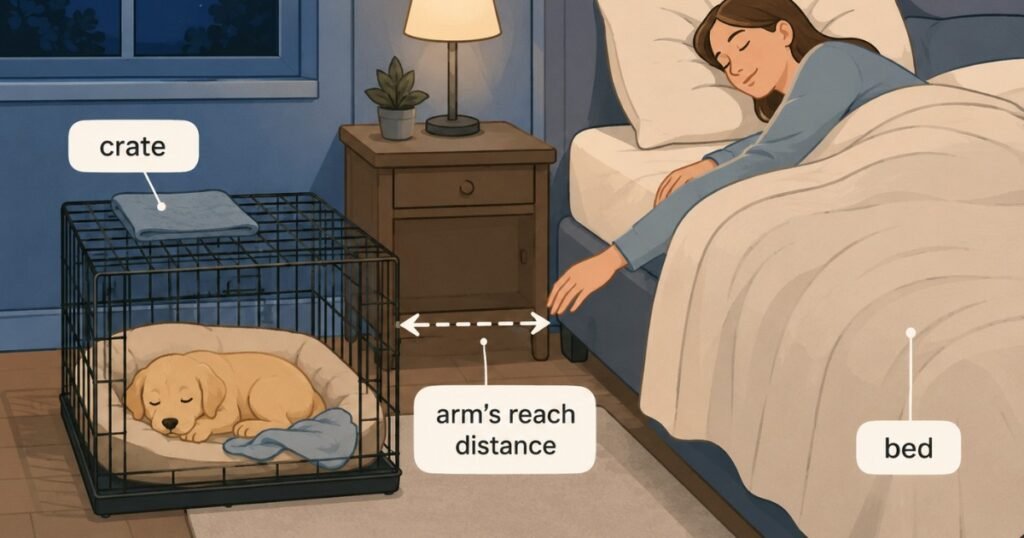
- Keep the crate beside your bed. This is your puppy’s first time away from its littermates, and being able to hear and smell you nearby makes a big difference in how anxious it feels.
- Take one last potty break right before lights out. That final bathroom trip has a direct impact on whether you’ll need to get up overnight.
- Keep midnight potty breaks completely boring. No lights, no play, no chatting — straight out, straight back in.
Stick with these three rules consistently for two to four weeks, and most puppies gradually learn to settle and sleep quietly.
Why Night-Time Crate Training Helps Puppies Sleep Better
Puppies are descended from den animals, so a small, enclosed, quiet space feels less like confinement and more like a den. That’s exactly why a properly introduced crate can become a source of comfort rather than fear.
Most crying at night isn’t really about the crate itself — it’s about being alone. Your puppy has just left the littermates and mother it’s been surrounded by since birth, and now it’s facing an unfamiliar room and unfamiliar smells on its own. Crying is simply how it says, “I’m scared and I’m alone.”
Understanding this matters, because it shapes how you should respond.
The crate should never be used as punishment. If a crate is only used after your puppy misbehaves, it will quickly start associating the crate with negative feelings. The crate should always represent safety and rest, not consequences.
Here’s something that’s easy to overlook: most puppies struggle the most during the first two to five nights, and that’s a normal part of adjusting — not a sign that something is wrong. Many first-time owners see crying continue on night two or three and start to second-guess their approach, when in reality this stretch is simply the adjustment period. With a consistent method, things usually improve noticeably within about a week.
Key takeaway: A crate that’s introduced correctly becomes your puppy’s own safe sleeping space — not something it’s being forced to accept.
Get Everything Ready Before Your Puppy’s First Night
A smooth first night starts long before bedtime. Taking a few minutes to set up the crate and gather the right supplies can make it much easier for your puppy to settle and sleep comfortably.
Choose the Right Crate Size
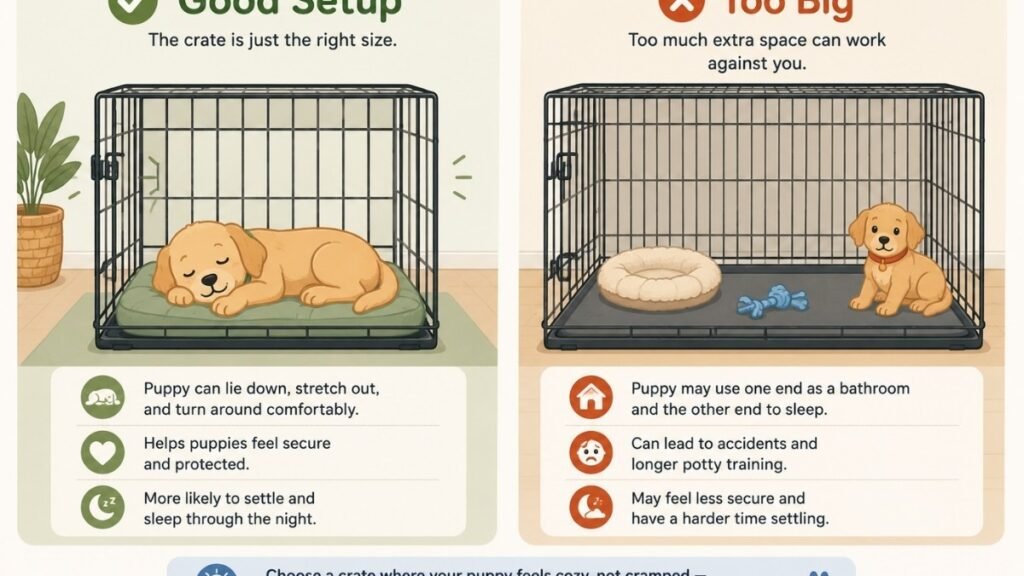
A crate that’s too big gives your puppy room to potty in one corner, which works against potty training. A crate that’s too small won’t let it turn around or stretch out comfortably. The right size lets your puppy stand without hitting its head, turn around easily, and lie down fully stretched out — with no extra room to spare. If you’ve bought an adult-sized crate, use a divider panel to shrink the space now and expand it gradually as your puppy grows.
Set Up a Safe Sleeping Space
- Location: For the first several nights, keep the crate in your bedroom — ideally within arm’s reach of your bed.
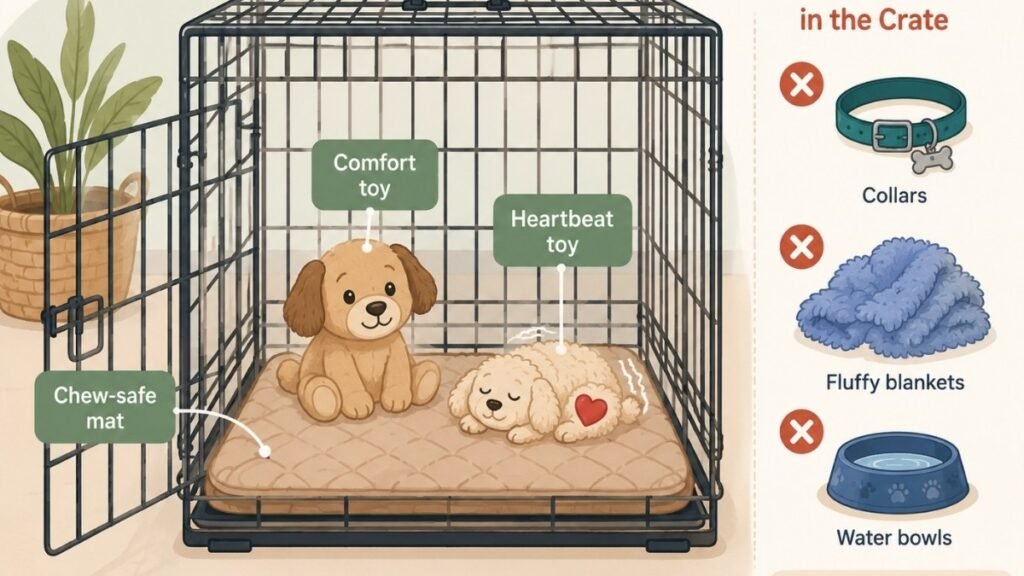
- Bedding: Choose durable, washable bedding. Avoid overly fluffy materials that can be shredded and swallowed.
- Temperature and airflow: Keep the crate away from direct AC vents or heaters, and make sure the room has good ventilation.
- White noise or heartbeat toys: Toys that mimic a mother’s heartbeat can genuinely help soothe a puppy that’s recently left its littermates, while a white noise machine can mask household sounds that might otherwise wake it up.
What Can Stay Inside the Crate — and What Shouldn’t
| Safe to leave in the crate | Better to avoid |
|---|---|
| Chew-safe, low-profile bedding | Collar or tags (snagging risk) |
| Small, durable comfort toys with no loose parts | Fluffy blankets that can be shredded and swallowed |
| Heartbeat toy or white noise device | Water bowl (easily spilled, soaks bedding) |
| One piece of your worn clothing (no buttons or zippers) | Toys with strings, ribbons, or detachable pieces |
Remember to remove your puppy’s collar and tags before bedtime. It’s a small step that’s easy to forget, but it matters — collars can catch on crate gaps overnight.
First Night Setup Checklist
- [ ] Crate is the right size and positioned by the bed
- [ ] Bedding and comfort toys are in place
- [ ] Collar and tags have been removed
- [ ] Room temperature and airflow are comfortable
- [ ] White noise or heartbeat toy has been tested
- [ ] Overnight alarm is set (based on age)
Key takeaway: A calm, safe sleeping setup solves most overnight problems before they even start.
A Step-by-Step Bedtime Routine That Actually Works
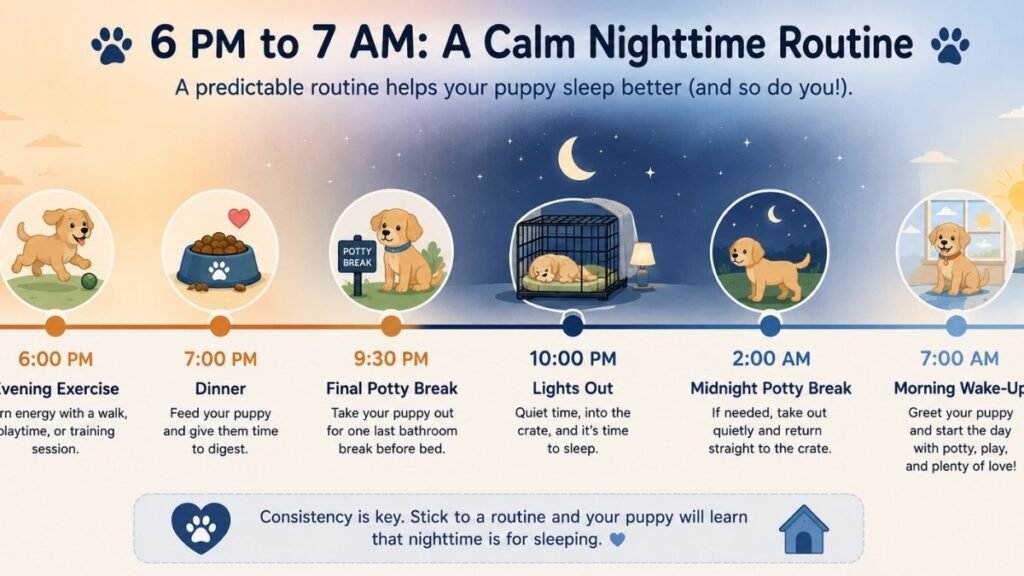
More than the crate itself, a consistent bedtime routine is often the single biggest factor in how well a puppy settles at night. Plenty of owners swap crates, try new toys, and still struggle — only to realize the real issue was an inconsistent evening routine.
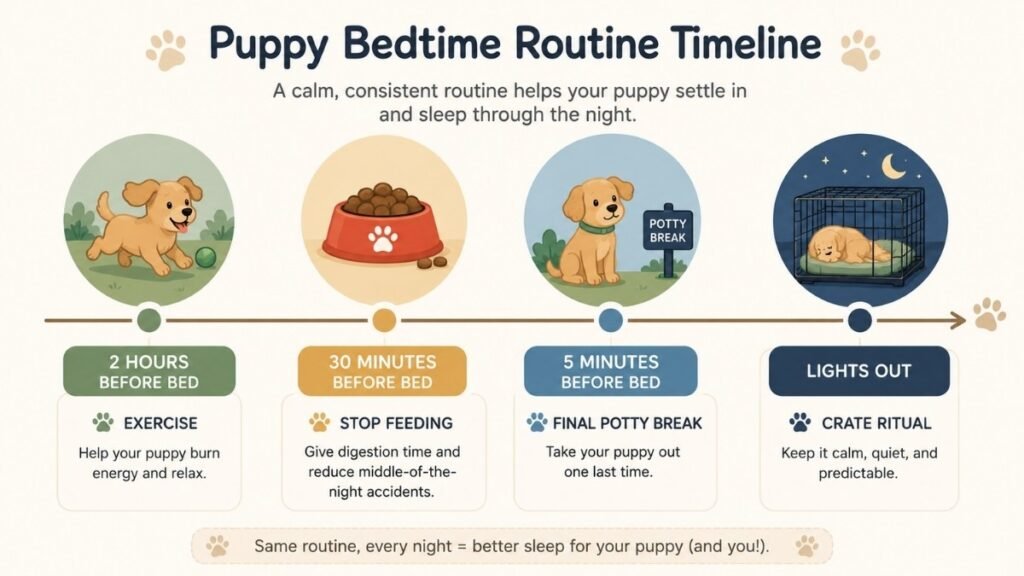
Two Hours Before Bed
Give your puppy some moderate exercise or play to burn off extra energy, but avoid anything too exciting right before bedtime — overstimulation right before sleep tends to backfire.
Thirty Minutes Before Bed
Stop feeding and limit water intake (a small amount is fine) so your puppy’s body has time to settle before sleep. This is a good window for quiet activities, like gentle petting or a chew toy.
Right Before Lights Out
Take your puppy for one final potty break, then come inside for a brief, calm “into the crate” ritual — a small treat, a consistent phrase (“time for bed”), and then lights out. Keep the goodbye short and calm. The shorter and more predictable it is, the faster your puppy learns to associate the crate with “time to sleep.”
| Time | Recommended Action |
|---|---|
| 2 hours before bed | Moderate exercise, avoid overstimulation |
| 30 minutes before bed | Stop feeding, limit water |
| 5 minutes before bed | Final potty break |
| Lights out | Short crate ritual with a consistent cue |
Here’s a common pattern: after a few days of sticking to the exact same routine, many puppies’ crying time noticeably shortens — not necessarily because they’ve “gotten over it,” but because they can start predicting what happens next, and predictability itself is calming.
Key takeaway: A consistent bedtime routine often matters more than the crate itself.
What to Do When Your Puppy Cries at Night
One of the hardest parts of night-time crate training is knowing how to respond when your puppy starts crying. Sometimes they genuinely need something, and sometimes they’re simply having a hard time settling.
Signs Your Puppy Genuinely Needs Help
- Crying suddenly shifts from quiet to urgent, often related to needing to go
- Crying is paired with scratching at the door or pacing in circles
- It’s been longer than your puppy’s age-appropriate bladder limit since the last potty break
Signs Your Puppy Just Wants Attention
- Crying starts the moment it’s placed in the crate, but pauses noticeably when you get close and starts again when you step away
- Crying escalates after you leave the room, almost like it’s testing whether you’ll come back
- It’s been a short time since the last potty break, so a bathroom need is unlikely
What Not to Do
- Opening the crate the moment your puppy starts crying
- Standing outside the crate talking or soothing for long stretches
- Bringing your puppy into your bed “just for one night”
Here’s a lesson many owners learn the hard way: if you give in even once and let your puppy out mid-cry, it’s likely to remember that crying longer eventually works, and the crying may get longer over the next few nights. This isn’t your puppy being difficult — it’s simply testing and learning patterns. That’s exactly why consistency matters more than any single moment of giving in.
A simple decision guide:
- Has it been close to your puppy’s age-based bladder limit since the last potty break? → Yes: take it out for a potty break
- Is the crying paired with clear distress (scratching, circling)? → Yes: pause and observe for 1–2 minutes first
- Does the crying pause and restart depending on whether you’re nearby? → Yes: likely attention-seeking, and can often be left alone briefly
Key takeaway: Respond to genuine needs — not to crying that’s become a strategy for getting attention.
The Midnight Potty Break Routine
Overnight potty breaks are the part most owners dread, but with a standardized routine, each one only takes a few minutes.
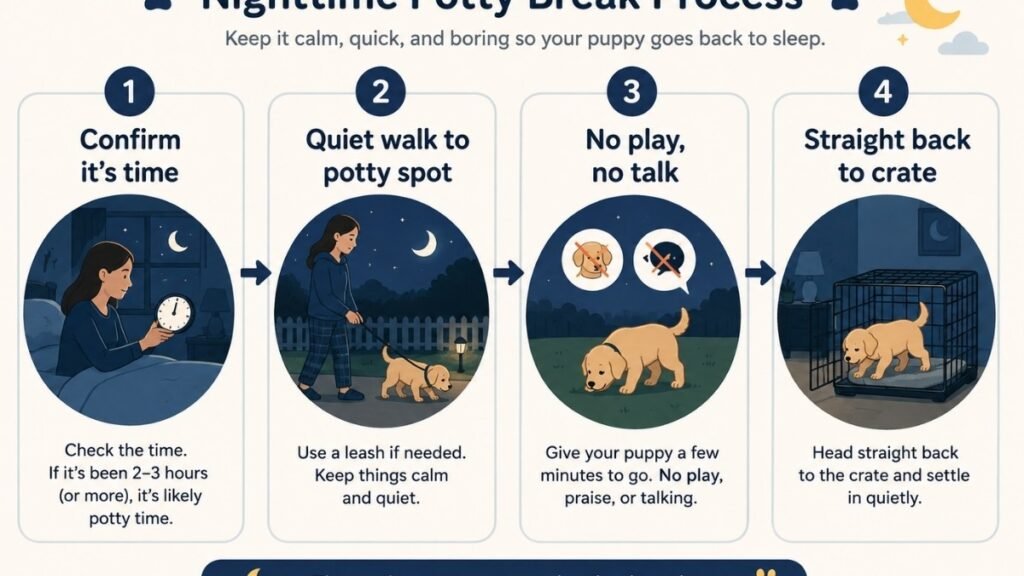
Before Leaving the Crate
Confirm it’s actually time for a potty break (using the guidance above) before opening the door. Opening the crate every single time your puppy cries teaches it that crying equals an open door.
During the Potty Break
- Keep the lights dim — avoid switching on bright lights that wake your puppy up fully
- Go straight to the designated potty spot, skipping toys or play areas
- No playing, no cuddling, no talking
- Offer a brief, low-key acknowledgment or a tiny reward once your puppy goes
Back in the Crate
Return to the crate immediately after the potty break — no lingering, no extra interaction. Experienced owners often describe this whole approach as making midnight potty breaks completely boring — the more uneventful they are, the less your puppy associates waking up at night with anything fun.
Key takeaway: Every overnight potty break should be short, quiet, and predictable.
How Long Can Puppies Hold Their Bladder Overnight?
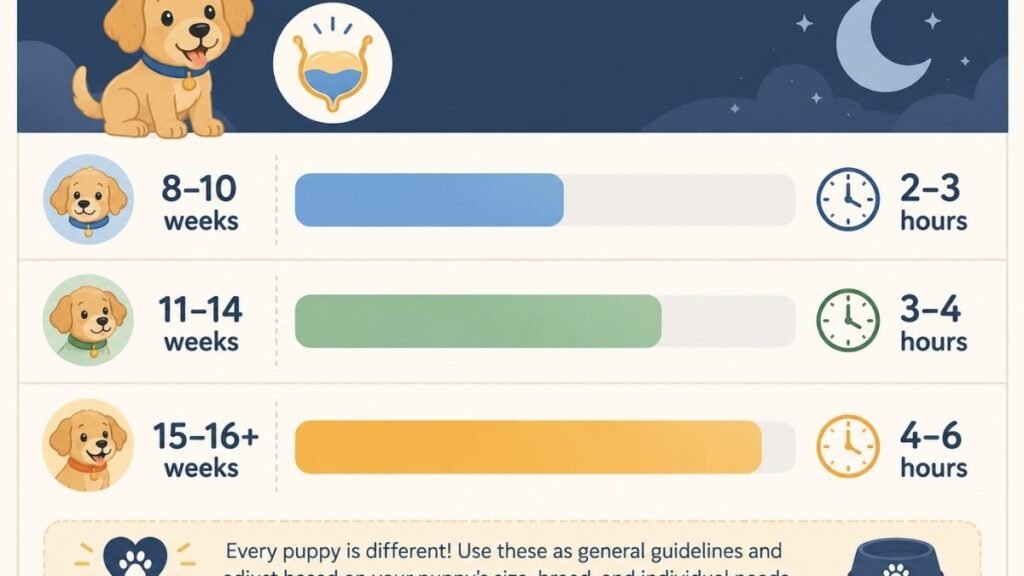
Direct answer: as a general rule of thumb, a puppy can hold its bladder overnight for roughly its age in months plus one hour — but this is only a starting estimate, not a hard rule.
| Puppy Age | Approximate Bladder Capacity | Recommendation |
|---|---|---|
| 8–10 weeks | About 2–3 hours | Set 1–2 overnight alarms |
| 11–14 weeks | About 3–4 hours | Try gradually extending the interval |
| 15–16 weeks+ | About 4–6 hours | Many puppies begin sleeping through the night |
It’s worth noting that the “age in months plus one hour” formula is just a starting point, not a precise rule. Smaller breeds typically have smaller bladders and may need more frequent overnight breaks, while individual puppies can vary quite a bit even at the same age. A more reliable way to judge whether you can stretch the interval is to watch for several consecutive dry nights, rather than relying purely on the calendar.
Key takeaway: Your puppy’s age and individual needs determine the overnight potty schedule — not how badly you’d like to sleep through the night.
Common Night-Time Crate Training Mistakes
These mistakes are easy to make, and almost every new owner runs into at least one of them.
- Placing the crate too far away too soon. Puppies need time to adjust to being alone, and jumping straight to another room often extends the adjustment period.
- Letting your puppy out while it’s actively crying. This reinforces the idea that crying harder gets faster results.
- Skipping daytime crate practice entirely. Puppies that only see the crate at night tend to adjust more slowly overall.
- Using a crate that’s too large. Extra space gives your puppy room to potty in a corner, working against house training.
- Too much stimulation during overnight wake-ups. Turning on lights or playing during a potty break teaches your puppy that nighttime can mean playtime.
- Changing the bedtime routine night to night. Inconsistency makes it harder for your puppy to predict what’s coming, which keeps anxiety higher for longer.
Here’s a situation many owners find themselves in: after an especially rough night, it’s tempting to let your puppy sleep in bed “just this once” to get some rest. That’s understandable, but it often makes the following nights harder, since your puppy quickly learns the bed is more comfortable and becomes more resistant to going back into the crate.
Mistakes to Avoid Checklist
- [ ] Crate distance is being adjusted gradually, not moved far away all at once
- [ ] Short daytime crate sessions are part of the routine
- [ ] Crate size is appropriate, with no extra corner space
- [ ] Midnight potty breaks stay quiet and uneventful
- [ ] Bedtime routine stays consistent night to night
Key takeaway: Most long-term issues come down to a lapse in consistency, not a flaw in the method itself.
Your First Three Nights: A Simple Survival Plan
A clear plan makes those first few nights much easier to manage. Use this simple three-night routine as your starting point.
Night One
Expect noticeable crying — this is completely normal. Follow the bedtime routine, keep the crate beside your bed, and if crying continues after lights out, try the Reachable Hand Method: rest your hand near the edge of the crate so your puppy can smell and touch it, without opening the door or taking it out. This offers comfort without reinforcing the idea that crying opens the door.
Night Two
Crying time is often somewhat shorter than night one, though some back-and-forth is completely normal at this stage. Keep the exact same bedtime routine and the same overnight potty break process.
Night Three
Many puppies start settling noticeably faster by this point. That doesn’t mean training is “done,” but it’s usually a good sign that you’re on the right track.
First Night Countdown Checklist
- [ ] Bedtime routine is identical every night
- [ ] Crate stays beside the bed throughout
- [ ] Overnight potty breaks follow the standard routine
- [ ] Rules stay the same even after a particularly hard night
- [ ] Crying duration is tracked night to night to spot the overall trend, not just one bad night
Key takeaway: Having a plan for the first three nights significantly reduces stress for both you and your puppy.
Helpful Products That Can Make Night-Time Easier
No product replaces a consistent routine, but the right ones can genuinely make things easier.
| Problem | Product Type to Consider | Best For |
|---|---|---|
| Puppy is especially sensitive to being alone | Heartbeat comfort toy | Puppies recently separated from littermates |
| Crate needs to grow with your puppy | Adjustable crate with divider panel | Budget-conscious owners who want one crate long-term |
| Household noise wakes the puppy easily | White noise machine | Noisy homes or mismatched sleep schedules with roommates |
| Crate feels too open, puppy seems unsettled | Breathable crate cover | Puppies easily distracted by light or movement |
| Concerned about wet bedding overnight | Waterproof crate mat | Puppies still early in potty training |
| Want to check in remotely without disturbing sleep | Puppy camera | Owners in a separate room who want visibility |
It’s worth noting that among these, heartbeat toys and adjustable crates tend to make the biggest practical difference for most puppies, while white noise machines and puppy cameras are more of a nice-to-have than a necessity. It’s often worth watching how your puppy responds for a night or two before buying everything at once — that way you’re not stuck with accessories your puppy never really needed.
Key takeaway: Products can support the process, but consistency is what actually drives results.
Frequently Asked Questions
Should you let a puppy cry it out in the crate at night? Letting a puppy cry it out completely isn’t recommended, and neither is responding every single time. The better approach is telling the difference between genuine distress and attention-seeking crying: respond promptly to real needs like a full bladder or clear distress, but avoid opening the crate every time it’s likely just seeking attention. Full “cry it out” can leave a puppy feeling deeply unsettled, while responding to every cry can reinforce the behavior — the goal is telling the two apart.
How do you put a puppy back in the crate after a midnight potty break without crying? Keep the entire process short and low-key so your puppy doesn’t come to expect extra interaction. After the potty break, skip play and conversation, head straight back to the crate, and close out with the same brief cue you use at bedtime. Avoid lingering with lights on — the more uneventful the return, the easier it is for your puppy to understand that a bathroom trip means going right back to sleep.
Where should a puppy’s crate be placed for night-time sleep? Ideally, in your bedroom, close enough to your bed that your puppy can hear and smell you. This significantly reduces the anxiety that comes with being alone in a new environment. Once your puppy has adjusted over a few weeks, you can gradually move the crate to another room if that’s your long-term plan.
How long can a puppy sleep in a crate overnight without a potty break? A common rule of thumb is age in months plus one hour — for example, a 3-month-old puppy can typically hold it for around 4 hours — but this is just a starting point. Individual differences and breed size both play a role, and smaller breeds in particular tend to need more frequent overnight breaks.
How can you tell if a puppy is whining for a potty break or just for attention? Genuine potty needs usually show up as sudden, urgent crying paired with restless behavior like scratching or circling, and typically happen after a longer stretch since the last bathroom trip. Attention-seeking crying tends to pause and restart depending on whether you’re nearby, almost like it’s testing your response, and often happens soon after the last potty break.
Should you cover a puppy’s crate at night with a blanket? A breathable, purpose-made crate cover can help by reducing light and movement that might otherwise keep your puppy alert, helping it settle faster. Just make sure airflow stays good — avoid heavy, non-breathable fabric, and keep an eye on room temperature so the crate doesn’t get too warm, especially in summer.
Do heartbeat toys like Snuggle Puppy help puppies settle in the crate at night? For puppies recently separated from their littermates, a toy that mimics a heartbeat and warmth can genuinely ease some of that loneliness, and many puppies noticeably settle faster with one. Results vary by individual puppy, though, so it’s worth trying as a helpful addition rather than expecting it to solve overnight crying entirely on its own.
How do you crate train a puppy at night when living in an apartment with thin walls? Leaning more heavily on daytime crate practice, giving neighbors a heads-up, and scheduling the toughest first few nights for a time you can manage comfortably all help. A white noise machine can also help reduce how much crying carries through the walls. The overall approach stays the same as in any home — you’ll just want to be extra patient about managing the intensity and duration of crying, and may need to stretch out the adjustment period a bit longer.
🏠 Behind This Guide
The first few nights with a new puppy can feel overwhelming, especially when every whine makes you wonder if you’re doing the right thing. That’s why this guide focuses on simple routines that first-time owners can actually follow—from setting up the crate to handling night-time crying and potty breaks with confidence.
This guide is built around three essentials:
- 🛏️ A Comfortable Crate Setup — Create a safe, cozy space your puppy can relax in.
- 🌙 A Consistent Bedtime Routine — Build habits that make nights calmer and more predictable.
- 🐾 Confident, Calm Responses — Learn when to comfort your puppy and when to give them time to settle.
Because the goal isn’t a perfectly quiet first night.
It’s helping your puppy feel safe while building healthy sleep habits that last.
Continue Your Puppy Journey
Raising a puppy is a series of small milestones, and each stage brings new questions. These guides can help you build good habits, solve common challenges, and feel more confident as your puppy grows.
- What Puppy Kennel Do You Actually Need?
- Puppy Crying at Night: Why It Happens, How Long It Lasts,and What to Do Tonight
- How Much Do Puppies Sleep? The Complete Guide by Age
- How to Potty Train a Puppy: The Step-by-Step Guide
- Puppy Separation Anxiety: What’s Normal, What’s Not,and How to Fix It
❤️ A Final Note
A well-behaved puppy isn’t raised overnight—it’s built through patience, consistency, and small daily wins.
At PurrliPaw, we’re here to help first-time dog owners feel more confident, avoid common training mistakes, and make puppy care a little less overwhelming.
Our goal is simple: helping you raise a happy, confident puppy while making every stage of the journey easier to enjoy.